
The First Current
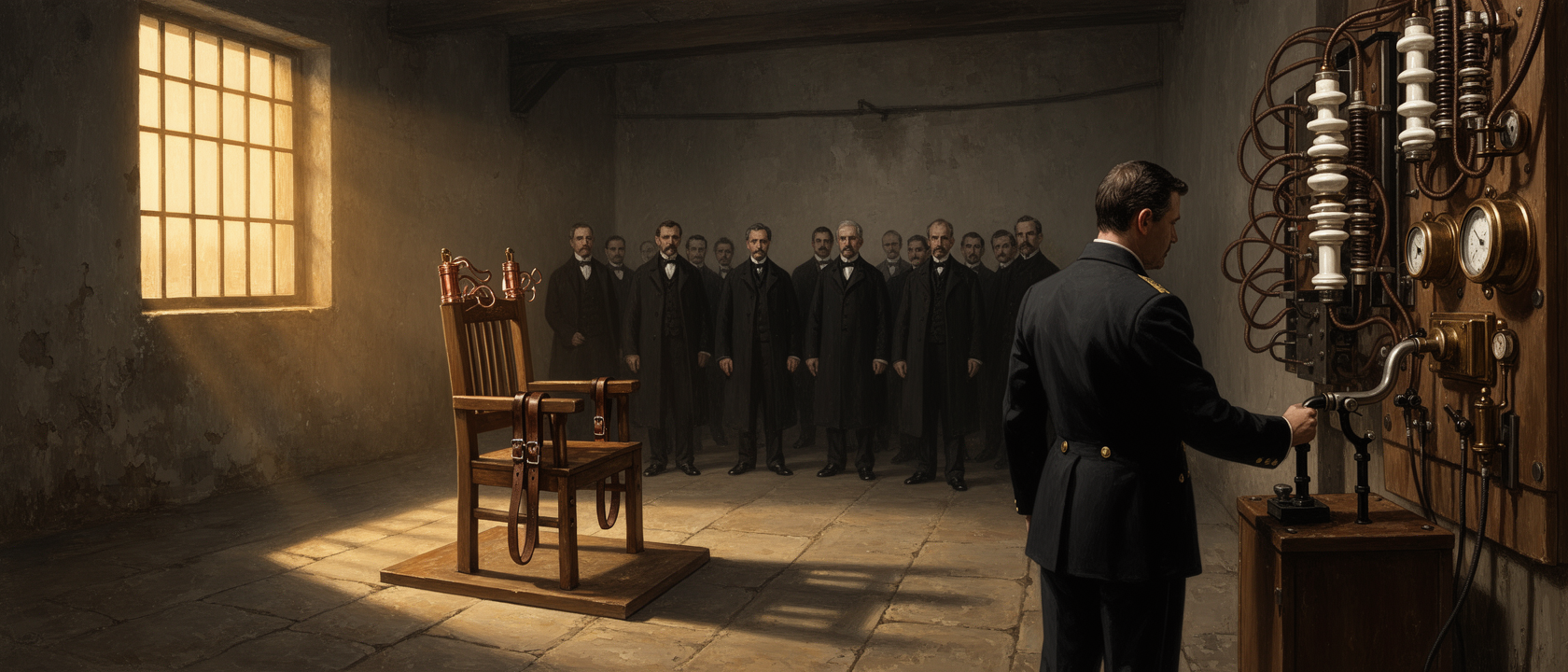
Twenty-five witnesses filed into Auburn State Prison on August 6, 1890, to witness what no official execution had ever produced: death by electric chair.
The man in the chair was William Kemmler, aged thirty, a produce merchant from Buffalo convicted of killing his common-law wife, Matilda “Tillie” Ziegler, with a hatchet on March 29, 1889. New York had been building toward this moment for two years. In 1888, a state commission recommended replacing hanging with electrocution. Governor David B. Hill signed the enabling law on June 4, 1888; it took effect on January 1, 1889, the first statute of its kind anywhere in the world. An electrician named Harold Brown was commissioned to build three chairs for Auburn, Sing Sing, and Clinton at Dannemora.
The chair’s advocates had described the method as certain, swift, and painless. What the witnesses saw on August 6 was something else. The first current, somewhere between 1,000 and 2,000 volts AC, ran through Kemmler for approximately 17 seconds. Those present believed he was dead. He was not. A second application continued until the smell of burning flesh reached the room, a period of roughly four minutes. The state declared the procedure a success.
The War of Currents
The choice of alternating current for the chair was not purely technical. It came out of a corporate fight.
In the late 1880s, Thomas Edison’s company was promoting direct current (DC) while George Westinghouse’s company promoted alternating current (AC). AC was gaining ground because it could travel longer distances without significant loss. Edison lobbied behind the scenes to have AC designated as the execution current, calculating that public association of AC with state-sanctioned killing would damage Westinghouse’s business. Edison’s people coined a term for death by electrocution: “Westinghousing.” Harold Brown conducted his experiments at Edison’s laboratory and arranged to acquire a Westinghouse generator specifically for the Auburn chair.
Westinghouse bankrolled the legal appeals against Kemmler’s sentence, with lawyer W. Bourke Cockran arguing that electrocution constituted cruel and unusual punishment. The appeals failed. The U.S. Supreme Court allowed the execution to proceed, accepting the state’s premise that the method was painless. Kemmler was executed using AC current drawn through a Westinghouse generator obtained for exactly that purpose.
Mechanical Failure
Auburn was not an isolated case. Sing Sing Prison in Ossining, New York, held its first electrocution on July 7, 1891. Four men were executed on the same morning. Later that December, according to one primary account, a Sing Sing execution required the current to be switched on four separate times before the condemned man was dead. The state’s position throughout remained that death was instantaneous.
Institutional Expansion
Over the following decades, the electric chair spread well beyond New York. Twenty-six states, the District of Columbia, the federal government, and the U.S. military eventually adopted it.
On March 20, 1899, Martha M. Place was executed at Sing Sing, becoming the first woman put to death by electric chair, convicted of murdering her stepdaughter, Ida Place. Governor Theodore Roosevelt declined to commute her sentence.
On July 13, 1928, Kentucky State Penitentiary in Eddyville executed seven men in a single day, tying a record set by New York in 1912.
On June 16, 1944, George Junius Stinney Jr. was strapped into the chair at South Carolina Penitentiary in Columbia. He was fourteen years old, born October 21, 1929, in Alcolu, South Carolina, and weighed approximately 90 pounds (40.8 kg). His trial had lasted approximately three hours; an all-white jury deliberated for ten minutes before convicting him of murdering two white girls, Betty June Binnicker, aged eleven, and Mary Emma Thames, aged seven or eight. He was the youngest person executed in the United States in the twentieth century.
The Physical Toll
The official account of electrocution rested on the claim that death was immediate. The physical evidence told a different story. The procedure regularly produced burned flesh and, in multiple documented cases, ruptured organs. The gap between what officials declared and what witnesses observed was not incidental to the technology; it was a feature of how high-voltage current moved through a human body.
From 1890 to 1972, ending with a Supreme Court-imposed moratorium on capital punishment, 4,251 people were executed by electric chair in the United States; by 2010 that figure had risen above 4,300. By the mid-1980s, lethal injection had replaced electrocution as the most common method. Eight states continue to authorize the chair as an option. The transition to lethal injection was driven in part by the visible physical trauma that electrocution produced, the very features the original advocates had promised the method would eliminate.
The Legal Reckoning
The execution of George Stinney produced no legal challenge in 1944. Seventy years later, on December 16, 2014, Circuit Court Judge Carmen T. Mullen of South Carolina vacated his conviction, finding that he had been denied due process: the ten-minute deliberation, the absence of any meaningful defense, and the circumstances of a fourteen-year-old held without a parent or attorney present all contributed to her ruling.
The corporate calculation that placed Westinghouse’s alternating current in the chair, the state’s decades-long insistence that the results were painless, and the 1944 execution of a child who weighed 90 pounds: none of it had been hidden. The cost was visible from the first morning at Auburn. The accounting took longer.