
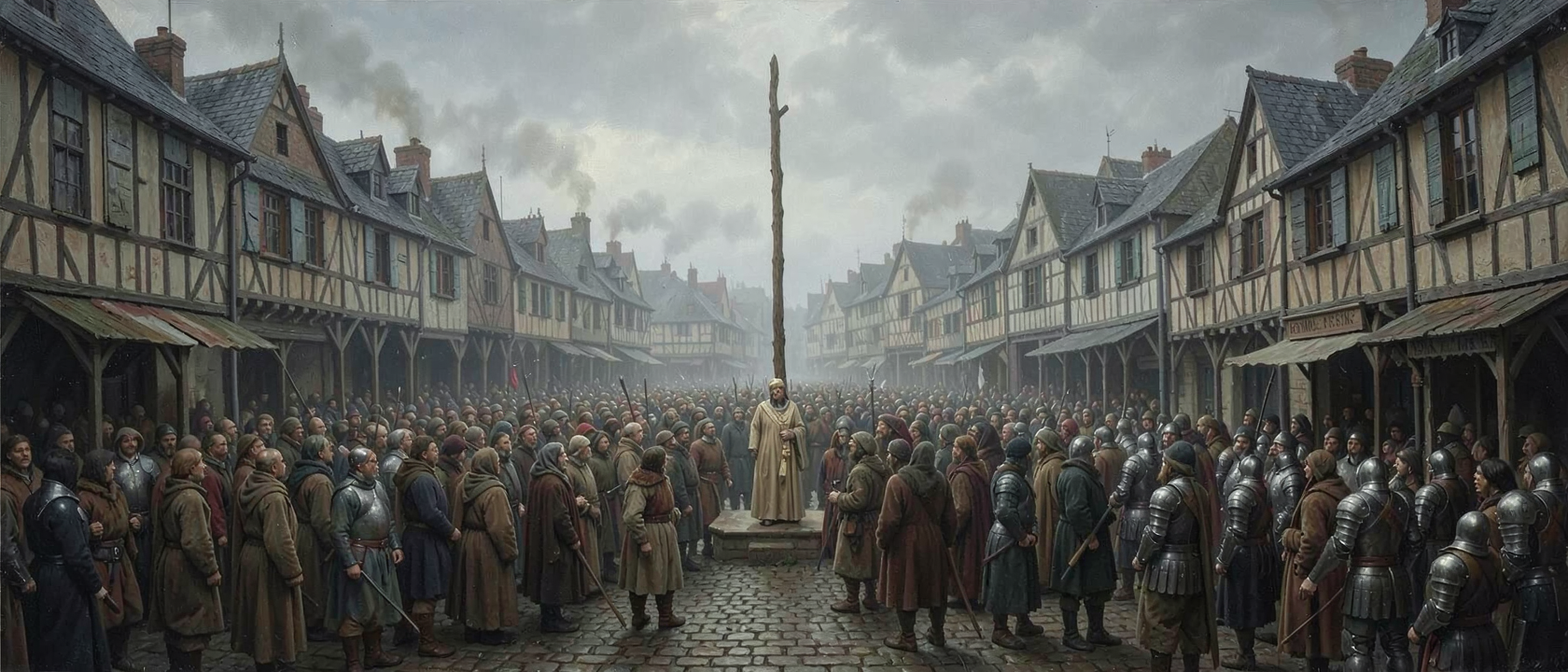
The Courtroom, February 21, 1431
On February 21, 1431, Joan of Arc appeared before a tribunal of 43 clergy and university men inside the castle at Rouen, in English-held Normandy. The court had been assembled by Pierre Cauchon, Bishop of Beauvais, a diocese that had fallen back under French control. That left Cauchon without a see of his own and, by one account, with his eye on the vacant archbishopric of Rouen. Joan had been captured at Compiègne in 1430, sold by her Burgundian captors to agents of Henry VI, and brought to Rouen rather than to Paris or Reims. Henry VI’s council had written to Cauchon asking him to investigate her for heresy. The men who judged her answered, in one way or another, to the English crown.
Why a Verdict Mattered More Than a Life
Two years earlier, churchmen at Poitiers had spent six weeks examining Joan and found no proof of a miracle, only, in their words, “goodness, humility, virginity, devotion, honesty and simplicity,” enough to send her to the siege at Orléans, which was lifted in May 1429. She went on to help crown Charles VII at Reims. That record was the problem the English faced in 1431. The University of Paris, then under English control, had already ruled that Joan was guided by the Devil rather than by “the Spirit of truth.” A heresy verdict would do more than end her life. It would put God’s judgment against Charles’s coronation and behind Henry VI’s claim to France instead.
A Record Once Removed
What survives from 1431 is not a transcript of what Joan actually said in that room. Clerks working for the prosecution kept a daily French summary, the minute française, which was later turned into the official Latin record historians read today. Each step, from spoken answer to French note to Latin document, passed through people with a stake in the outcome. Historians still disagree over how much of Joan’s own voice made it through that process and how much was shaped along the way. The document presents itself as a faithful account of the trial. It reads more like what the court wanted the trial to look like.
Four Months, One Verdict
The interrogation ran from February to late May 1431, a little over four months. Found guilty of heresy, Joan signed an abjuration, a formal statement renouncing her claims, and was sentenced to life in prison rather than death. Days later, officials found she had put on men’s clothing again, against a court order, and heard her say she no longer stood by what she had signed, that she had abjured only from “fear of the fire.” That reversal made her, under the court’s own rules, a relapsed heretic, a status that led automatically toward execution. On May 30, 1431, before a crowd at Rouen’s Old Market, she was declared relapsed, excommunicated, and handed to secular officers acting for Henry VI. She was burned at the stake that same day.
A Dossier Built to Convict
Cauchon’s court left behind more than a verdict. It left a file: transfer letters, the tribunal’s appointment papers, formal charges, Joan’s abjuration, sermons preached during the trial, and statements from witnesses to her execution. Read together, the file made her evasive answers and her defiance of the court read as proof of guilt, not as the responses of a young woman facing 43 trained interrogators. For the next two decades, this dossier stood as the only official account of who Joan of Arc had been. It had been compiled entirely by the institution that condemned her.
Rouen Changes Hands
In November 1449, Charles VII’s army retook Rouen, putting the original trial records and the men who had judged Joan within French reach for the first time. In 1450, Guillaume Bouillé, a professor at the University of Paris, opened a preliminary inquiry and interviewed witnesses from 1431. He concluded that the judges had “made and committed many errors and abuses,” putting Joan to death “very cruelly, iniquitously and against reason.” For Charles, overturning that verdict meant more than clearing Joan’s name. It meant erasing a ruling that had once implied his own crown rested on a heretic’s word.
A Second Trial, Four Times the Size
Full action took longer still. Pope Calixtus III authorized a formal inquiry, and between 1452 and 1456 investigators drew up 101 charges against the conduct of the 1431 trial and gathered depositions from 135 witnesses, by one count; others say closer to 150. The result was a dossier roughly four times the size of the original. Soldiers, childhood neighbors from Domremy, and clergy who had known Joan testified to her piety rather than her guilt. Unlike the 1431 record, a copy of this new dossier was open for public consultation at Notre Dame in Paris. The appeal opened there on November 7, 1455, and on July 7, 1456, the court declared the original trial invalid, citing improper procedure, deceit, and fraud, and annulled the conviction.
Twenty-Five Years Under a Label
From her execution on May 30, 1431, to her rehabilitation on July 7, 1456, twenty-five years passed. For all of them, the only standing verdict on Joan of Arc was heretic. The 1456 court then ordered copies of the 1431 trial record destroyed: one account says the copies were torn up, another describes the condemnation trial’s articles being burned publicly at the same proceedings. Some copies survived anyway, folded into later transcripts of the rehabilitation trial itself. Destroying the old file was not a neutral act of correction. It was the winning side, once again, controlling what the paper record would say.
The Question the Sources Don’t Answer
Two things stay open. Church officials are said to have begun reconsidering Joan’s case as early as 1436, when Charles VII returned to Paris, yet the full papal inquiry did not open until 1452, sixteen years later, a gap no surviving source explains. Historians, too, have at times treated the 1431 record or the 1456 one as a plain account of what Joan said and did, rather than as a document built by people who needed a particular Joan to be true. Both courts got the Joan they needed onto paper, one defiant and evasive, the other pious and wronged, and the record of that second inquiry, as it reaches us, breaks off in the middle of a witness’s testimony from the 1450s.