
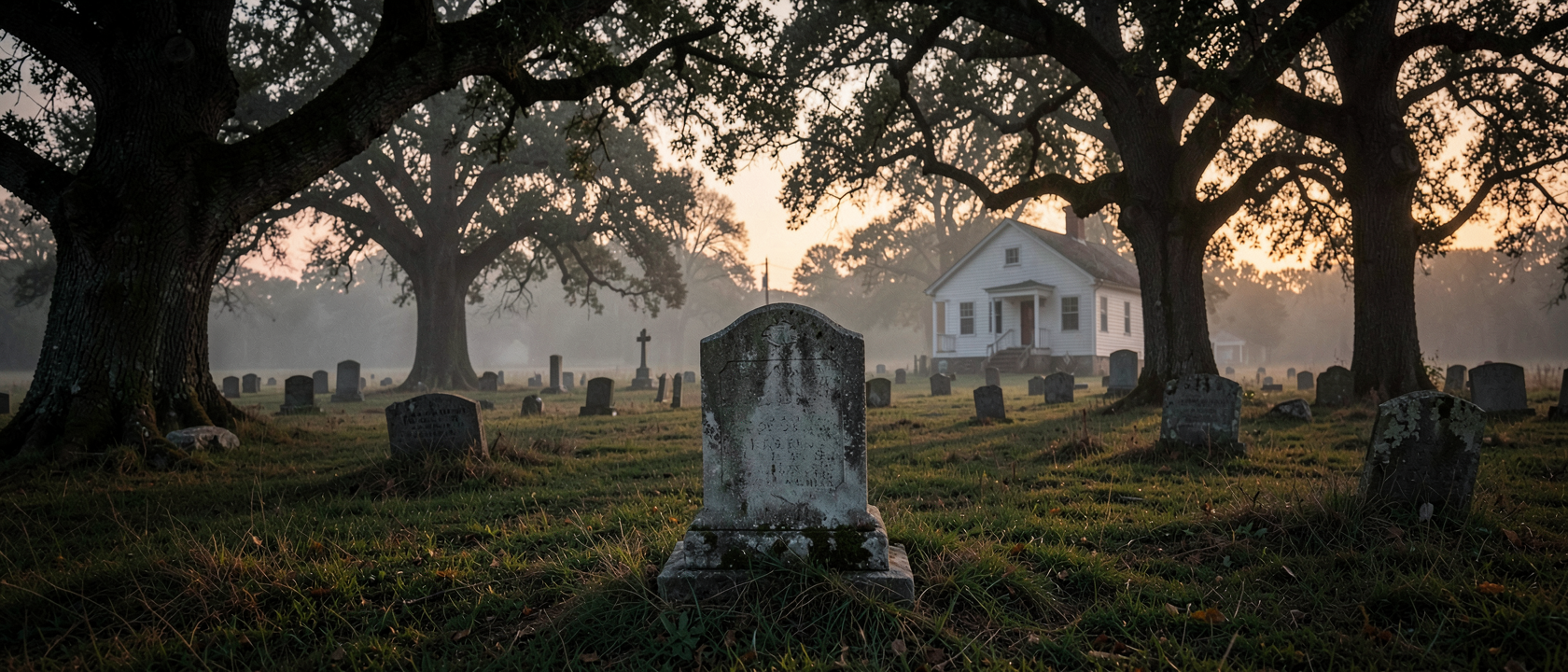
The Woods Outside Lenoir
In 1906, a 25-year-old man named Henry Lawrence Nelson vanished from Lenoir, North Carolina, a small town in Caldwell County where his family was well known. He worked for the Gwynn Veneer company. His father, Rev. John Hugh Nelson, pastor of Nelson’s Chapel church, put a newspaper notice offering $100 for information about him.
The body turned up roughly two months later in the woods outside town; accounts vary slightly on the exact number of weeks. A coroner’s examination found he had been shot through the neck, a wound that would have killed him instantly.
The case against anyone rested almost entirely on one witness: Omah Grier, 14 years old, who said she and a friend, Maggie Lewis, had been paid to lure Nelson into the woods, and that she had heard gunshots after leaving him there.
Two Names, Thirty Years
In 1907, two men went on trial for Nelson’s murder: Charles Hampton “Hamp” Kendall, a barber’s assistant, and John Vickers. Both had roomed with Nelson at the same boarding house. Grier’s testimony was the foundation of the state’s case. The jury convicted both men of second-degree murder. Kendall was sentenced to 30 years, Vickers to 26, a shorter term attributed to his earlier military service.
A Caldwell County resident named Christine Horton, who knew Kendall later in life, recalled that he had a strong, clear voice, and that when he was questioned during the investigation, he said: “If I’d have killed the man, they would never have found his body.”
Rev. Nelson owned Nelson’s Chapel cemetery, behind his own church, where his son was buried. After the convictions, he had Kendall’s and Vickers’s names cut into the gravestone, naming them as his son’s killers, along with a date for the murder, September 25, 1906. Nothing in the law of the time stopped him. It was a legal grave marker, in a cemetery his own family controlled, naming two living, convicted men as murderers.
The Confession, the Pardon, the Grave
Rev. Nelson died in 1915; the stone he had commissioned remained standing. Two years later, in 1917, Governor Thomas Walter Bickett pardoned both Kendall and Vickers. The pardon turned on doubts about Grier’s reliability: her account had grown contradictory over the years, and her own mother reportedly admitted, privately, that her daughter had lied. Kendall had by then spent roughly nine to ten years in prison.
The story kept unraveling after that. Sam Green, Grier’s cousin, had also stood trial for the murder in 1907 and been acquitted. Sources differ on exactly when, placing it anywhere from soon after the pardons to as late as 1922, but at some point Green confessed to killing Nelson himself, then took his own life. Vickers never saw any of this settled. He died shortly after his release, without further vindication in his lifetime.
A Free Man, Named a Killer
Kendall was pardoned in 1917. Under the law, he was innocent. On the gravestone, he was still a murderer, and the cemetery belonged to the Nelson family, not to him. He had no legal claim to touch it. For more than three decades, he took his case to journalists and to local officials, asking that his name be cut from the stone. None of it worked. Christine Horton, who knew him in his later years in Caldwell County, said the inscription “worried him to death,” a public accusation that outlasted his sentence, his pardon, and most of his adult life.
What the Law Finally Said
In 1947, North Carolina’s legislature passed the state’s first law compensating people who had been wrongfully convicted, a measure credited in part to Kendall’s long campaign. He was awarded $4,912.56.
Two years later, in 1949, lawmakers went further and banned the practice outright. It became illegal in North Carolina to erect or keep a gravestone accusing anyone of a crime, and cemetery custodians were required to remove any such inscription already standing, wherever it was found.
Accounts differ on when Kendall’s name actually came off the stone: one source puts it at 1949, when he was 74; others describe an unidentified person removing the marker around 1951 or 1952. Either way, the original stone was eventually replaced with a plainer one. It reads simply, “Gone to rest.”
What the Record Doesn’t Say
Some questions have no answer in the surviving record. No source says what happened to the original, inscribed stone once it was taken down. None says whether Vickers or his family ever received compensation of their own, or what became of Omah Grier after the case ended.
Tanya Marsh, a law professor at Wake Forest University School of Law who studies cemetery law, has argued that most cemeteries would never have permitted such an inscription in the first place, and that the case reads more as grave defamation than as desecration. She is careful to add that her reading is interpretation, not eyewitness fact. She was not there.
The Same Grief, Decades On
A similar grievance surfaced later, far from Lenoir. In Florida, a man named Herman Harband had his own gravestone inscribed with an accusation that his wife had poisoned him. He died in 2011 and was buried in North Carolina. Florida has no law like the one North Carolina passed in 1949, so when his wife sought to have the accusation removed, the route ran through ordinary libel law instead, according to Nicholas Kassatly, a Florida lawyer who works on cemetery cases. The Florida stone was eventually taken down. Whether Harband’s accusation had any basis is not something the record settles.
Meghan Cousino, of the National Registry of Exonerations Foundation, and Marsh both point to the case as proof that the underlying problem never disappeared. It simply moved to places where the law had never caught up to it.