
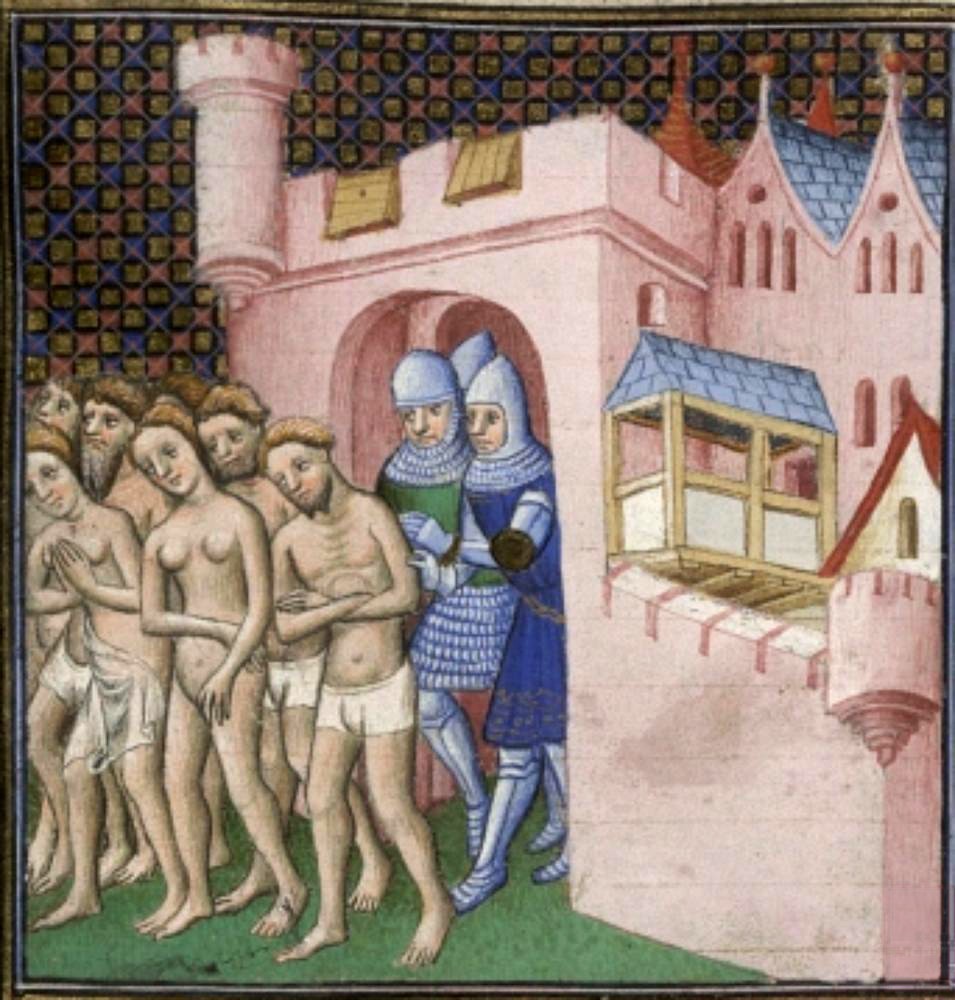
The Albigensian Crusade was a religious war fought against Catharism in southern France between 1209 and 1229, waged across the Occitania region. It began with the sack of Béziers in 1209, when a demand to hand over the town’s Cathars was refused and the entire population was killed, even though Béziers is believed to have held no more than 500 Cathars. The campaign continued for two decades through a series of sieges and mass burnings, and it reshaped the religious and political map of southern France.
Key facts
- Country: France
- Type: religious war; military campaign
- Start: 1209
- End: 1229
- Location: Occitania
Béziers and Carcassonne
At Béziers in 1209, crusaders demanded that the town surrender its Cathar residents. When the town refused, the whole population was slaughtered, a disproportionate response given that the town is believed to have held no more than 500 Cathars. The Abbot-Commander Arnaud Amaury is said to have given the order “Kill them all! The Lord will recognise His own” during the sack.
The Siege of Carcassonne followed as the crusade’s next major target after Béziers fell. At Minerve in 1210, the outcome was different: after the town capitulated, some Cathars were allowed to leave freely, in contrast to the killings at Béziers.
Lavaur and the campaigns of Simon de Montfort
At Lavaur in 1211, crusader forces under Simon de Montfort laid siege to the town from March or April until 3 May. When it fell, hundreds of Cathars were burned alive, one of the largest mass executions of the crusade’s early years.
Later burnings and the fall of Montségur
In 1239, more than 180 Cathars were burned near Champagne at Mont-Aimé, a lesser-known episode but one of the largest single executions of the period.
Montségur castle became the crusade’s final major target. A force of around 10,000 royal troops besieged the castle, which was defended by about 100 armed men alongside 211 pacifists. There had been three earlier, unsuccessful sieges of Montségur: in 1212 by Guy de Montfort, in 1213 by Simon IV de Montfort, and in 1241 by Raymond VII of Toulouse. On 16 March 1244, more than 220 Cathars who refused to renounce their faith were burned in a mass bonfire at the base of the mountain below the castle.
Aftermath
The crusade was followed by an Inquisition targeting surviving Cathars across Occitania. One effect of this process was the founding of a university at Toulouse in 1229, the same year the crusade is generally considered to have ended. Before the crusade, the Languedoc region had been noted for little religious oppression and a fairly advanced cultural level.
Did you know
- During the final siege of Montségur, the roughly 220 Cathars burned alive were offered the chance to convert and refused, choosing death over renouncing their faith. (theculturalexperience.com)
- At the 1210 Siege of Minerve, some Cathars were allowed to leave the town freely after it capitulated. (plantagenetdiscoveries.com)
- Montségur had withstood three earlier, unsuccessful sieges before the final one: in 1212 by Guy de Montfort, in 1213 by Simon IV de Montfort, and in 1241 by Raymond VII of Toulouse. (beyond.fr)
- The Montségur castle standing today is a rebuilt structure dating from three centuries after the original fortress was destroyed in 1244. (beyond.fr)
- Before the crusade, the Languedoc region was known for little religious oppression and a fairly advanced cultural level. (dlab.epfl.ch)
Data sources
Where it appears
- Moissac, 1212: A Siege, an Interdict, and a Crusade’s Logic November 10, 2026
Data updated: 2026-11-07