
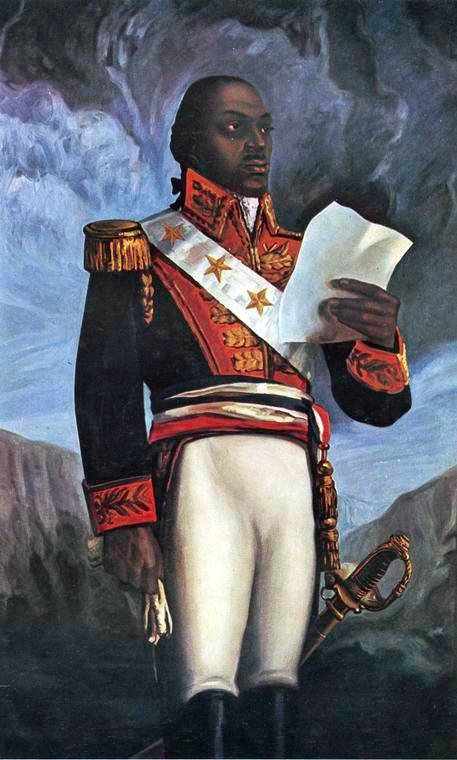
Toussaint Louverture was a Haitian politician, military commander and governor who led the enslaved population of Saint-Domingue through revolution and became the colony’s Governor-General for Life. Born on 20 May 1743 in Cap-Haïtien, he rose from slavery to command armies and rewrite the island’s laws before dying a prisoner at Fort de Joux in France on 7 April 1803. His career culminated in the constitution of 7 July 1801, which abolished slavery permanently in Saint-Domingue. He remains a central figure of Haitian national identity, honored in Saint-Domingue and France and claimed abroad as a son of West Africa.
Key facts
- Born: 20 May 1743
- Birthplace: Cap-Haïtien
- Died: 7 April 1803
- Place of death: Fort de Joux
- Country: Saint-Domingue; France
- Occupation: politician; military personnel; governor; freedom fighter
Early life and rise to command
Toussaint was known for his equestrian skill, which earned him the nickname “centaur of the savannas.” His letters and writings show familiarity with the Stoic philosopher Epictetus, who had also once been enslaved. After gaining his own freedom, he became a small-scale planter, leasing a coffee plantation, and between 1779 and 1781 he himself owned a slave or slaves.
He entered the revolution as secretary to rebel leader Georges Biassou, taking command of around 600 former slaves. After Biassou’s death in 1801, Toussaint became supreme commander of the insurgent forces.
Governor-General and the 1801 constitution
On 7 July 1801 (some sources give 8 or 12 July), Toussaint promulgated a new constitution for Saint-Domingue. It abolished slavery on the island permanently and named him Governor-General for Life.
His record as ruler is contested. He reintroduced a forced-labor system on the plantations and had previously owned a slave himself, which led contemporaries to question how firmly he held to abolition even as his constitution outlawed it.
Defeat, deportation and death
French forces faced heavy fighting on the island along with a yellow fever outbreak that killed 2,000 French soldiers within three months. Toussaint was forced to submit to the French on 6 May 1802.
In June 1802 he was seized by French troops through deception, deported to France, and imprisoned at Fort de Joux in Doubs from 25 August 1802. His wife Suzanne was reportedly mistreated by French soldiers and later deported to Jamaica. A prison guard recorded in January 1803 that Toussaint suffered constant fevers, severe stomach aches, loss of appetite, vomiting and bodily inflammation. He died at Fort de Joux on 7 April 1803.
Memory and monuments
A statue of Toussaint stands at the former Hôtel Fleuriau in La Rochelle, a building once owned by a slave-trading family; its placement there has drawn debate among slavery-memory activists over how visible and prominent it should be.
Benin erected a statue honoring him as “the proud son of Allada,” a reference to his parents’ West African origins, even though Toussaint never visited the country.
Did you know
- His son Isaac Louverture died in Bordeaux in September 1854 and was eventually reburied in the vault of the Gragnon-Lacoste family, whose patriarch was one of Toussaint’s biographers. (invisiblebordeaux.blogspot.com)
- The exact year of Toussaint’s birth is disputed among sources, with figures ranging from 1736 to 1746. (prospectmagazine.co.uk)
- One of his former sugar plantation sites near Cap-Haïtien was bulldozed in recent years so a local high school could extend its recess yard. (blog.oup.com)
Data sources
Data updated: 2026-11-23