
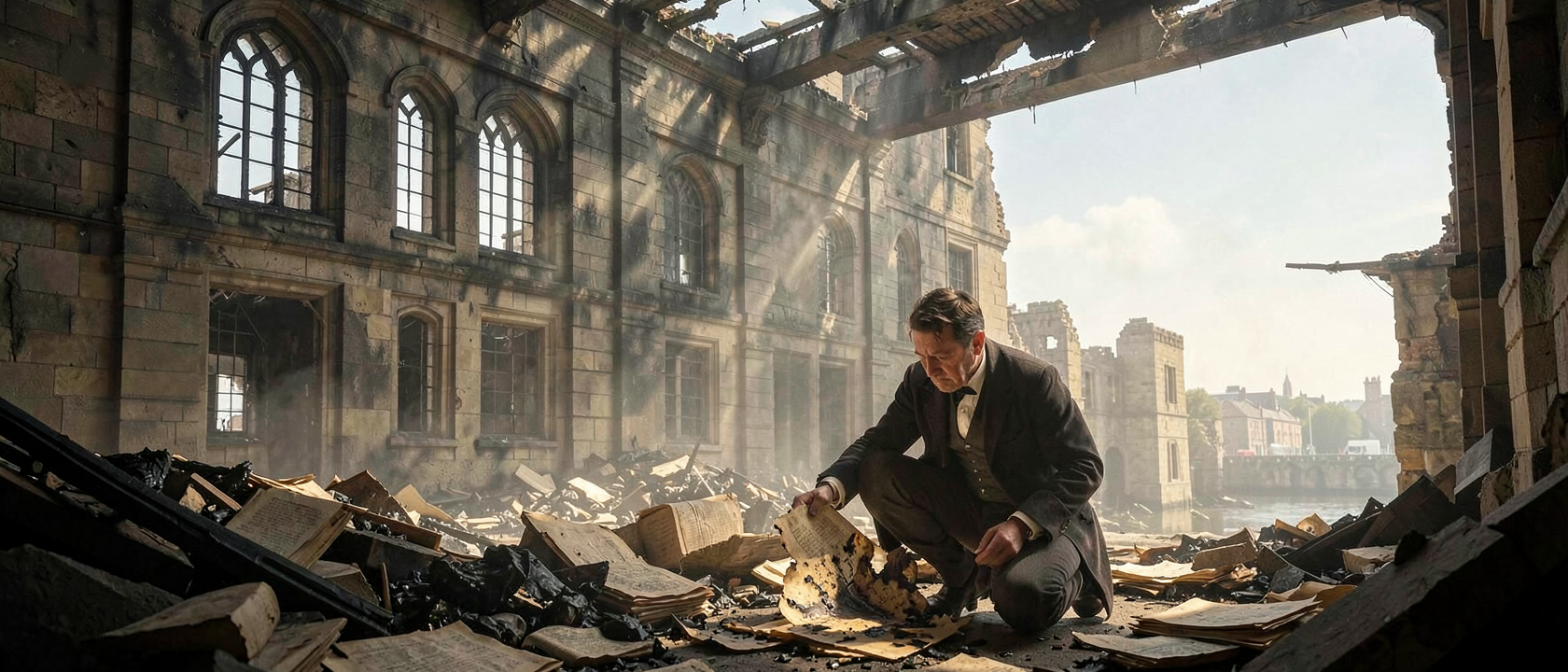
Seven Centuries in One Room
The Public Record Office of Ireland opened at the Four Courts complex in Dublin in 1867, with Sir Samuel Ferguson as its first deputy keeper. Its purpose-built, six-story granite treasury on the River Liffey held records reaching back to 1174, the period following King Henry II’s establishment of his lordship over Ireland. Parish registers, probate wills, census returns from 1821 onward, Chancery records documenting Crown land grants from the fourteenth century, court transcripts, financial ledgers, ecclesiastical deeds: all of it consolidated by design into a single national deposit spanning roughly 700 years.
Herbert Wood joined the office in 1884 and by 1921 was serving as deputy keeper. In 1919 he had published A Guide to the Records Deposited in the Public Record Office of Ireland, a meticulous inventory of every class of document the treasury held. Later archivists described it as the most depressing book in Irish history, a catalogue of what no longer existed.
Four Courts, June 1922
On April 14, 1922, anti-Treaty IRA forces occupied the Four Courts complex and established a munitions store inside the Record Treasury. The Provisional Government opened an artillery bombardment on June 28, 1922, with pro-Treaty forces under Michael Collins directing fire at the complex. At approximately 2 p.m. on June 30, two mines exploded inside the Record Treasury. Whether the explosion was deliberate or an accidental consequence of the stored munitions is not settled in the historical record. What is certain is the result: the building burned, and when the fire was out, only the outer granite walls were standing. Seven centuries of Irish documentary inheritance had been reduced to ash in a single afternoon.
The Catalogue of an Absent Archive
The particular difficulty with this destruction is that the catalogue burned alongside the records it described. The nineteenth-century census returns back to 1821 were gone, along with the largely destroyed 1766 Religious Census, Chancery records from the fourteenth century onward, and probate wills spanning every social class across several generations.
Over 25,000 individual sheets of paper and parchment were pulled from the rubble and are now held at the National Archives of Ireland as the 1922 Salved Records, a fraction of what the building had contained. The 1901 and 1911 census returns survived intact. Records held outside Dublin were unaffected. But the central national accumulation was gone, and no complete list of what had been there would ever be possible.
Administrative Habit and Accidental Survival
Medieval and early modern governance ran on copies. A Crown land grant required a duplicate filed in London. An ecclesiastical decision reached in Rome left a record in Rome. An exchequer account submitted in Dublin was copied for Westminster. Nobody designed this system to protect an Irish archive from a future civil war; it was simply how bureaucracies functioned across centuries and jurisdictions.
Peter Crooks, a medieval historian at Trinity College Dublin and founding director of Beyond 2022: Ireland’s Virtual Record Treasury, identified that those copies were still out there, held by institutions with no particular reason to flag their Irish holdings. The project was publicly announced on February 8, 2018. Researchers found relevant copies in more than 70 archives across multiple continents: the National Archives of the United Kingdom, the Public Record Office of Northern Ireland, the Library of Congress, the National Library of Australia, and the Guinness Archives in Dublin, among many others. The survival was a byproduct of administrative routine.
$2.5 Million and the Reconstruction
The Irish government committed €2.5 million under its Project Ireland 2040 cultural funding program. Five core partners joined Trinity College Dublin: the National Archives of Ireland, The National Archives of the United Kingdom, the Public Record Office of Northern Ireland, the Irish Manuscripts Commission, and the Library of Trinity College Dublin. The formal funded phase ran from July 1, 2019, to December 31, 2022. The ADAPT Centre, Trinity’s AI research unit, co-led by the late Dr. Séamus Lawless alongside Crooks, built tools to digitize, translate, and cross-reference fragmentary documents dispersed across four continents.
In categories the project designated “Gold Seams,” where survival rates were high enough to permit substantive reconstruction, recovery reached an estimated 80 percent of lost material, a figure from the project’s own primary documentation, not independently verified. The medieval exchequer records, held intact in London, represent one of the strongest examples. The 1766 Religious Census reconstruction drew on 59 surviving documents combined with partial transcripts, recovering approximately 50,000 individual householders’ names.
150,000 Records and the Limits of Recovery
The Virtual Record Treasury of Ireland launched on June 27, 2022, at St. Patrick’s Hall in Dublin Castle, with Taoiseach Micheál Martin speaking at the event. The online treasury held 150,000 records containing an estimated 50 million words and more than 6,000 maps. A three-dimensional virtual-reality model of the pre-fire Record Treasury, built from surviving architectural plans and photographs, allows visitors to move through a building that has not stood intact since 1922. That year the Archive and Record Association awarded the project the Roger Ellis Prize, only the tenth time in fifty years the prize had been given.
The 80 percent recovery figure applies to specific Gold Seam categories, not the archive as a whole. Across the full range of what the Record Treasury once held, reconstruction remains partial and ongoing. Who triggered the explosion on June 30, 1922, and whether the destruction was deliberate or incidental, has not been resolved. Wood’s 1919 guide now functions as a record of absence: the most accurate inventory that exists of what is no longer there.