
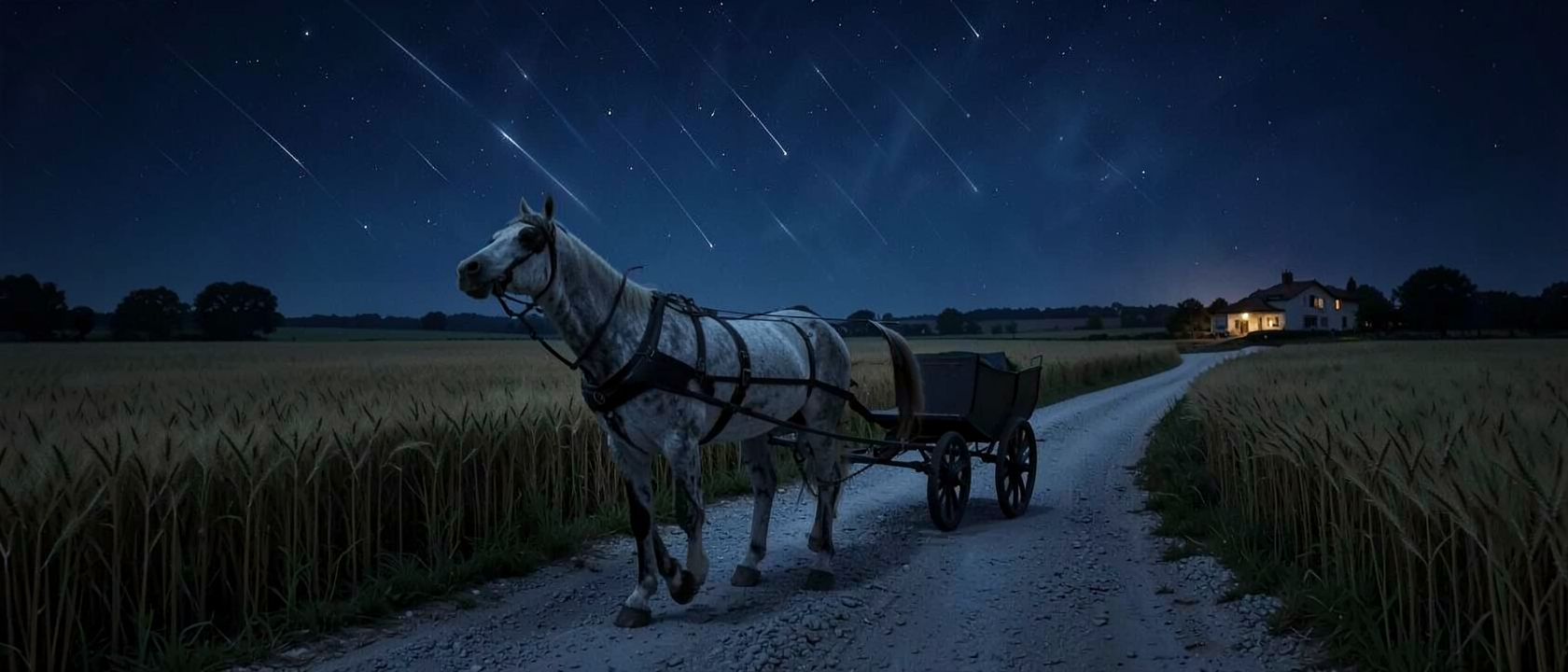
The Mare Came Home Alone
On the evening of August 10, 1867, Ruggero Pascoli was returning from the market at Cesena by horse-drawn carriage along a narrow road near Savignano di Romagna [now Savignano sul Rubicone], roughly 12 miles (19 km) inland from the Adriatic coast. Someone waiting at the roadside shot him. He died on the road. The horse, following the route she knew, continued to San Mauro di Romagna [now San Mauro Pascoli] without him.
When the carriage arrived, it carried Ruggero’s body and, according to one account, two unwrapped dolls bought as gifts for his daughters. That detail appears in a single source and has not been confirmed elsewhere. The mare’s arrival is documented; it became the grounding image of a poem written decades later by Ruggero’s son Giovanni.
Ruggero Pascoli, born in Ravenna on March 24, 1815, worked as administrator, or fattore, of the La Torre estate belonging to the Torlonia princes near San Mauro. Between 1859 and 1867 he had also served the town as mayor, councillor, and assessore. He was 52 when he was killed.
Five Gone in a Handful of Years
Giovanni Placido Agostino Pascoli had been born in San Mauro on December 31, 1855, the fourth of ten children. On the night of his father’s murder he had not yet turned 12. What followed compounded the losses: his mother Caterina died in 1868 (sources disagree on the cause, recording it variously as cardiac arrest or typhus); his sister Margherita died of typhus the same year; his brother Luigi died of meningitis in 1871; his brother Giacomo died in Bologna in 1876, with some later studies suggesting he was killed rather than dying naturally, though that has not been established. Britannica states five other children died before Giovanni reached adulthood; other accounts put the figure at three of his seven siblings. The precise count is disputed. The direction is not.
The Torlonia family withdrew the financial subsidy it had been providing to the widow. The family owned no land of its own. The single shot near Savignano had removed its only reliable income.
Nothing in the File
No suspect was named. No motive was recorded. No arrest was made, no trial held. Whether a formal judicial inquiry was opened and then abandoned, or never opened at all, sits entirely outside what the surviving documentary record shows.
Some Italian sources have suggested the killing was carried out by hired assassins sent by a man identified as “Cacciaguerra,” who subsequently took over Ruggero’s position as estate administrator. Italian Wikipedia describes the murder as probably the work of criminals and political extremists. Neither account rests on a verified evidentiary record, and no judicial conclusion was ever reached.
The Poems He Could Not Stop Writing
Giovanni Pascoli studied at the University of Bologna under the poet Giosuè Carducci and graduated in 1882. He spent a few months in prison in 1879 after an arrest for preaching political anarchy, taught in secondary schools, then held university positions in Messina from 1897 to 1903, in Pisa, and finally at Bologna, where he was appointed to the chair of Italian literature in 1905, succeeding Carducci.
Two of his poems address the murder directly. X agosto (“The Tenth of August”) takes its frame from the Catholic calendar: August 10 is the Feast of San Lorenzo, the night of the Perseid meteor shower, known in Italy as le lacrime di San Lorenzo, the tears of Saint Lawrence. Italian sources date its first publication to 1896, when it appeared in the newspaper Il Marzocco and in the volume Myricae, whose definitive edition eventually ran to 156 poems. The second poem, La cavalla storna (“The Dappled Gray Mare”), belongs to the later collection Canti di Castelvecchio; its central device is a refrain in which the speaker’s mother addresses the mare directly, asking what she saw that night. The mare cannot answer. Both poems entered the Italian school curriculum and reached millions of readers across successive generations.
In 2019, the American poet Taije Silverman and co-translator Marina Della Putta Johnston published a comprehensive English translation of Pascoli’s work through Princeton University Press, described as the first such collection in English. It was shortlisted for the John Florio Prize.
What Was Never Answered
Giovanni Pascoli died in Bologna on April 6, 1912, of liver cancer, aged 56. The question of who shot his father on a road near Savignano in 1867 was not answered before his death and has not been answered since. There is no recorded motive, no confirmed name, no historical explanation for why a man was shot while driving home from a market. The poems exist in the space where an explanation never arrived, giving the event a form the judicial process never provided.
The Mosaic at the Murder Site, 2017
In 2017, on the 150th anniversary of the killing, students from the Academy of Fine Arts in Ravenna, working under mosaic artist Professor Enzo Tinarelli, installed a memorial at the site on the road between the modern municipalities of Longiano and Sogliano al Rubicone. Funding came from the municipality of San Mauro Pascoli, the Accademia Pascoliana, the municipalities of Longiano and Sogliano al Rubicone, and the local Rotary Club. Built from enameled Venetian glass, it shows the mare looking backward against a night sky, her form dissolving into darkness, a shattered carriage wheel at the edge of the composition. A plaque carries the text of both X agosto and La cavalla storna. The surrounding landscape is now farmland, auto yards, and industrial chicken hatcheries. The mosaic stands there because the case never produced anything else to put in its place.