
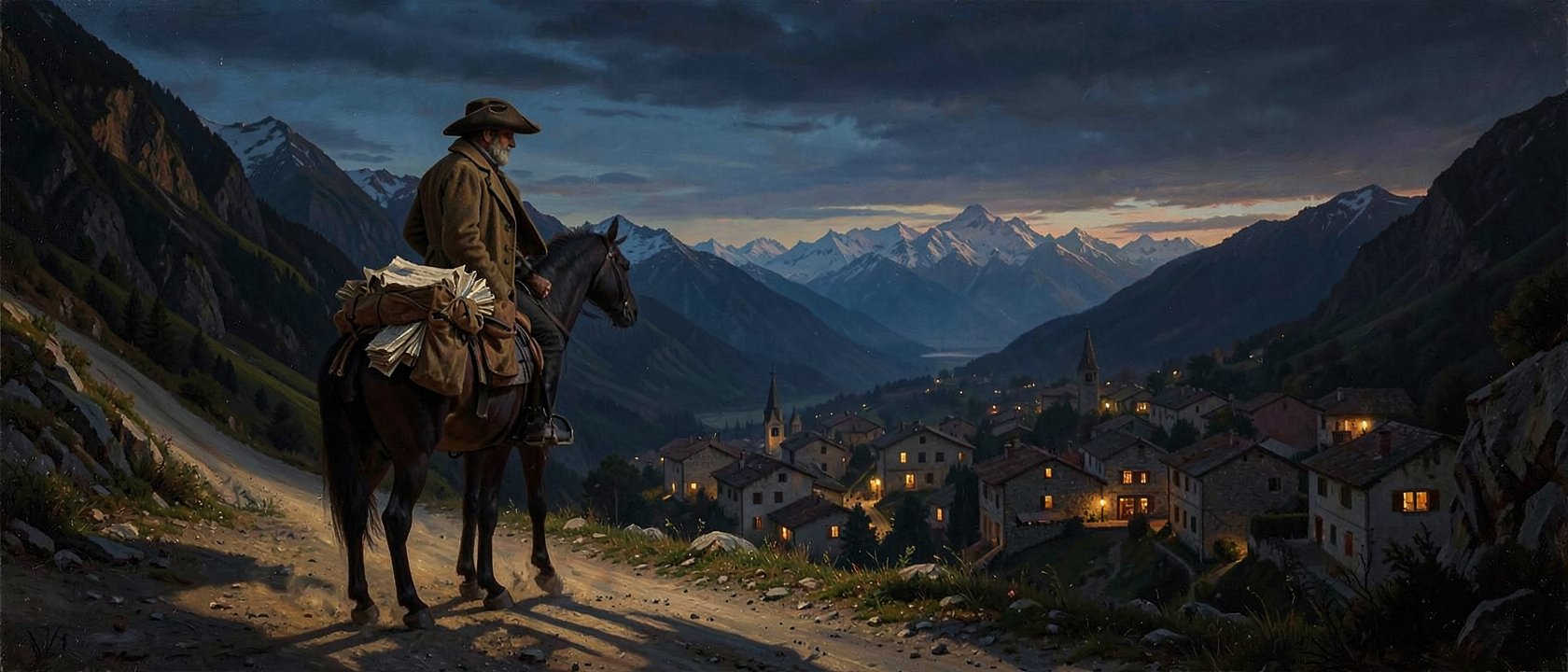
The Salesman and the Bales
On July 5, 1778, a twenty-nine-year-old traveling salesman named Jean-François Favarger left La Neuveville, a small town roughly ten miles (approximately 16 kilometers) north of Neuchâtel, and set out on a circuit that would carry him approximately 1,200 miles through provincial France. His route ran south through Lyon and Marseille, west to Bordeaux, north to Orléans, and back east through Besançon. He would not return for five months.
Favarger worked for the Société typographique de Neuchâtel, the STN, a Swiss publishing house founded in 1769 by Frédéric-Samuel Ostervald, Jean-Elie Bertrand, and Samuel Fauche. His job was to call on booksellers, rate their reliability and creditworthiness on a three-tier scale, recover unpaid debts, and file written reports back to headquarters. In the surviving correspondence he appears as a careful commercial agent doing a commercial job.
The merchandise he represented did not travel with him. Unbound page-sheets were pressed into 50-lb bales, concealed among legitimate publications, and moved separately over Alpine passes. The STN’s most sensitive titles could not legally cross a French customs post. The salesman and the goods he sold could not legally share a road.
What Paris Would Not Permit
From 1769 onward, the Paris publishing guilds held a legally enforced monopoly over French book production, backed by royal censors and border officials with authority to seize entire shipments. The STN operated from Neuchâtel because Switzerland, then a Prussian-administered principality at Neuchâtel, placed it outside French jurisdiction. That geography was the business model.
Its catalogue ran to roughly 300 titles, though historians note a distinction between what the STN itself produced (closer to 250 by some counts) and what it made available through exchange arrangements with other houses. The range covered Enlightenment writings by Rousseau, Voltaire, and Diderot, including the Encyclopédie; works by Laurence Sterne; libels targeting the court of Louis XV; natural science and geography; and pornography, including John Cleland’s Fanny Hill, circulated in France under the title La Fille de joie and catalogued under the heading livres philosophiques. The risk calculus behind all of it was commercial. Seized bales were a cost of doing business, absorbed as a direct loss. The archives record no evidence they were treated as anything else.
The Machinery of Delivery
The STN did not print its most sensitive titles itself. It acquired them through exchange arrangements with other publishing houses, keeping production at arm’s length. Physical delivery fell to passeurs, specialist cross-border carriers who guaranteed safe passage for a negotiated fee, functioning in practice as a form of freight insurance. At the receiving end, Huguenot networks across provincial France provided trusted distribution contacts. Their pre-existing ties gave the STN an infrastructure it could attach to without building from scratch.
Border officials were not uniform. Some accepted bribes or looked away, and the shipment went through; others were diligent and the bales were seized, with the loss falling on the STN. Both outcomes appear in the company’s records. No surviving document sets one count against the other.
A Political Market, 1781
In February 1781, Jacques Necker, then serving as Director-General of Finances to King Louis XVI, published the Compte rendu au Roi, a public account of the state of royal finances. Nothing like it had been released before. Twenty thousand copies printed in Paris sold out within weeks; the document was subsequently translated into five languages. Necker was dismissed from office in May 1781, and the report acquired a politically charged afterlife. The STN filled orders for it.
The episode shows the network’s operating logic without ambiguity. Its infrastructure did not distinguish between a geography text and a document that embarrassed the crown. What mattered was that demand existed and that the margin covered the risk of delivery. A system built for profit turned out to be structurally indifferent to what it was moving.
The Bill, 1789
By 1789, mounting regulatory pressure and the onset of the Revolution collapsed the enterprise. Favarger abandoned the book trade entirely and moved into wine and groceries. That shift, documented in the records, is the practical endpoint of the whole operation. No surviving correspondence records a prosecution of any named individual; the firm had run for two decades without that particular reckoning. What arrived instead was commercial extinction. The trade network had depended on a stable regulatory environment, however restrictive. When that environment dissolved, so did the network. How many bales were successfully delivered against how many were seized over those twenty years is not recoverable. The archives contain the correspondence; they do not contain a final ledger.
What Darnton Found, and What He Couldn’t Settle
From 1965 onward, historian Robert Darnton worked through the STN’s surviving material: approximately 25,000 letters and account books held at the Bibliothèque publique et universitaire de Neuchâtel. He had come to the collection while following up a footnote during research on a different subject entirely, and stayed for decades. The result, published as A Literary Tour de France (Oxford University Press, 2018), reconstructed the routes, personnel, titles, and commercial logic of the network in documented detail.
What it could not settle was whether the books carried any consequence beyond commerce. One reading of the evidence holds that the sustained flow of Enlightenment texts and political libels into provincial France shaped a reading public in ways that fed into revolutionary sentiment. Another holds that the STN was simply meeting demand that pre-existed the supply and would have found another channel regardless. Darnton’s own work, which treats the STN’s motive as commercial rather than ideological, does not decide between those two positions. More recent digital humanities projects, analyzing the same archive at scale, have raised further questions about the scope of his conclusions. The debate sits unresolved in the scholarship, and the 25,000 letters, for all their detail, do not close it.