
Anmer, the King’s Horse
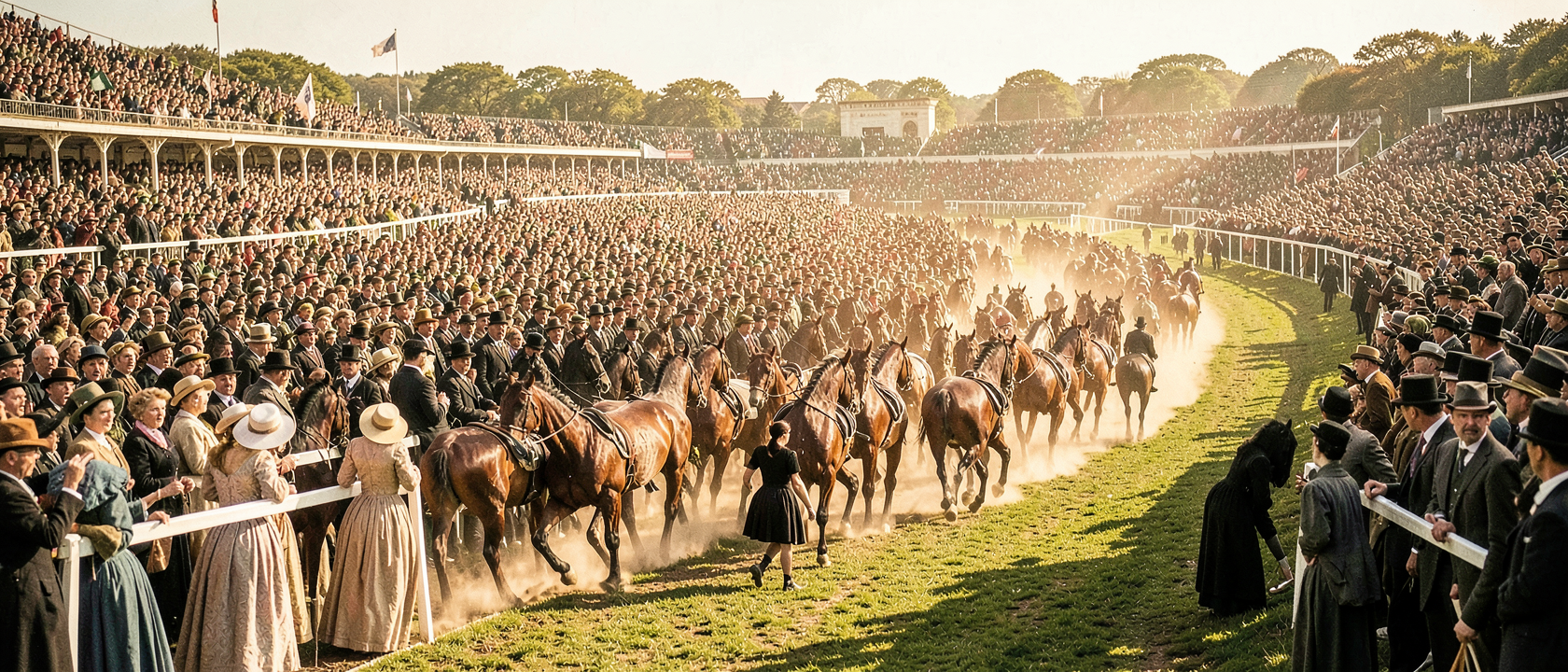
At approximately 3:10 in the afternoon on June 4, 1913, the fifteen horses running in the Epsom Derby came around Tattenham Corner. Emily Wilding Davison stepped from the infield rail onto the track. Anmer, owned by King George V and running third from last, struck her with his chest, pitched onto his head, and threw his jockey, Herbert Jones, who was rendered unconscious. Davison sustained a fractured skull. She never regained consciousness. Four days later, on June 8, she died at Epsom Cottage Hospital. The coroner returned a verdict of misadventure.
She had bought a return ticket to Epsom. That single fact has kept the argument going for more than a century.
An Organization Already Breaking Apart
The Women’s Social and Political Union (WSPU) that Emmeline Pankhurst had founded in October 1903 was, by June 1913, considerably reduced from what it had been. Frederick and Emmeline Pethick-Lawrence, who had co-edited the WSPU newspaper Votes for Women and bankrolled substantial portions of the organization’s operations, were expelled in 1912. Sylvia Pankhurst was pushed out in 1913. Christabel Pankhurst, the organization’s principal strategist, was directing operations from exile in Paris to avoid arrest. Private correspondence addressed to Christabel Pankhurst, cited in later scholarship, described the organization as effectively hollowed out, its most capable members gone while its leadership remained abroad.
Davison was not on the WSPU’s payroll. By 1911 the organization employed approximately 110 paid staff; she was not among them, supporting herself through occasional journalism and help from relatives. Her militancy had long operated outside WSPU instructions: in 1911 she set postboxes on fire using paraffin-soaked linen, an action the leadership had not sanctioned. On two occasions in Holloway Prison she threw herself over railings built specifically to prevent suicides. In June 1912, she told a prison doctor that “a tragedy is wanted.” She arrived at Epsom on June 4 alone, with no evidence that she was executing any organized plan.
June 14, and What Followed
Grace Roe organized the funeral procession that left Buckingham Palace Road at 2:00 p.m. on June 14, 1913. The coffin, draped in the WSPU’s purple, green, and white and drawn by four black horses, moved through Piccadilly and up Shaftesbury Avenue to St. George’s Church, Bloomsbury, where clergy from the Church League for Women’s Suffrage held a memorial service lasting approximately thirty minutes. Approximately 5,000 suffragettes and supporters marched; an estimated 50,000 people lined the route. A young woman carried a large cross at the procession’s head. At 5:30 p.m. the coffin left King’s Cross by train for Morpeth, Northumberland, where a private family funeral was held at St. Mary Virgin Church; some 100 suffragettes accompanied the coffin north.
Emmeline Pankhurst had been temporarily released from prison under the Prisoners (Temporary Discharge for Ill-Health) Act 1913, known colloquially as the Cat and Mouse Act, which allowed authorities to free hunger-striking prisoners too ill to remain in custody and re-arrest them upon recovery. She was re-arrested before she could join the procession.
The government’s response to the Derby incident was not moderation. Home Secretary Reginald McKenna directed raids on WSPU offices, telephone tapping, mail interception, and the seizure of the organization’s newspaper, The Suffragette. By 1914 prosecutors were preparing cases against the WSPU’s financial backers. No legislative concession followed.
What the Derby Cost the Campaign
Maud Arncliffe-Sennett, a suffragette present at Epsom on June 4, recorded at the time that the crowd’s immediate reaction was hostility: what she heard was not silence but “The King’s ‘orse!” The WSPU’s public standing had been declining through 1912 as the arson and bombing campaign widened. Labour Party leaders distanced themselves further, and non-militant suffragists including Helena Swanwick and Mary Stocks publicly criticized suffragette martyrdom as contrived. The Daily Sketch acknowledged Davison’s courage while describing the broader campaign of suffragette violence as a form of terrorism.
The militant campaign did not end because Davison died at Epsom. It was suspended in 1914, when Britain entered the First World War. That suspension, not any single act of protest, was what closed the WSPU’s militant phase.
What She Meant to Do
Two pieces of evidence have anchored the debate since 1913. The return ticket points against suicide; the statement to the prison doctor in June 1912, that “a tragedy is wanted,” points against pure accident. No letter and no diary entry has come to light in which Davison states what she intended to do at Tattenham Corner. Historians have broadly divided into three positions: that she meant to die, that she meant to attach a suffragette banner to the king’s horse as a symbolic gesture and miscalculated the timing, or that the collision was unplanned. None of the three camps has produced evidence sufficient to settle the question.
For decades the most detailed account of her movements that afternoon came from fellow suffragette Mary Richardson, in her 1953 memoir Laugh a Defiance. Scholars who subsequently examined the evidence concluded that Richardson had not been present at Epsom and that her account was fabricated. Her biographer’s assessment was blunt: the memoir’s stories ranged from embellished to wholly invented. That finding removed what had been the most granular eyewitness testimony from the record.
What remains: a woman who bought a return ticket, stepped onto a racecourse during a race in front of a crowd estimated at approximately 500,000, was struck by the king’s horse, and died four days later. The coroner called it misadventure. More than a century of scholarship has not improved on that ambiguity.