
Eighteen Cents
The Lower East Side of Manhattan in 1902 was one of the most densely populated urban districts on earth. The men who ran its slaughterhouses and distribution networks operated in a market where their customers had nowhere else to turn.
On the evening of May 14, 1902, a group of housewives gathered to change that calculation. The price of kosher meat had risen from twelve cents a pound to eighteen cents, a jump of fifty percent, and their household budgets could not absorb it. Mrs. Levy, identified in period accounts as the wife of a cloakmaker, had called the meeting; Sarah Edelson, who ran a small restaurant on the Lower East Side, joined her in organizing it. What they planned was a collective consumer boycott.
No Other Counter
These were observant Jewish women, which matters to the mechanics of what followed. Kashrut, the body of Jewish dietary law derived from the Torah, governs not just how food is prepared but how an animal is slaughtered. An observant household could not substitute cheaper non-kosher meat from a general butcher. Religious law made the entire consumer population captive to a single supply chain.
When the Beef Trust, a cartel of large Midwestern meatpacking corporations including Swift, Armour, and Morris, raised wholesale prices in early May 1902, that increase traveled directly to the women managing household budgets. The retail kosher butchers had already tried to push back: around May 11, some 400 of them organized their own boycott of the wholesalers. It collapsed within days. By May 14, the women had decided to act for themselves.
Five Days in May
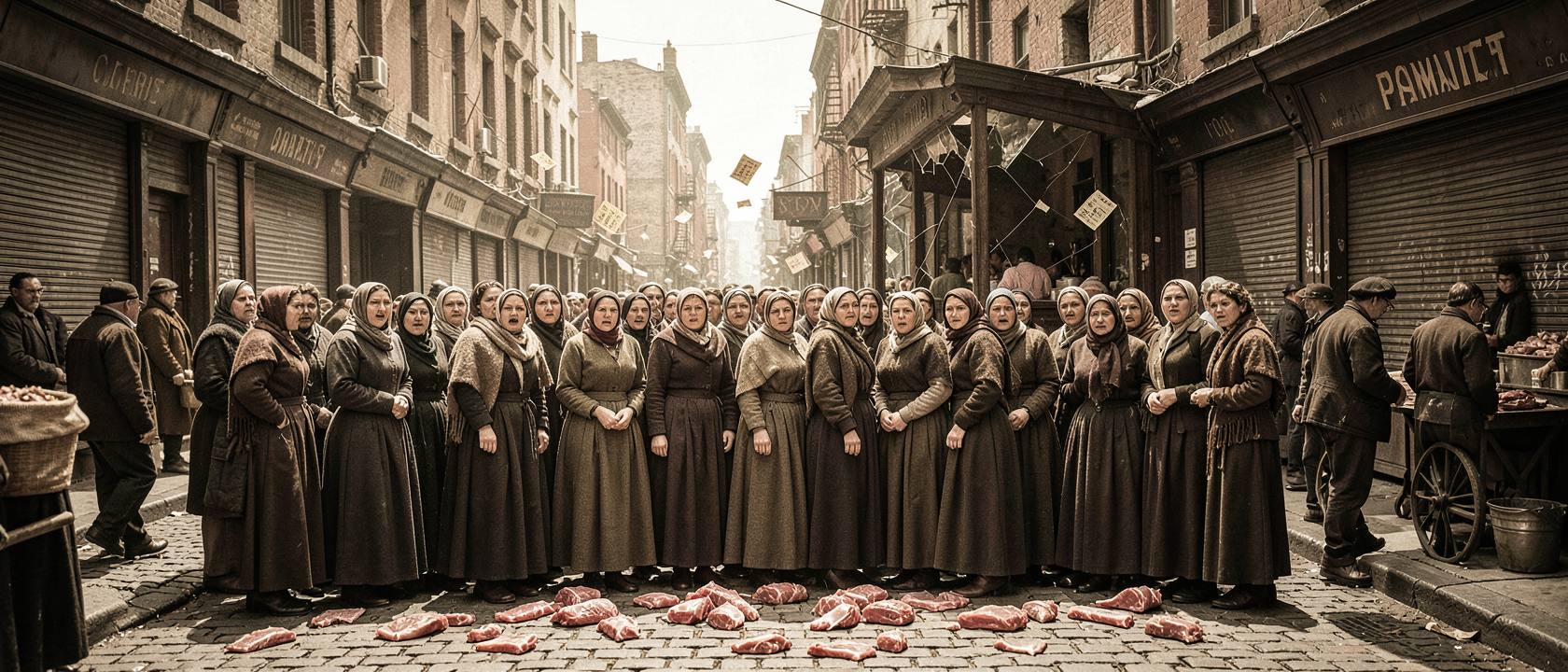
By the early hours of May 15, roughly 3,000 women were positioned on Lower East Side streets in organized squads. Butcher shop windows were broken. Meat was thrown into the street, doused with kerosene, and burned. Yiddish-language leaflets illustrated with skulls and crossbones moved through the neighborhood, and a crowd that press accounts put at around 20,000 gathered in front of New Irving Hall.
On May 16, organized picketers took stations outside each kosher butcher shop. May 17 was the Sabbath; women entered synagogues and interrupted Torah readings to put their case to congregants and seek rabbinic endorsement, a recognized, if forceful, move within Jewish tradition. Orthodox religious leaders formally endorsed the boycott around May 27.
By May 18, most kosher butchers on the Lower East Side had shuttered. The action had already reached Brooklyn, where 400 women signed up to patrol neighborhood butcher stores, and would spread further to the Bronx, Harlem, Brownsville, Newark, Boston, and Philadelphia.
What the Police Did
The street actions of May 15 brought direct confrontation with police. Women were handled and thrown to the ground during arrests; the Herald documented the treatment. A total of 85 people faced disorderly conduct charges, one account cites 70 women and 15 men, others put the women’s share at roughly 75 of approximately 85 to 100 arrested. Fines ran from $5 to $10 per person.
Sarah Edelson was among the first arrested. Rebecca Ablowitz, another woman taken into custody, addressed a court with the question: “If we stay home and cry, what good will that do us?” Caroline Schatzberg, a Romanian-born widow of around 50, became president of the Ladies’ Anti-Beef Trust Association and served as its public spokesperson throughout.
June 5
Around June 5, 1902, the boycott ended. The retail price had fallen to 14 cents per pound, down from the crisis peak of 18 cents. The Ladies’ Anti-Beef Trust Association had achieved in roughly three weeks what the butchers’ own boycott had not managed to sustain for three days.
The May 21 Conference
Male communal leaders had not waited for the outcome. On May 21, they called a conference of their own. Joseph Barondess, a labor figure known as the “King of the Cloakmakers,” attended; historian Paula Hyman’s account records that he supposedly urged the women to step back and leave the fighting to men, a characterization the source marks as supposed rather than confirmed.
Whatever was said, the structural outcome is documented. The conference produced the Allied Conference for Cheap Kosher Meat, whose ten-member steering committee gave women three seats. The organizers who had built the boycott from the street now held a minority position on the body negotiating on their behalf. On May 22, the Retail Butchers Association re-aligned with the boycotters, the institutional machinery was running, with different people at the controls.
What Holds and What Doesn’t
Two details carry uncertainty. The figure of 20,000 at New Irving Hall comes from press estimates, not independent verification. The arrest breakdown of 70 women and 15 men sits alongside other sources that put the women’s share at roughly 75 of approximately 85 to 100 total; the 85 figure is most consistently cited, the precise split disputed.
The sharper question concerns what the outcome was worth. Paula Hyman, whose 1980 article in American Jewish History remains the foundational scholarly treatment, called the result a “qualified success.” The retail price came down from 18 cents to 14 cents, then began rising again. The Allied Conference had displaced the street organizers, and the women held three of ten committee seats and a price reduction that did not hold.
What survived was a different kind of record: evidence that immigrant women could organize without the established male labor movement, shut down a supply chain, attract newspaper coverage, and force a measurable price rollback. The costs came in fines, arrest records, and committee seats that went to others. The price of kosher meat resumed its climb. The record of May 1902 did not.