
Flour, Fat, and a Ship Manifest
Francisco Pizarro founded Lima in January 1535, two years after his forces seized Cusco. Within a decade it was the administrative capital of the Viceroyalty of Peru, formally established November 20, 1542, by royal decree of King Charles I of Spain. The colonial period that followed lasted approximately 288 years and ran on two kinds of imports that arrived through entirely different mechanisms.
One was a recipe. The buñuelo, a deep-fried wheat-flour dough ball already common across the Spanish colonial world, came with the colonizers. The other import was a population. Through the transatlantic slave trade, enslaved Africans were transported to Peru in large numbers, and by the mid-17th century Lima held a substantial enslaved urban population. Both things, a Spanish fritter and a population held in bondage, ended up in the same colonial kitchens, with entirely different standings inside the household.
What the Pantry Held and What It Withheld
Wheat flour, the base of buñuelos, was not always cheap or reliably abundant. What was available at low cost and in quantity were Andean staples: sweet potato known as camote (Ipomoea batatas) and a large winter squash called zapallo macre (Cucurbita maxima). Enslaved cooks had physical access to both as a basic condition of kitchen work.
Colonial law classified enslaved people as property. Their labor, including any culinary knowledge they applied or developed, belonged to the household. Whatever modifications an enslaved cook made to a received recipe passed, without attribution, into the household’s daily routine. The substitution of local produce for costly imported flour was not, in the colonial framework, an authorized act of invention. It happened within the ordinary logic of servitude: practical, unremarkable to record-keepers, and unacknowledged as authorship by anyone with the standing to write it down.
One additional ingredient needs placing here: the syrup that finishes the dish. Chancaca, raw unrefined cane sugar, also known as panela, is described in some sources as solidified molasses, a cheap waste product of sugar production. The fritter’s topping came from the same plantation economy as the people who made it.
What the Dough Became
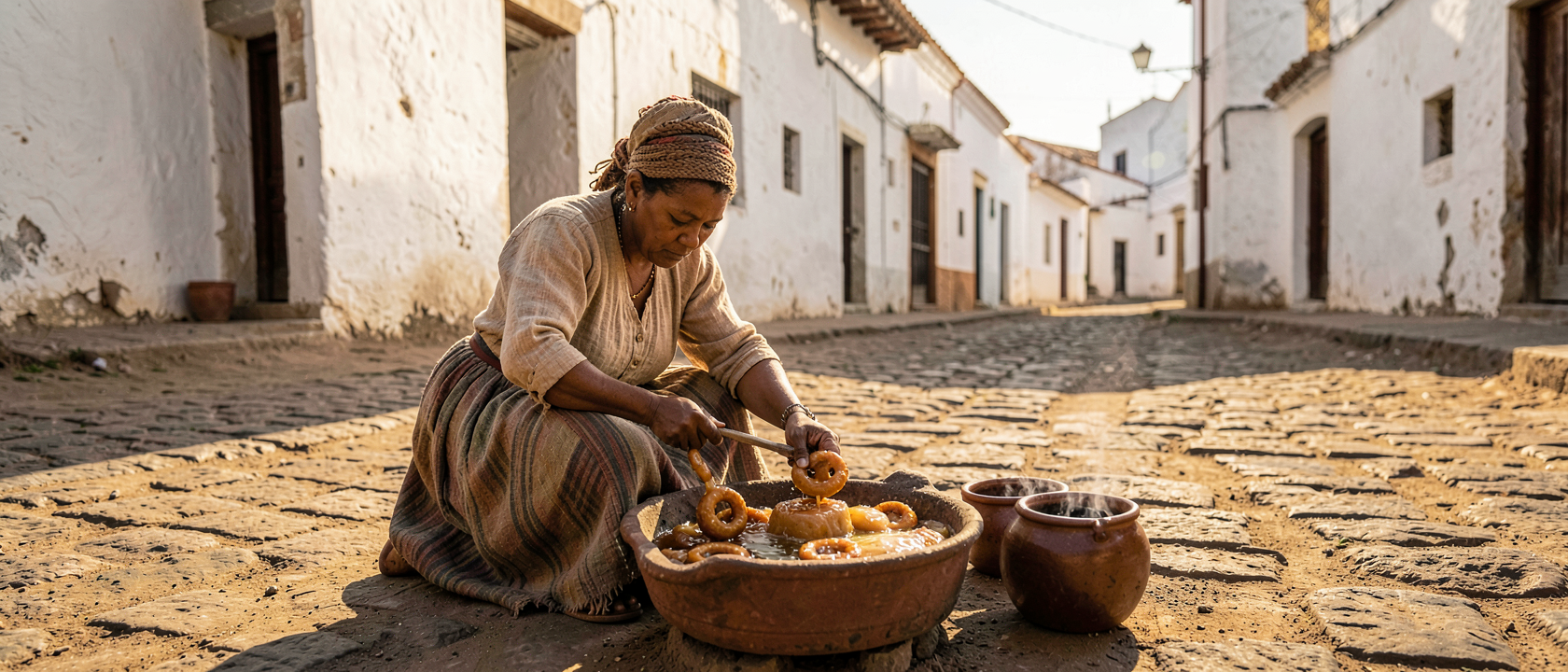
The precise moment of transformation is unrecorded. At some point during the Viceroyalty period, the buñuelo’s flour base was replaced or substantially supplemented with mashed camote and zapallo macre in roughly equal parts, producing a distinctive orange-colored dough. Anise seeds, salt, and either yeast or chicha de jora, a fermented corn beer with pre-colonial Andean roots, went into the mix as well. The dough was fried in lard and finished with chancaca syrup: raw cane sugar cooked with water, cinnamon, and orange peel into a warm, dark glaze. The form was a ring, pulled by hand, center opened with a thumb, laid directly into hot fat.
Frying mashed sweet potato and squash was not an invention that originated in the colonial kitchen; similar preparations existed in Indigenous Andean cooking before Spanish arrival. What the colonial period contributed were the flour, the leavening, the spices, and the ring shape. The result acquired its own name: picarones.
By the 18th century the dish was appearing in Lima literary sources. The Afro-Peruvian painter Pancho Fierro, born around 1807 or 1809, died July 28, 1879, depicted the female street vendor of picarones, called the picaronera, in costumbrista watercolors produced from the 1820s through the 1850s. Ricardo Palma (February 7, 1833, October 6, 1919) described an Afro-descendant picaronera calling out her fritters at two in the afternoon in his Tradiciones Peruanas, the first volume of which appeared in 1872. That work is historical fiction rather than formal scholarship, but it remains among the most widely circulated literary documents to feature picarones, and the passage Palma wrote is the most frequently cited by later sources.
No Name in the Ledger
No individual creator appears anywhere in the historical record. Colonial documentation treated enslaved people as entries in property registers and was not designed to record who developed a recipe or how. The dish crossed into Chilean culinary life at some point, though the mechanism and timing are not established. Chile has on several occasions been closely associated with picarones, a 2016 promotional campaign and a 2022 advertising controversy are two documented instances, with public discussion continuing into 2025. Peruvian historians cite the Viceroyalty-era Lima documentation as the strongest established claim of origin. The Chilean version reportedly uses more squash; the basic structure is recognizable across both traditions.
Within Peru, the recipe outlasted colonial rule, passing not through any institution but through family practice and community transmission, which is why the dish has a thoroughly documented present and an almost entirely anonymous past.
October, Lima, a One-Handed Technique
Each October, Lima’s religious processions draw crowds through the streets, and the concentration of picaroneras increases noticeably alongside them. The vendors are recognized by a specific technique: they wet their hands in salted water to prevent the sticky dough from clinging, pull each portion into shape, push a thumb through the center, and lay the ring into hot lard in a single fluid motion. The skill is transmitted through practice, not through any culinary institution.
Pancho Fierro painted those women. Ricardo Palma wrote one into his chronicles, announcing her fritters at two in the afternoon. The dish they sold is still served alongside anticuchos, beef-heart skewers and the other pillar of Afro-Peruvian street food, in neighborhoods including Barrios Altos and Miraflores.
What the record still does not contain: the name of anyone who first made the substitution, the documented route by which the recipe entered Chile, or a settled scholarly consensus on the precise timeline. What it does contain is the dish itself, made by the cultural descendants, and in many cases the direct descendants, of people who produced it under conditions that gave them no standing to describe what they had made, or to sign it.