The World That Gathered in Buffalo
The Pan-American Exposition opened in Buffalo, New York, on June 1, 1901, built to demonstrate that the Western Hemisphere had arrived at modernity. Its organizers had not initially planned for Black Americans to appear except on the midway, where two attractions, “Darkest Africa” and “The Old Plantation”, offered African people as living displays and a fictionalized antebellum setting. After pressure from Black civic organizations, a separate educational exhibit was added at the physical margins of the grounds, away from the main halls celebrating American achievement, a placement that reflected the exposition’s governing assumptions about who belonged where.
McKinley’s Silence and Its Price
By 1901, the Republican Party’s connection to emancipation had become largely ceremonial. On November 10, 1898, white supremacists in Wilmington, North Carolina, violently overthrew the legitimately elected biracial city government, killing an estimated 14 to 300 Black residents. McKinley’s administration issued no federal response. On April 23, 1899, Sam Hose was burned alive before a crowd of roughly 2,000 people in Newnan, Georgia; his body was mutilated and pieces taken as souvenirs. McKinley said nothing publicly. Black newspapers documented these silences in sequence. By September 1901, whatever goodwill McKinley retained among Black Americans had largely dissolved.
James B. Parker, September 6, 1901
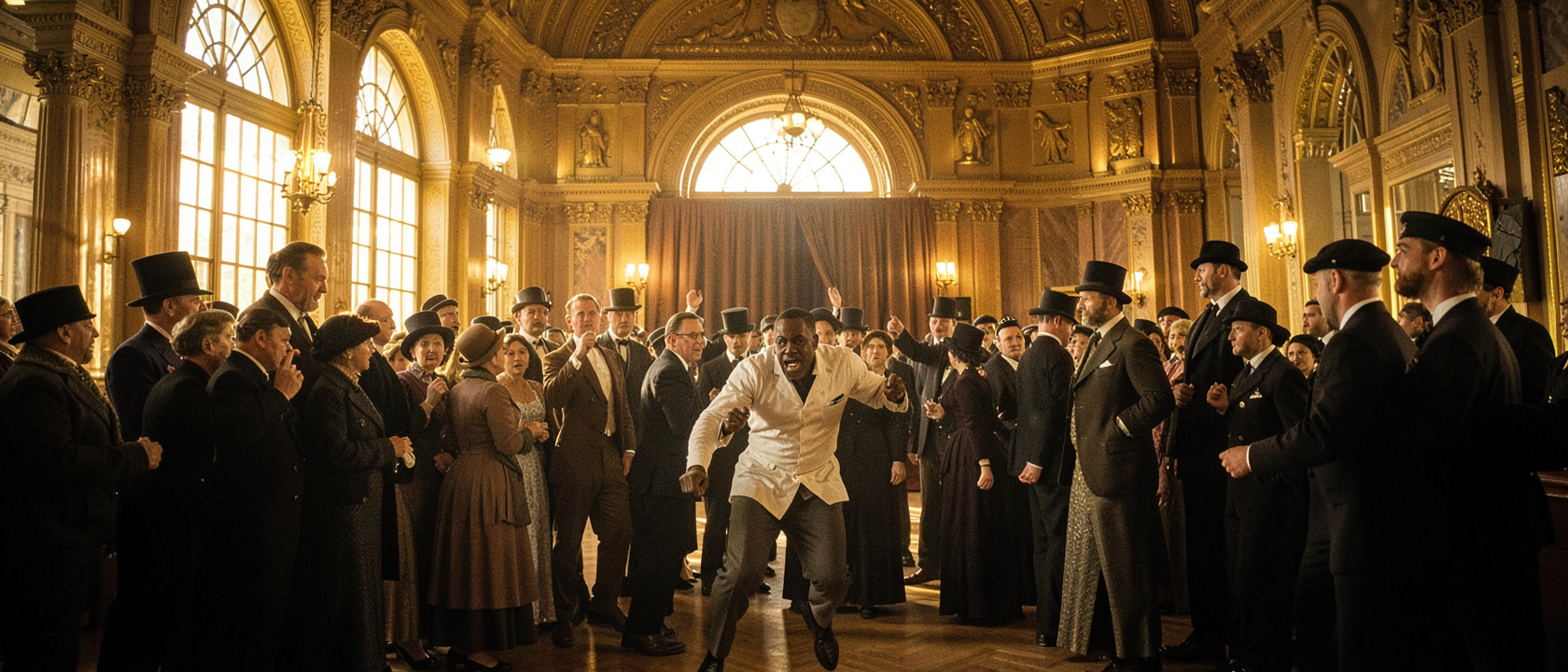
At 4:07 p.m. on September 6, 1901, Leon Czolgosz fired two shots at McKinley inside the Temple of Music. Czolgosz, born in Detroit to Polish immigrant parents, carried a .32 caliber Iver Johnson revolver and described his ideology as anarchism. One bullet struck the sternum superficially; the second entered the abdomen. He had been moving to fire a third shot when he was stopped.
Standing nearby was James Benjamin Parker, born July 31, 1857, in Atlanta, Georgia, and working at the exposition through the Bailey Catering Company. Contemporary reports described him as approximately 6 feet 6 inches tall and over 250 pounds, though those figures come from popular press accounts and should be treated as estimates. In the hours and days following the shooting, multiple white mainstream newspapers, including national wire services, reported that Parker had seized Czolgosz’s arm, struck him, and helped bring him down, possibly preventing a third shot. His name appeared in print across the country within forty-eight hours.
How Parker Was Unmade
The favorable coverage did not hold. Within weeks, Secret Service agents began circulating accounts disputing Parker’s role. A witness named James Quackenbush stated by September 13, 1901, that he had seen no one except Secret Service men and artillerymen seize Czolgosz. When the trial proceeded, the judicial record contained no Black witness, no Black name. Parker was not called to testify. Czolgosz was convicted and executed by electric chair on October 29, 1901, at Auburn State Prison. By that date, much of the white press had recast Parker as a self-promoter. The reversal played out in print and official channels without leaving a clear record of who directed it.
The Argument Made in the Black Press, 1901
The New York Age charged that a systematic effort had been made to strip Parker of recognition. Other Black commentators made a broader structural argument: a government that permits the killing of its Black citizens has already fractured the social contract that is supposed to protect everyone, including presidents. Historian Mitch Kachun has noted that this reasoning predates by six decades the logic Malcolm X applied after John F. Kennedy’s assassination in 1963.
Booker T. Washington made a different rhetorical move, pointing to Czolgosz’s immigrant parentage to argue for the loyalty and civic belonging of native-born Black Americans. Neither strategy produced a federal civil rights response.
What Cannot Be Settled
Kachun, whose 2010 article in the Journal of the Gilded Age and Progressive Era remains the most sustained scholarly examination of Parker, is precise about what the evidence can carry: we will likely never know the full nature of Parker’s intervention. The erasure itself is thoroughly documented, its stages, agents, and timing are traceable. The act that was erased sits permanently behind that documentation. Kachun draws a distinction worth keeping: we can establish that something was taken away; we cannot reconstruct what it was. Whether the absence in the trial record reflects deliberate suppression or institutional negligence is a question the surviving evidence does not settle.
What Parker Paid, and What the Strategy Cost
James Benjamin Parker died in Philadelphia, Wikipedia gives the date as April 13, 1907; the JSTOR Daily account drawing on Kachun’s research gives the year as 1908. What is not disputed is that he died penniless in the Philadelphia State Hospital at Byberry, committed to its psychiatric ward. His body was turned over to medical students. No located grave has been identified for the man the white press briefly called the “tawny lion of the Exposition.”
The nativist rhetorical strategy Washington and others employed in 1901 extracted no civil rights concession. Kachun argues, as a historiographical inference rather than a direct causal chain, that the anti-immigrant sentiment those arguments helped normalize contributed to conditions enabling the Ku Klux Klan’s mass expansion in the 1920s, a resurgence that visited sustained violence on Black communities across the country. The argument extracted a price that outlasted the men who made it.