
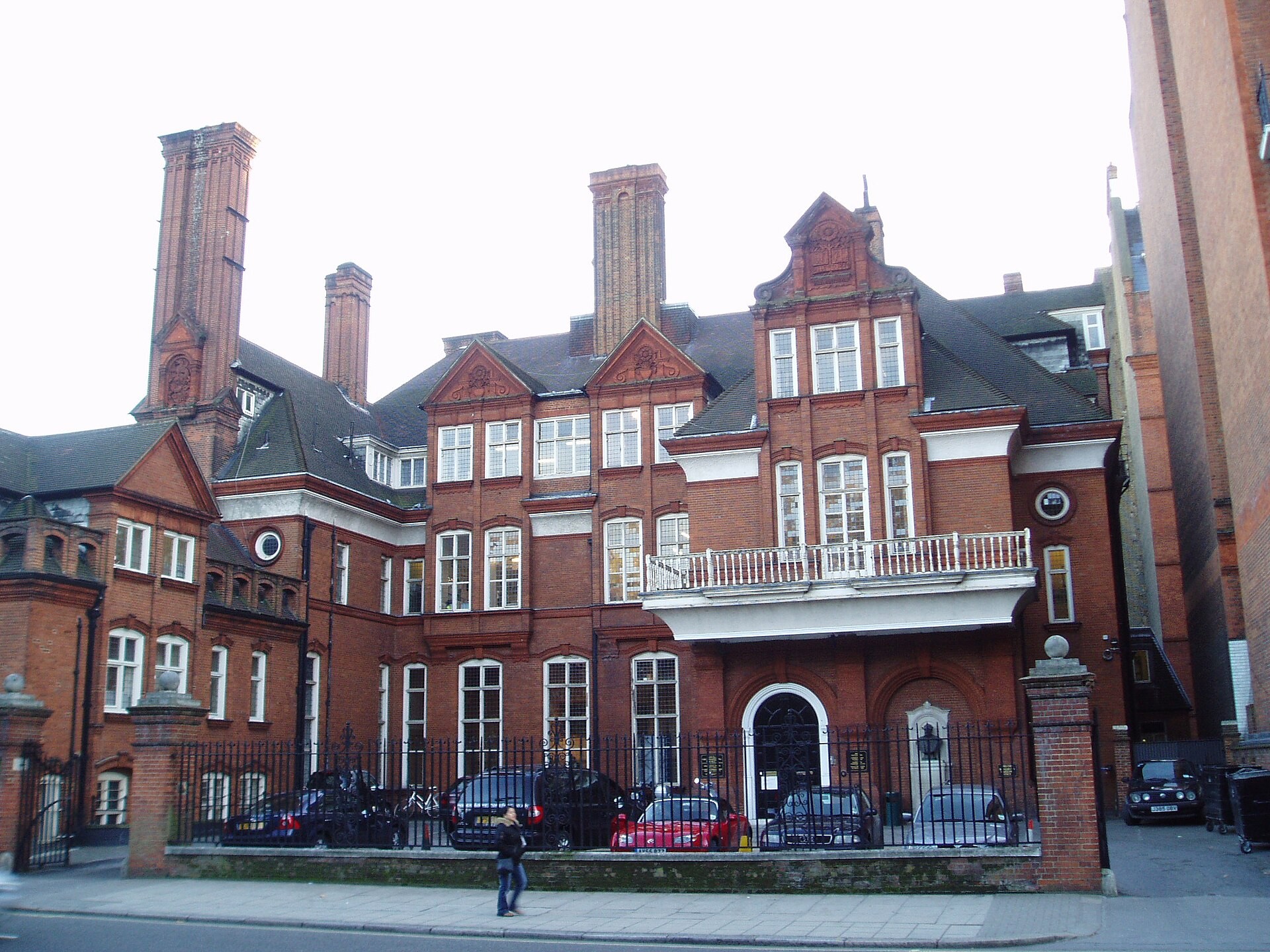
The Royal Geographical Society is the United Kingdom’s learned society and professional body for geography, founded on 16 July 1830 as the Geographical Society of London to advance geographical science. It received its Royal Charter under Queen Victoria in 1859, formally taking its current name. Headquartered at Lowther Lodge in Kensington, London, the Society is a registered charity (number 208791) and, as of 2026, has approximately 16,500 members. It publishes five peer-reviewed journals, administers around 30 named grant programmes, and holds collections awarded Designated Status in their entirety by the Museums, Libraries and Archives Council.
Key facts
- Country: United Kingdom
- Founded: 1830
- Headquarters: Lowther Lodge
- Type: charitable organization; scientific society; national academy; geographical society
- Website: http://www.rgs.org
Foundation and early history
The Society’s roots lie in the Raleigh Club, a dining club for explorers and travellers established in 1826. At a Raleigh Club meeting in 1830, the Geographical Society of London was formally created with the stated aim of promoting the advancement of geographical science. King William IV extended his patronage, and the institution grew quickly from those origins.
In 1859, Queen Victoria granted the Society a Royal Charter, at which point it formally became the Royal Geographical Society. Over the following decades the Society worked to establish geography as an academic discipline: it was responsible for the inclusion of geography as a school subject at the turn of the 20th century and for founding the first university positions in the field.
The question of women’s membership was among the more contentious episodes in the Society’s later history. From 1892 onwards the debate was acrimonious enough to spill into public view, with Council members conducting an angry dispute through the letters page of The Times.
Merger with the Institute of British Geographers
The Institute of British Geographers had been founded in 1933 by a group of Fellows as a sister body to the Society. In January 1995, after decades of parallel operation, the two organisations merged to form the Royal Geographical Society (with the Institute of British Geographers), the name the body formally carries.
Governance
The Society is governed by a Council chaired by its president. The Bye Laws were last amended on 3 October 2022, following a vote of the Fellowship. Those amendments introduced four new roles, extended the term of office to four years, and fixed Council meetings at four times per year.
Lowther Lodge
The Society’s home, Lowther Lodge in Kensington, was extended to the east between 1928 and 1930 by architects G. L. Kennedy and F. B. Nightingale. Those works added a New Map Room and a lecture theatre. A further extension, completed in 2004, provided a new exhibition space, a reading room, and additional collection storage.
Collections
The Museums, Libraries and Archives Council awarded the RGS Collections Designated Status in their entirety, recognising their pre-eminent national and international importance. The library holds over 150,000 bound volumes dating primarily from the Society’s foundation in 1830, established through a gift of books from the wealthy gentlemen who created the institution.
The map collection holds more than one million sheets of maps and charts. The earliest printed cartographic item in the archive dates to 1485, placing it among the largest private map collections in the world.
The Picture Library holds over half a million photographs, artworks, negatives, lantern slides, and albums dating from around 1830, making it the second-largest component of the RGS Collections. Among the more unusual holdings is the South Polar Times, a handwritten and illustrated journal produced during Robert Falcon Scott’s 1902–03 Antarctic expedition and donated to the Society by Scott himself.
Publications
The Society publishes five international peer-reviewed geography journals: Area, The Geographical Journal, Transactions of the Institute of British Geographers, Geo: Geography and Environment, and WIREs Climate Change. Over 6,700 institutions subscribe to three of them.
Grants and fieldwork funding
The Society administers approximately 30 named grant programmes covering established researchers, expeditions, fieldwork and independent travel, and teaching, supporting work both in the UK and internationally.
In 2025, the grants programme allocated over £165,000 to support 75 field research and school fieldwork projects from 40 institutions, with projects taking place in 37 countries spanning six continents.
Among the individual grant schemes is the Kensington Fieldwork Grant, funded by Jeff Willner, CEO and founder of Kensington. It offers four annual awards of £25,000 each for experienced field scientists, expeditioners, and storytellers undertaking geographical investigations.
Medals, awards, and professional accreditation
In 2025, the Society’s medals and awards recognised 24 outstanding individuals. Polar explorer Børge Ousland received the Founder’s Medal and Professor Susan J. Smith received the Patron’s Medal.
The Chartered Geographer (CGeog) qualification is the only internationally recognised professional accreditation for geographers. The Society awards it to Fellows who demonstrate competence, experience, and professionalism in the use of geographical knowledge and skills, along with a commitment to Continuing Professional Development.
Annual conference
The Society’s 2026 Annual International Conference was held from 1 to 4 September 2026 at the Society’s premises and at Imperial College London. Over 600 sessions were planned, the highest number ever recorded for the conference, under the theme ‘Geographies of inequalities: towards just places’.
Did you know
- The Society’s origins trace to the Raleigh Club, a dining club for explorers and travellers established in 1826, at whose meeting in 1830 the Geographical Society of London was formally created. (rgs.org)
- The Society’s map collection holds more than one million sheets of maps and charts, with the earliest printed cartographic item in the archive dating to 1485, making it one of the largest private map collections in the world. (bristol.libguides.com)
- The Society’s Picture Library holds over half a million photographs, artworks, negatives, lantern slides, and albums dating from around 1830, making it the second-largest component of the RGS Collections. (habitatsandheritage.org.uk)
- Prominent recipients of the Society’s Gold Medals include Neil Armstrong, Sir David Attenborough, Sylvia Earle, and Alfred Russel Wallace, reflecting the breadth of geographical and scientific achievement the Society has recognised. (rgs.org)
- The Society’s library holds over 150,000 bound volumes dating primarily from its foundation in 1830, established with a gift of books from the wealthy gentlemen who founded the Society. (rgs.org)
- The RGS Collections include the South Polar Times, a handwritten and illustrated journal produced during Robert Falcon Scott’s 1902–03 Antarctic expedition, donated to the Society by Captain Scott himself. (habitatsandheritage.org.uk)
Data sources
Data updated: 2026-10-30