
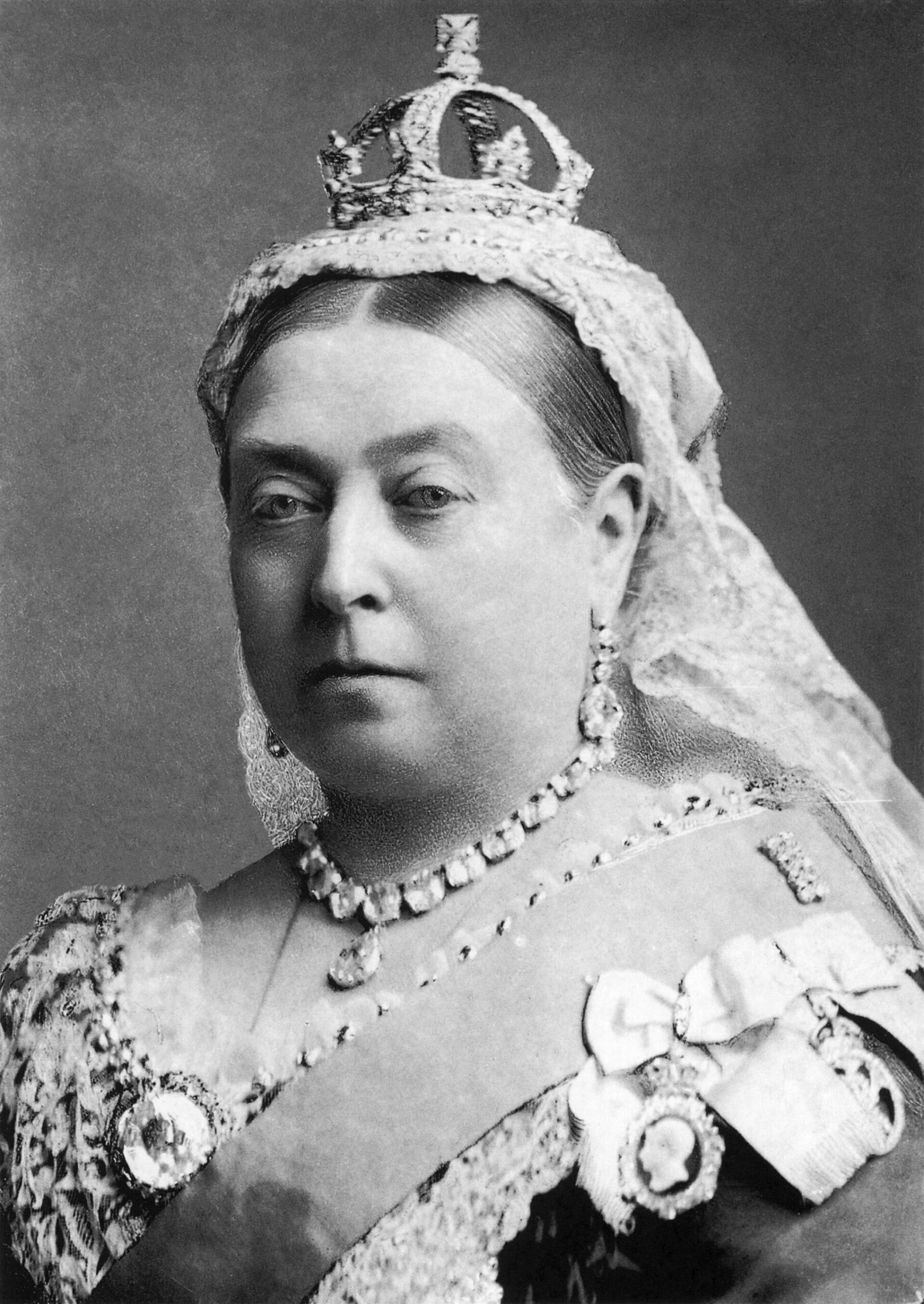
Born Alexandrina Victoria on 24 May 1819 at Kensington Palace, Victoria reigned as Queen of the United Kingdom of Great Britain and Ireland from 20 June 1837 until her death on 22 January 1901, a span of 63 years. She was also Empress of India from 1876, a title formally proclaimed at the Delhi Durbar on 1 January 1877. Her reign witnessed railways, photography, and industrial expansion reshape British life, and she kept a written record of nearly all of it: across 141 volumes of diary kept over 69 years, she reportedly accumulated roughly 60 million words. At her death the empire over which she presided covered roughly a quarter of the world’s land surface.
Key facts
- Born: 24 May 1819
- Birthplace: Kensington Palace
- Died: 22 January 1901
- Place of death: Osborne House
- Country: United Kingdom of Great Britain and Ireland
- Occupation: monarch
- Education: Windlesham House School
- Awards: Knight of the Garter; Order of the Thistle; Order of St Patrick; Order of the Star of India
Origins and early life
Victoria was the only child of Prince Edward, Duke of Kent, fourth son of King George III, and Princess Victoria of Saxe-Coburg-Saalfeld. At birth she ranked fifth in line to the throne, a position that shifted dramatically when her father died in 1820. Her three surviving uncles had no legitimate heirs who lived through childhood, so the infant became heir apparent.
Her upbringing was shaped almost entirely by the so-called Kensington System, a strict regime devised by her mother and her mother’s adviser, Sir John Conroy. Its purpose was to keep Victoria dependent on the two of them and to cut her off from outside influences. Under this arrangement she was required at all times to be accompanied by an adult, and she slept in the same room as her mother until she became queen at 18.
Education, however, was taken seriously. Baroness Louise Lehzen, who served as Victoria’s governess, supervised a rigorous daily schedule that covered reading, writing, music, languages, history, and geography. Lehzen also devoted hours to the child’s piano practice and to playtime.
Accession and the early reign
Victoria ascended the throne on 20 June 1837, less than a month after her eighteenth birthday, following the death of King William IV. Her coronation took place at Westminster Abbey on 28 June 1838. Among the practical changes that followed accession was her choice of residence: Victoria became the first sovereign to make Buckingham Palace her primary home, and she also made the first recorded royal appearance on the palace balcony.
In the opening years of her reign she leaned heavily on her first Prime Minister, Lord Melbourne, who guided her through the workings of constitutional monarchy.
Marriage, family, and the death of Albert
Victoria married Prince Albert of Saxe-Coburg and Gotha in 1840. Together they had nine children — five girls and four boys — all born between 1840 and 1857, and all of whom survived into adulthood, an unusual outcome for the era. Albert took an active interest in the arts, science, trade, and industry; the project for which he is most remembered is the Great Exhibition of 1851, whose profits helped establish the South Kensington museums complex in London.
Albert died on 14 December 1861 at the age of 42. The loss shaped the remainder of Victoria’s reign. Her close relationship with her Scottish servant John Brown became a source of sustained public controversy. Victoria herself dismissed the criticism as ‘ill-natured gossip of the higher classes,’ while tabloid papers nicknamed her ‘Mrs Brown.’ Her children had all of Brown’s letters and journals destroyed to suppress the nature of their relationship, and when Victoria herself died she was buried wearing a ring that had belonged to Brown’s mother.
Empress of India and the later reign
On 1 May 1876, following the Royal Titles Act introduced by Prime Minister Benjamin Disraeli, Victoria accepted the title Empress of India. The title was formally proclaimed in India at the Delhi Durbar on 1 January 1877. The addition marked a shift in how the British crown presented its relationship with its overseas territories.
Despite eight assassination attempts over the course of her 63-year reign, Victoria continued her public duties with notable composure. After the final attempt, on 2 March 1882, it was reported that only two hours elapsed before she returned to her official work.
Railways, photography, and public life
Victoria was the first British monarch to travel by train. On 13 June 1842 she made her inaugural railway journey on the Great Western Railway from Slough to Paddington, a trip of 25 minutes pulled by an engine named Phlegethon. Her diary entry described the experience as ‘delightful and so quick.’ She later reportedly imposed a strict speed limit of 40 mph on her royal train journeys.
She was also the first British monarch whose life was fully documented by the camera. Her interest in collecting photographs began in the 1840s, and her enthusiasm for the medium helped make photographic portraiture respectable in British society more broadly.
Death and burial
Victoria died on 22 January 1901 at Osborne House. She was buried on 4 February 1901 at the Frogmore Royal Mausoleum in Windsor, beside Prince Albert, in a mausoleum she had built as their intended final resting place. After the queen’s death, her daughter Princess Beatrice transcribed and edited Victoria’s 141 volumes of diary, destroying the originals in accordance with the queen’s own instructions.
Did you know
- Victoria’s wedding dress was a white satin gown trimmed with English Honiton lace, chosen in part to support the lace-making industry. The choice helped spread the white wedding dress as a Western bridal convention, a fashion shift that had taken hold across Britain and the United States by the mid-19th century. (fashionhistory.fitnyc.edu)
- As a child, Victoria kept a collection of over 100 dolls, and she and Baroness Lehzen made clothes for them. She continued to sketch and paint throughout her adult life. (heathervoight.com)
- Victoria kept diaries for 69 years and reportedly wrote an average of approximately 2,000 words per day, accumulating roughly 60 million words across 141 volumes. After her death, her daughter Princess Beatrice transcribed and edited the diaries, destroying the originals on the queen’s instructions. (britishheritage.com)
- Victoria was the first British monarch to travel by train and reportedly imposed a strict speed limit of 40 mph on her royal train journeys. After the 1842 trip she wrote in her diary that it was ‘delightful and so quick.’ (royalcentral.co.uk)
- Victoria survived eight assassination attempts during her 63-year reign. After the final attempt on 2 March 1882, it was reported that only two hours passed before she returned to her official duties. (thevintagenews.com)
- Victoria stood only 4 feet 11 inches tall, yet governed an empire that at its height covered roughly a quarter of the world’s land surface. (biography.com)
- After Albert’s death in 1861, Victoria was reportedly so close to Highland servant John Brown that her children had all his letters and journals destroyed to suppress the nature of their relationship. She was buried wearing a ring that had belonged to Brown’s mother. (queenvictoriaroses.co.uk)
Data sources
- Wikidata
- royal.uk
- biography.com
- victorianchildren.org
- heathervoight.com
- historyfacts.com
- londonmuseum.org.uk
- nationalarchives.gov.uk
- historyofroyalwomen.com
- victoriantrail.co.uk
- getty.edu
Data updated: 2026-10-30