
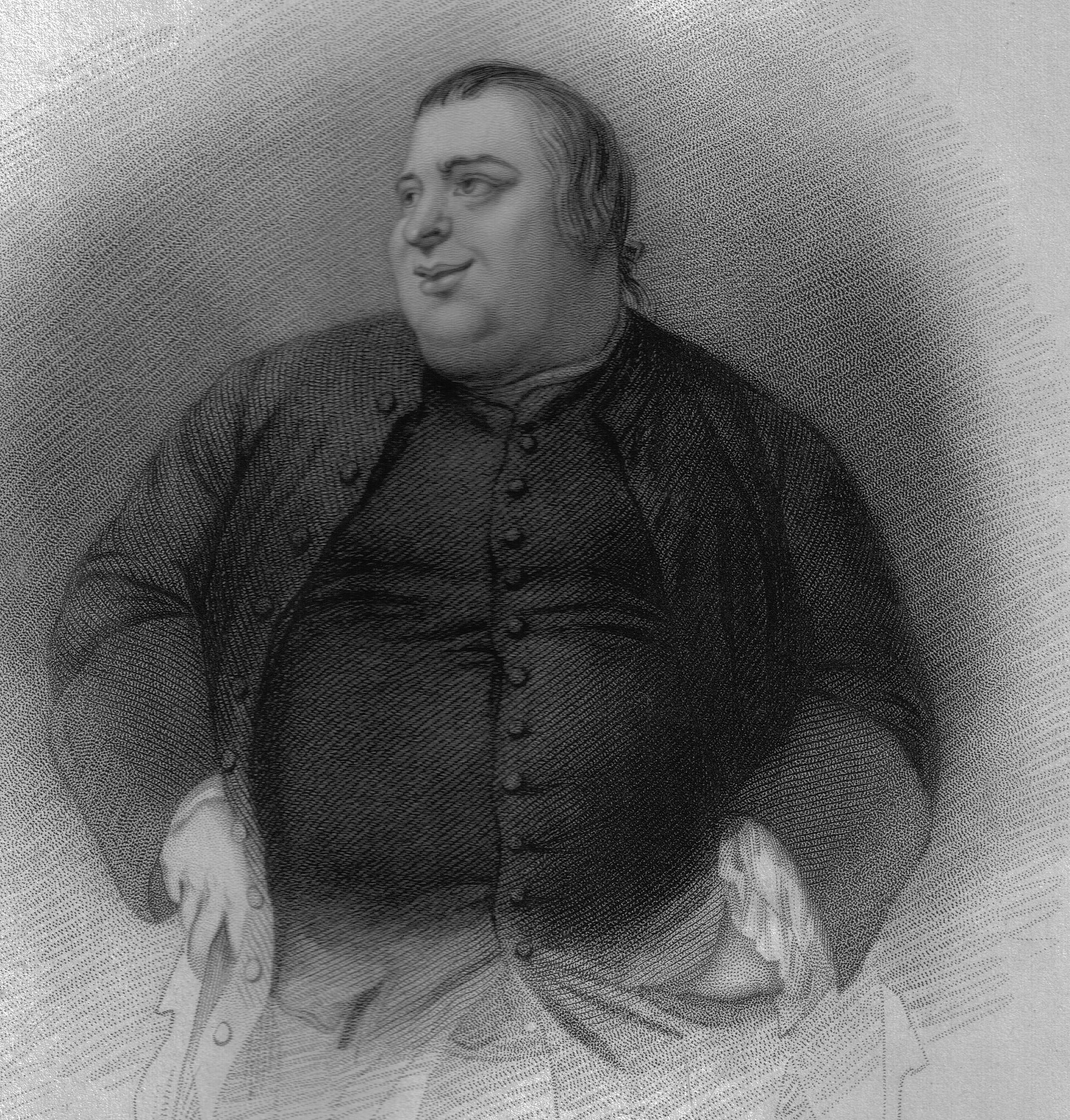
Francis Grose (11 June 1731 – 12 June 1791) was an English antiquary, draughtsman, and lexicographer whose working life bridged the polite world of topographical drawing and the disreputable underworld of street slang. Born in London to a Swiss-born jeweller who had settled at Richmond in Surrey, Grose pursued no university degree yet produced a body of work spanning military history, architectural illustration, caricature theory, and dialect study. His Classical Dictionary of the Vulgar Tongue (1785) recorded approximately 9,000 words omitted from Samuel Johnson’s Dictionary of the English Language, making it one of the most ambitious English slang glossaries of the eighteenth century.
Key facts
- Born: 11 June 1731
- Birthplace: London
- Died: 12 June 1791
- Place of death: Dublin
- Country: United Kingdom of Great Britain and Ireland; Kingdom of Great Britain
- Occupation: lexicographer; linguist; painter; antiquarian bookseller
- Field: lexicography
Origins and early life
Grose was the eldest of seven children. His father, Francis Jacob Grose, came from Berne, Switzerland, immigrated to England, and built a comfortable living as a jeweller at Richmond in Surrey. The elder Grose had a notable connection to the monarchy: he fitted up the coronation crown of George III. He also collected prints and shells, a collection sold in 1770.
Francis Grose received a classical education but did not proceed to a university. Whatever gaps that left in his formal training, they do not appear to have limited the range of work he undertook across the following decades.
Draughtsman and exhibitor
In 1766 Grose became a member of the Incorporated Society of Artists. Two years later, in 1768, he exhibited with the society a stained drawing entitled ‘High Life below Stairs’. From 1769 he also exhibited tinted drawings at the Royal Academy, chiefly of architectural remains.
His interest in caricature led to Rules for Drawing Caricatures, published in 1788. The work crossed the Channel: it was translated into French and published in Paris in 1802, more than a decade after his death.
Lexicography: slang and dialect
A Classical Dictionary of the Vulgar Tongue appeared in 1785, published in London by S. Hooper. Its approximately 9,000 entries covered words that Samuel Johnson had left out of his authoritative Dictionary of the English Language, giving the book an immediate practical use for anyone trying to understand the language spoken on the streets rather than in print.
Two years later, in 1787, Grose published his Provincial Glossary with a Collection of Local Proverbs and Popular Superstitions, one of the earliest attempts to document versions of English spoken outside London, Oxbridge, and the Home Counties. The two dictionaries together gave Grose a lasting reputation as a chronicler of the English language in its less formal registers.
The twentieth-century lexicographer Eric Partridge described Grose as ‘the greatest antiquary, joker, and porter-drinker of his day, and one of the happiest wits of the late 18th century.’
Military and antiquarian publications
Between 1786 and 1788 Grose published Military Antiquities respecting a History of the English Army from the Conquest to the Present Time in two volumes. The work is not purely scholarly: it includes a satirical portrait of his former commanding officer in the Surrey militia, Jeremiah Hodges.
His topographical ambitions eventually took him through Scotland and then to Ireland. The Antiquities of Scotland appeared in 1789–91 in two quarto volumes. Grose died in Dublin on 12 June 1791, before the Irish project was complete. The unfinished Antiquities of Ireland (1791) was subsequently completed by his nephew Lieutenant Daniel Grose and the Reverend Edward Ledwich.
Robert Burns and public reputation
Grose’s travels in Scotland brought him into contact with Robert Burns, and the friendship had literary consequences on Burns’s side. Burns wrote the verses ‘Ken ye ought o’ Captain Grose?’ and a rather coarse ‘Epigram on Captain Francis Grose’, both inspired by the acquaintance.
In print, Grose attracted vivid characterisations. The Dictionary of National Biography described him as ‘a sort of antiquarian Falstaff,’ noting he was ‘immensely corpulent, full of humour and good nature, and an inimitable boon companion.’ The description captures the particular quality that made Grose unusual among antiquaries: he was as welcome in a tavern as in a library.
Did you know
- Grose’s personal annotated copy of the first edition of A Classical Dictionary of the Vulgar Tongue (1785) contains over 1,000 manuscript additions that he made in preparation for the second edition of 1788. (peterharrington.co.uk)
- On 26 May 1791, the St. James’s Evening Post suggested an epitaph for Grose: ‘Here lies Francis Grose … Death put an end to his Views and Prospects.’ The joke turns on two meanings at once: his topographical work (views and prospects as landscape terms) and his personal ambitions. (electricscotland.com)
Data sources
Data updated: 2026-10-31