
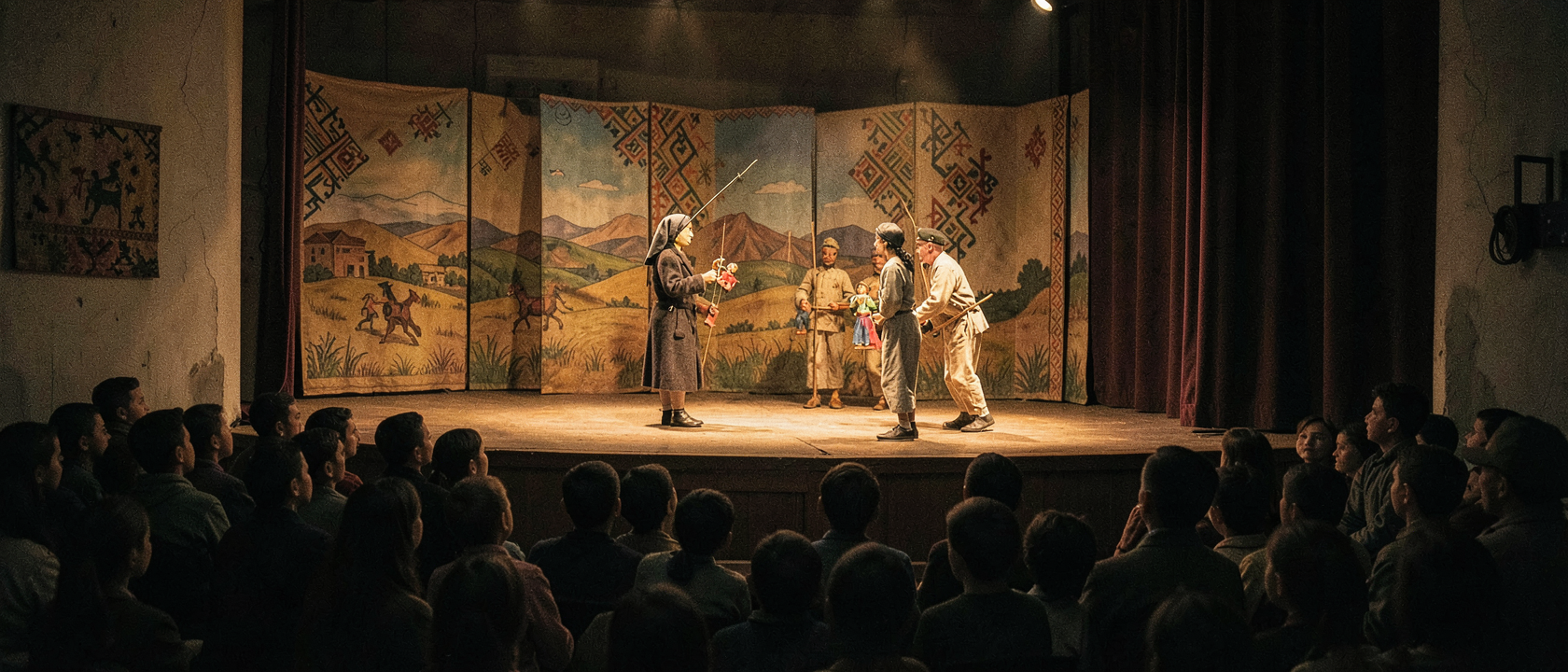
The Puppet Theatre of Alma-Ata
In 1941, the capital of the Kazakh Soviet Socialist Republic was Alma-Ata, a city that had carried that name only since February 1921, when it was still known as Verny. The republic’s capital had since moved there, and with it came the machinery of Soviet cultural administration, including a government-run puppet theatre. Institutional histories differ on exactly when the theatre took shape: some trace a State Puppet Theater to 1935, while another account describes a children’s troupe called Theatre of the Republic forming out of an Alma-Ata orphanage by 1938. Whichever thread is the right one, by 1941 the theatre was still young, and its director was a woman named Nadezhda Pavlovna Amori.
Amori’s job was not simply to stage puppet shows in the city. Her troupe was expected to tour the steppe, the vast open country beyond Alma-Ata, carrying performances to rural and nomadic communities who had little other contact with organized Soviet culture. That same season, she was not the only act moving across that ground. Private touring performers were working the same routes, chasing the same audiences, and in 1941 that overlap became a problem serious enough for Amori to put in writing.
Why Puppetry Mattered to the Soviet State
Puppet theatre in this setting was not treated as light entertainment. Soviet cultural policy leaned on it as a tool: a way to carry literacy campaigns, anti-religious messaging, and Soviet values into regions like Kazakhstan, where oral storytelling and nomadic ways of life still shaped daily culture far more than the printed word or the classroom did. A puppet show could travel where a school could not.
Because the stakes were treated as political, the republic maintained an oversight body, the Management of Artistic Affairs of the Kazakh Soviet Socialist Republic, whose job was to decide which performances counted as legitimate cultural work and which did not. In that framework, a private act putting on a puppet show or a circus turn was never just competition for ticket sales. It was a potential distortion of a message the state considered its own to control.
Amori’s Report to the Management of Artistic Affairs
Amori’s letter to the Management named two rival acts she had run into on tour. The first called itself “The Illusionist Apollo and the Lilliputians.” The name promised performers with dwarfism, a familiar draw for touring circus acts of the period. What audiences actually saw, according to Amori, were ordinary small children presented as though they were something else.
The second act she described belonged to a family named Vinogradov, who ran a traveling circus advertised with lions, bears, and a puppet theatre of their own. Amori’s account of the show was blunt. The lions, she reported, never actually appeared. The bears did little beyond fussing and struggling in place. And the puppet segment amounted to only three puppets, which she called, in her own words, disgusting. These two acts are the only rivals named in the surviving record; whether others existed along the same touring routes is not something the document tells us.
The Stakes of a Blurred Line
The surviving record shows no injuries, no lost money, and no public scandal attached to either act. What worried Amori was something harder to measure: confusion. If a family on the steppe watched three shabby puppets and a fidgeting bear one week, and a state-approved educational puppet show the next, there was no guarantee they would tell the two apart. And if they couldn’t, the government theatre’s authority to speak for Soviet cultural policy started to look no different from a traveling act putting on a show for coins.
That is the real subject of Amori’s complaint: not competition for an audience, but competition for what that audience believed it was watching. She made her case in the language Soviet bureaucracy was built to respond to, framing shoddy entertainment as an ideological risk rather than simply bad theatre. It was arguably the only kind of argument a cultural oversight body of that era would have taken seriously.
The Silence After
What happened after Amori filed her complaint is not preserved. There is no record of how the Management of Artistic Affairs responded, or whether it responded at all. Nothing tells us if “The Illusionist Apollo and the Lilliputians” kept touring, if the Vinogradov family’s lions ever made a stage appearance, or if either act was ever confronted about it. What survives is a single document from 1941, a director’s formal objection to shows that made her nervous for what they represented rather than for what they did.
It is the only window historians have into a rivalry that, on the evidence available, may have played out many more times across the steppe without ever being written down. What Amori was really guarding, in the end, was not her troupe’s ticket sales but its claim to speak for the state. That distinction between performance and propaganda is one modern audiences rarely have to make for themselves, which may be exactly why it is worth remembering that someone once had to.