
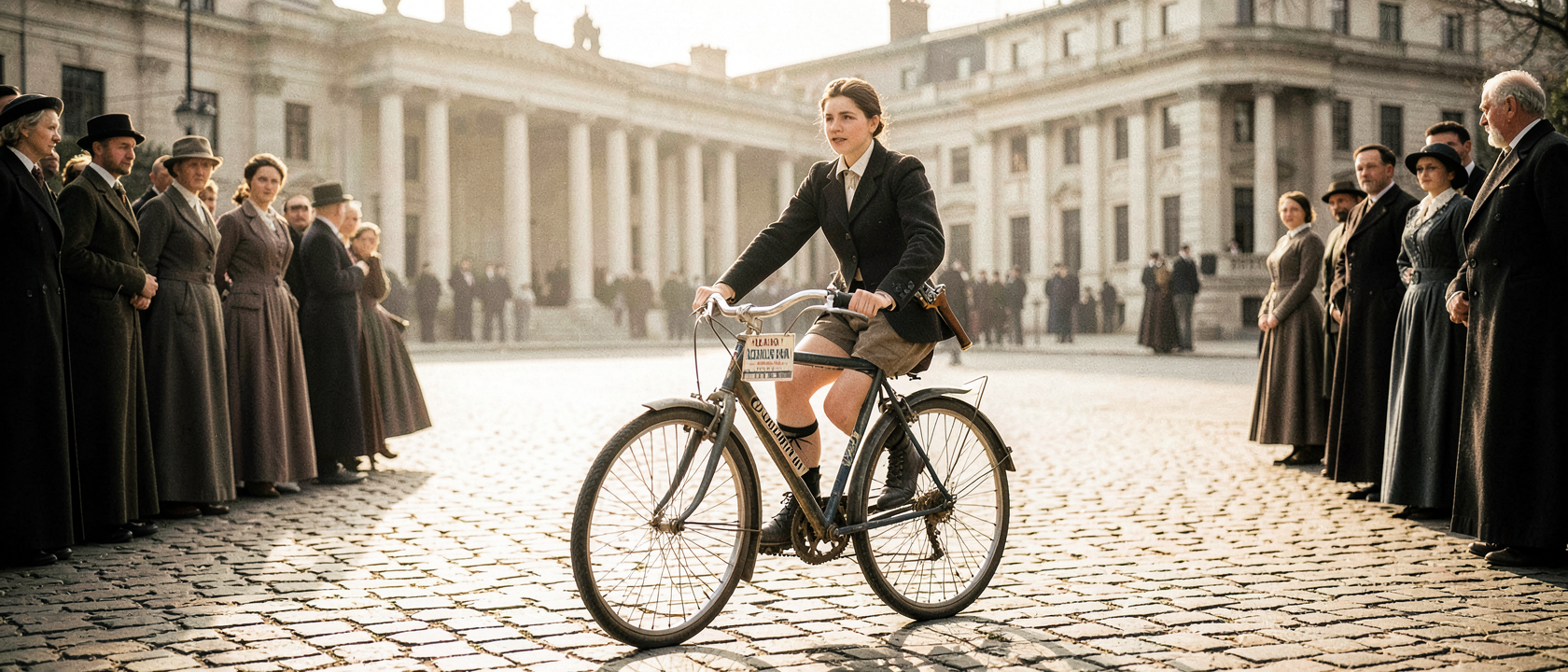
State House, June 25, 1894
On June 25, 1894, a crowd of about 500 gathered outside the Massachusetts State House in Boston to see off a woman on a bicycle. Annie Cohen Kopchovsky was 23 or 24, though newspapers at the time put her closer to 27. She sold advertising space for Boston newspapers, was married, and was a mother of three young children by most accounts, though one source claims six. She had climbed onto a bicycle for the first time only days before that morning. The June 25 gathering at the State House was a public sendoff; by other accounts she did not actually leave Boston until two days later, on June 27, after finishing preparations and having photographs made to sell along the way. Either way, she set out on a trip meant to last fifteen months.
She rode off on a 42-pound (19 kg) Columbia bicycle. Before she left, the Londonderry Lithia Spring Water Company of Nashua, New Hampshire, paid her $100 to carry its name, and from that point she rode and lectured as “Annie Londonderry.” She had no cycling experience worth the name, no support crew, and no guaranteed route. What she had was a deadline and, by her own account, a bet riding on her.
The Wager Behind Her
The trip was said to exist because of a bet between two Boston businessmen. One man supposedly staked $20,000 that no woman could cycle around the world; the other put up $10,000 that a woman could. Her biographer, Peter Zheutlin, has since raised the possibility that the wager, as she told it, may not have happened at all, or not in the form she described. The bar she was measured against was real enough: Thomas Stevens, the first man to circle the globe by bicycle, had done it in 33 months during the 1880s. Kopchovsky was given fifteen months, and the terms, whatever their true origin, fixed no minimum mileage. She could cross the world by pedal or by steamship, so long as she circled it and returned on time. Success was said to bring her $10,000.
News of the plan first reached the public on February 25, 1894, when the New York Times described a Boston newspaperwoman preparing to attempt it. What the paper did not explain, and what has never been settled since, is how or why Kopchovsky in particular came to be the one chosen to ride.
West, Then East: The First Wrong Turn
She started by heading west, toward Chicago, as though the continent itself were the first leg of the route. In Chicago, the Sterling bicycle company gave her a lighter machine, 21 pounds (9.5 kg) and without brakes, to replace the heavier Columbia she had started on. By the autumn of 1894 it was clear the Great Plains could not be crossed by bicycle before winter set in, so she reversed course and rode back east to New York instead. It was the first sign that the round-the-world plan was being worked out one stretch at a time, not mapped in advance. Under the wager’s loose terms on mileage, turning around cost her nothing but a season.
By Ship and by Bicycle: France to Japan
From New York she sailed for France, cycled to Marseille, and went on by ship: to Alexandria in Egypt, to Colombo in Ceylon (present-day Sri Lanka), and to Singapore, before further ship-and-bicycle legs carried her on toward Japan. Those stops are documented in contemporary itineraries. Her own claims of also having passed through Russia and North Korea rest on her account alone and have never been independently confirmed. She crossed Japan by bicycle and sailed out of Yokohama for San Francisco, closing the loop back onto American ground.
Chicago, September 1895
She reached Chicago in September 1895, reportedly fourteen days ahead of the fifteen-month deadline set the previous June, though the exact date of her finish is disputed among sources, with the New York Times reporting her arrival on September 24. Fourteen days sounds like nothing measured against fifteen months, but it was the margin the wager required. The circuit that had begun with a retreat on the Great Plains, and run through Egypt, Asia, and Japan, was, on paper, closed.
What It Cost Her
The New York Times reported her arrival on September 24, 1895, noting that she had finished the trip with a broken arm from a bad fall. By her own account the fall had happened in Iowa, where she rode into a drove of pigs and broke her wrist; earlier, in California, she had nearly been killed by a runaway horse and wagon. In an account published by the New York World on October 20, 1895, she also claimed to have been briefly imprisoned in China during the First Sino-Japanese War, a claim that has never been confirmed outside her own telling.
Set against the injuries was the payout. She stood to collect $10,000 for finishing within the fifteen months, and by one contemporary account had earned another estimated $3,000 lecturing about cycling along the way, near $13,000 altogether, though other sources give different figures for what the wager actually required her to earn.
What Can’t Be Checked
Decades afterward, Kopchovsky’s great-grandnephew Peter Zheutlin retraced her route and found that parts of the story would not hold up. Her claimed imprisonment in China could not be confirmed anywhere outside her own telling. Nor could he work out why she, specifically, had been picked for the wager in the first place. He has even suggested the wager itself, as she described it, might not have happened at all. Zheutlin has said his family remembered her as someone who liked to build her own legend. The stops in Russia and North Korea sit in the same file: claimed by her, confirmed by no one else.
The Bicycle and the New Woman
About two years after Kopchovsky finished her ride, the suffragist Susan B. Anthony said the bicycle “has done more to emancipate women than anything else in the world.” Her ride became one story folded into a larger one already running through the decade: the “New Woman,” the era’s picture of an independent woman out in public on a bicycle. Whatever she embellished along the way, the ride itself happened, the deadline was met, and she came home with something close to $13,000 by the most commonly cited account.