The Cliff, June 6, 1984
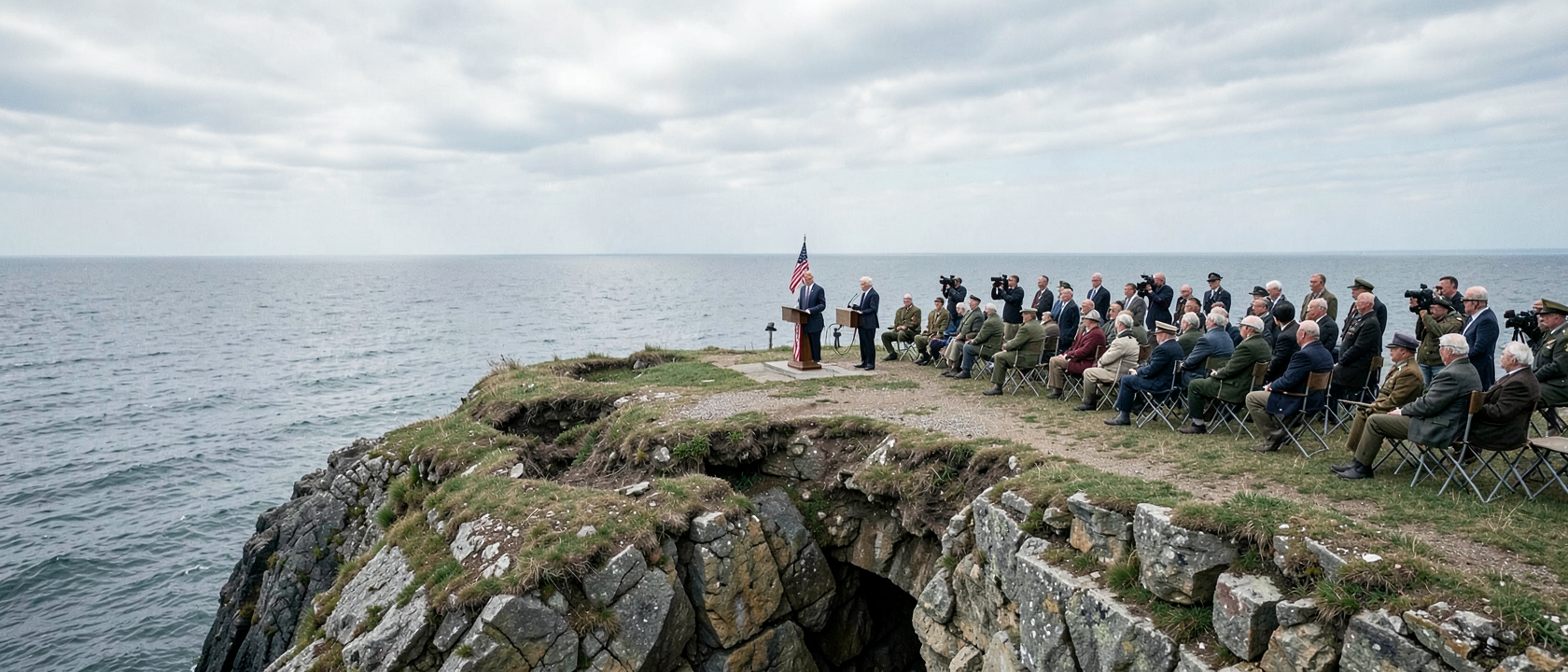
On the morning of June 6, 1984, Ronald Reagan stood on a stretch of cliff above the Normandy coast in France and spoke to a group of old men seated in front of him. Forty years earlier, at dawn on June 6, 1944, a force Reagan’s prepared remarks put at 225 Rangers had, in his words, “jumped off the British landing craft and ran to the bottom of these cliffs” at Pointe du Hoc, a promontory roughly three miles (some accounts say closer to four miles, or 5 to 6.5 kilometers) west of Omaha Beach. American troops did not fully secure the position until June 8, 1944, after two more days of fighting.
By one frequently cited count, 62 survivors of that assault sat before Reagan at Pointe du Hoc in 1984. His remarks, titled “The Boys of Pointe du Hoc” and written by his speechwriter Peggy Noonan, were broadcast to American television audiences on the day itself, timed to the 40th anniversary of the landings. The setting did the arguing for itself: a sitting president, standing on ground his country’s soldiers had taken under fire, addressing the men who had taken it.
A Primary Turning Ugly
While Reagan spoke in Normandy, the Democratic Party was still tearing itself apart at home. Walter Mondale and Gary Hart had been locked in a delegate fight through the spring of 1984, and the contest would not be settled until the party’s convention later that summer. Reagan himself would not formally open his own re-election campaign until August, when the Republican National Convention renominated him.
The overlap between his European trip and the closing, bitterest weeks of the Mondale-Hart race was, according to a later academic reconstruction of the trip’s planning, largely a matter of timing rather than a deliberate trap laid for the Democrats. Coincidence or not, it worked in Reagan’s favor. Every dollar and every reporter tied up covering a primary fight was a dollar and a reporter not available to question an incumbent who was, at that same moment, photographed among heads of state and D-Day veterans on the far side of the Atlantic.
Ten Days in Europe
Reagan’s tour ran from June 1 to June 10, 1984. It opened in Ireland, where he visited his ancestral home on June 1 and 2, and it closed in London with the G7 Economic Summit, a gathering that in 1984 brought together the leaders of the United States, Britain, France, West Germany, Italy, Canada, and Japan. The Normandy address fell on June 6, roughly in the middle of the trip.
Somewhere in that stretch, according to a contemporary account in TIME magazine, Reagan had a private lunch with Queen Elizabeth II and Prince Philip at Buckingham Palace on a Tuesday, along with a low-key dinner with Prime Minister Margaret Thatcher. TIME’s account described the royal lunch as coming before the Normandy speech; a fuller scholarly reconstruction of the week’s schedule leaves the exact order of the London stops less than fully settled, since the G7 sessions themselves ran later in the week. What is documented is that a monarch’s table and a war memorial both ended up on the same ten-day itinerary, broadcast to American viewers within days of each other.
CBS correspondent Lesley Stahl read the sequence as deliberate. “When it comes to political one-upmanship, Ronald Reagan is a master,” she said at the time. “Upstage the winner of the California primary, piece of cake: have lunch at Buckingham Palace with the Queen of England.”
What It Cost, What It Bought
There is no ledger of expense or casualty attached to Reagan’s 1984 tour in the record consulted here, because there was none to keep. This was theater, staged on ground where the actual cost, in June 1944, had been paid by other men decades before. The tour’s price was political, not physical, and its currency was attention.
What it bought, by the reading of journalists at the time and historians since, was an image that outlasted the news cycle around the Democratic scramble: a president standing among veterans on a cliff his country’s soldiers had climbed under fire, followed within days by summit photographs alongside six other heads of government, while his eventual challenger was still being decided at home. Reagan was formally renominated at the Republican convention in August 1984 and won re-election that November.
Whether the June trip actually moved votes is not something the sources here can show. The claim that it “helped secure” his re-election is a judgment made after the fact, not a documented chain running from Pointe du Hoc to the ballot box. No on-the-record complaint from Mondale or Hart survives alongside Stahl’s assessment; hers remains the only contemporaneous read of what the trip was built to do. What’s left is a photograph of a president among old soldiers, a schedule constructed for television, and an election won five months later. The connection between them is plausible. It was never proven.