
Six Clerks, Every Night
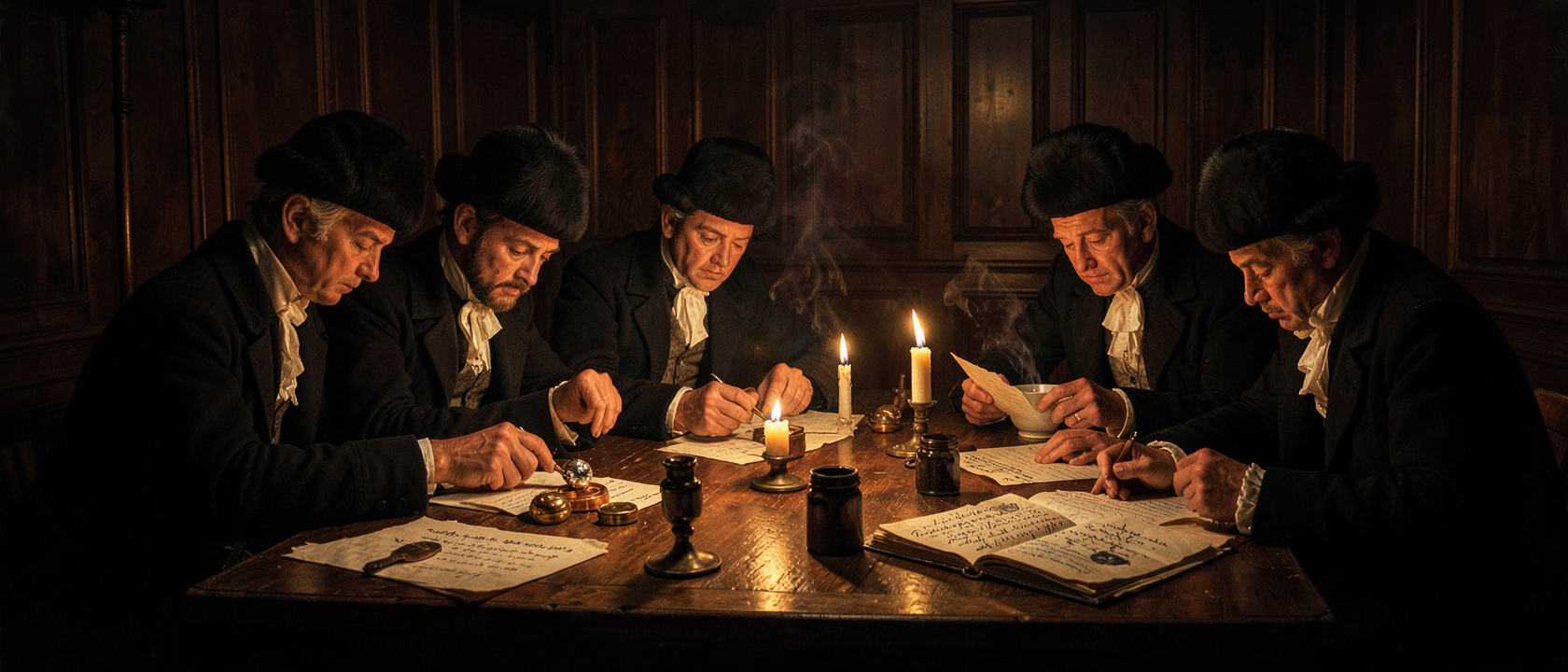
Somewhere in late-eighteenth-century Paris, behind the public counters of an ordinary post office, a small room served a second function that had nothing to do with delivering mail. Six clerks worked there after dark, by candlelight, reading letters not addressed to them.
The process was deliberate. A clerk pressed a small ball of mercury against a wax seal, capturing an impression before the letter was opened. Steam from hot water then softened the seal enough to lift it without visible damage. The contents were copied by hand, the original seal replicated using the mercury impression, and the letter returned to the postbag. From the recipient’s side, nothing had happened.
What arrived first, though, was a copy. Transcripts accumulated through the week and were passed to the postmaster general, who carried them each Sunday to Versailles for the king’s personal review. The whole arrangement was not a wartime improvisation; it was a standing operation with fixed personnel, a fixed weekly rhythm, and a fixed destination. The French called it the cabinet noir, or in official usage the cabinet du secret des postes.
A European Architecture
Paris was not the origin of this practice, and it was not alone. The roots of that operation stretched back more than a century. By the 1700s, every major European power maintained some version of the black chamber inside its postal system.
The Thurn und Taxis family, who held the imperial postal monopoly in the Holy Roman Empire under a privilege granted by Emperor Karl V in 1516, had infrastructure threading through much of the continent. Academic literature identifies their Brussels post office as arguably the first verifiable black chamber in Europe, operating during the Thirty Years’ War (1618–1648) under postmistress Alexandrine of Taxis, who held the role from 1628 to 1646. Controlling the routes meant first access to the letters moving along them.
In France, Cardinal Richelieu systematized mail surveillance roughly between 1626 and 1633, under Louis XIII. It was under Louis XV (reigned 1715–1774) that a separate, purpose-built office was formally established with its own staff and budget. One unconfirmed source puts the annual allocation at 50,000 livres drawn from Ministry of Foreign Affairs funds.
Austria ran its equivalent at the Hofburg Imperial Palace in Vienna under the name Geheime Kabinettskanzlei. Its timetable was precise: letters to foreign embassies arrived at 7 a.m. secretaries melted the seals while stenographers copied contents in parallel, and by 10 a.m. the resealed letters were back at the central post office. The operation peaked during the reign of Maria Theresa (1740–1780). Austria also sold intercepted intelligence to other European powers.
Britain’s equivalent, the Secret Office of the General Post Office, ran from around the 1660s to 1844. By the mid-1700s, cryptanalysis had become an organized government function, with specialists breaking ciphered letters that interception alone could not read. A postal route built to move correspondence had become the infrastructure through which states moved intelligence.
What the Sender Did Not Know
A diplomat writing to his court, a merchant reporting commodity prices, a private citizen writing to family: all sealed their letters with the same expectation. The wax would remain unbroken until the intended recipient opened it. That assumption was structurally false, and the sender had no mechanism for knowing it.
A letter whose seal had been lifted by steam and closed again with a forged impression was indistinguishable from one never touched. It became a document with two readers: the intended recipient and the state. The content did not have to be incriminating to become useful. The danger was structural: once a state possessed both the mechanism and the will to intercept, every sealed letter in circulation became a potential intelligence product.
By 1789, postal surveillance under the cabinet noir was listed among the grievances brought to the Estates General. Some correspondents eventually developed counter-measures, grains of sand or poppy seeds placed inside sealed envelopes, which would fall loose if the letter had been opened and resealed.
The Bill
No one who sent a letter through a post office in this period paid a financial charge for its interception. The cost ran in a different currency: a civil assumption, letter by letter, that a sealed message belonged to the sender and the recipient alone. That assumption had no legal protection in most European states and no enforcement mechanism. It existed as a convention built into the act of sealing an envelope, and the system worked precisely because that convention was trusted.
The invisibility was not incidental to the design. It was the design. Every letter returned to the postbag with its seal intact was a demonstration that the operation had succeeded. The measure of its effectiveness was the absence of any sign that it had functioned at all.
Most of Europe’s black chambers closed in the mid-nineteenth century under pressure from public opinion and a growing argument that reading private mail was an infringement of personal freedom. Austria and France ended their operations in 1848. Britain’s Secret Office had been effectively wound down after 1844, when a parliamentary scandal revealed that the government had opened the letters of Italian nationalist Giuseppe Mazzini, then living in exile in London, at the request of the Austrian ambassador. The exposure came not through any internal failure of the interception system but through Mazzini’s own counter-measures: he had placed poppy seeds and grains of sand inside his envelopes and noticed the markers were gone on receipt.
The chambers closed. The postal infrastructure they had occupied remained. The assumption of privacy in a sealed letter had been broken in practice for the better part of two centuries before it acquired legal protection worth the name.
What the Record Does Not Say
The sources do not name the monarch receiving the Sunday reports at Versailles. The late-eighteenth-century frame points toward Louis XVI, but the materials consulted here do not confirm that. How long the specific Paris operation ran, whether it was formally closed and by whom, and the names of any clerk or official involved are absent from the accessible record.
The continental scope of the black chamber system is attested in historical literature but not mapped with precision. Which cities ran full operations, which had partial arrangements, and whether any recipient successfully identified a tampered seal go unaddressed. These are not minor omissions in an otherwise complete record. They are the record. The archives that would answer these questions either were not kept, did not survive, or have not been examined for this purpose.