
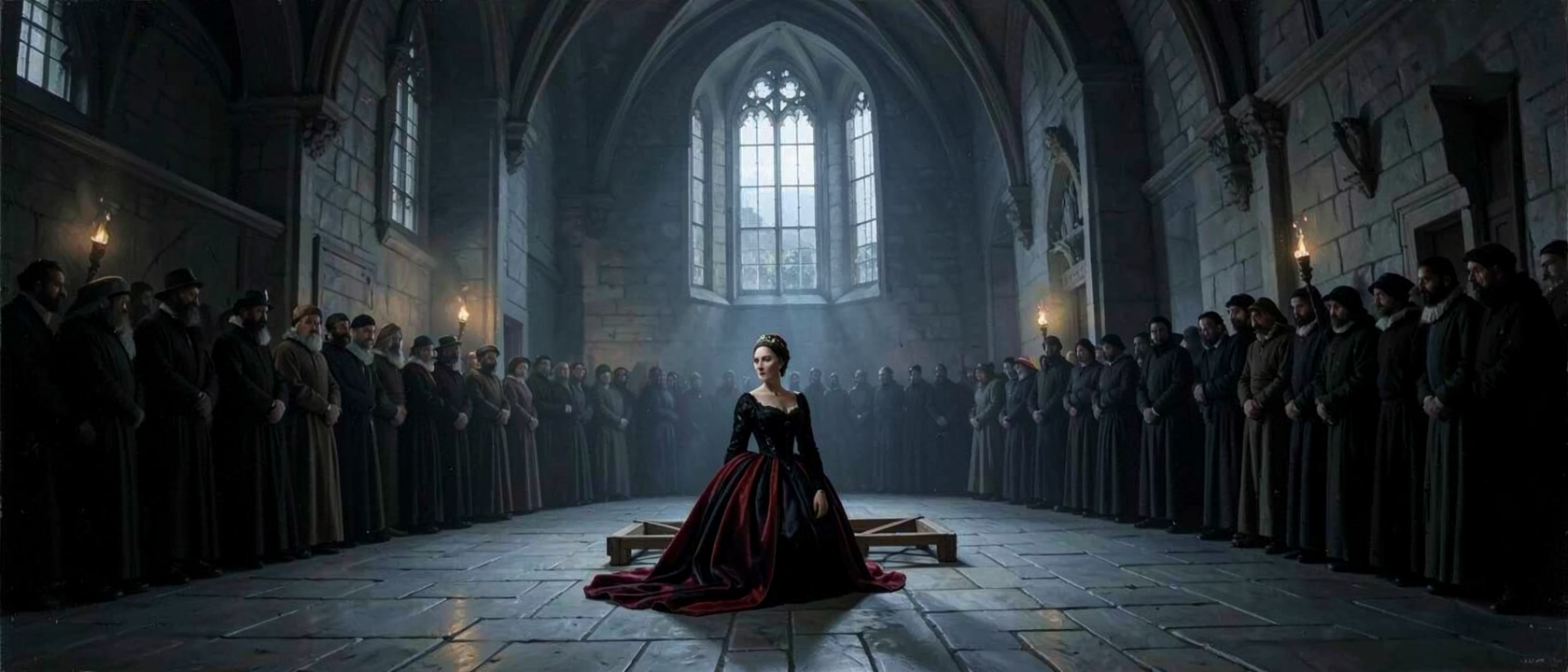
Fotheringhay, Before Dawn
Around two in the morning on February 8, 1587, Mary Stuart sat down to write a letter. She was forty-four years old, confined to Fotheringhay Castle in Northamptonshire, England, and she had been informed the night before that she would be executed that morning. She had been a prisoner in England for approximately nineteen years.
The letter ran to four pages, written in French, addressed to Henry III of France, the brother of her first husband, Francis II, making him her brother-in-law. She signed it: “Your very loving and most true sister, Mary R.” It was the last document she composed.
What the Letter Said
Mary did not write as a woman condemned for treason. She wrote as a Catholic queen condemned for her faith and for asserting her God-given right to the English crown. The charge on the record was high treason; the letter reframed it entirely.
She told Henry she had been denied the right to make that reframing publicly at the scaffold. Elizabeth I’s government had removed her Catholic chaplain and refused to allow her to state, before the assembled witnesses, that religion was the true cause of her death. The letter served as her alternative platform: if she could not speak it from the scaffold, she would write it to a king.
The requests were practical as well as devotional: prayers for her soul, wages for unpaid household servants, debts honored in France. Her physician, Dominique Bourgoing, carried the letter out of England after her death, delivering it to Henry III in late 1587.
The document is simultaneously a personal farewell, a Catholic devotional act, and a political argument, all three pointing toward the same claim: that what was about to happen was martyrdom, not execution for conspiracy.
Nineteen Years in the Making
The letter was the final, most concentrated act in a pattern running since 1568. Mary had fled Scotland after being forced to abdicate the Scottish throne on July 24, 1567, her infant son James becoming James VI in her place. She crossed into England seeking Elizabeth’s protection and was imprisoned instead, held at various locations before being confined to Fotheringhay. Across those nineteen years she wrote regularly to Catholic powers on the Continent, maintained Catholic devotional practices, and consistently positioned herself as a queen persecuted for her faith rather than a political prisoner held for reasons of state.
Scholars have noted that this image management was deliberate and sustained. Whether it reflected genuine piety, political calculation, or both is a question the surviving record does not resolve. The February 8 letter was less an improvisation under pressure than the sharpest statement of an argument she had been making for nearly two decades.
The Scaffold, and After
Mary was beheaded in the Great Hall of Fotheringhay Castle at around eight in the morning on February 8, 1587, before approximately 300 witnesses. She dismissed the Protestant minister offered to her and prayed aloud in Latin. When her outer garments were removed, the clothing beneath was crimson, the liturgical color of martyrdom in the Catholic Church. Her clothing was burned afterward to prevent supporters from keeping relics.
Bourgoing carried the letter to France, where it circulated among Catholic courts across Europe and was received not as the correspondence of a convicted traitor but as a martyrdom text. Mary’s request that her body be sent to France for burial was denied by Elizabeth I. Her son James, who became James I of England in 1603, ordered her reburial at Westminster Abbey in 1612. The letter passed through the French royal archives, then the Scots College in Paris, was dispersed during the French Revolution, purchased in 1917, and presented to the Scottish nation in 1923. It has been held by the National Library of Scotland since 1925, catalogued as Adv.MS.54.1.1.
What We Cannot Settle
In 1586, Anthony Babington led a Catholic conspiracy to assassinate Elizabeth I and place Mary on the English throne. Sir Francis Walsingham’s intelligence network intercepted coded letters between Babington and Mary, smuggled through a beer barrel. That correspondence became the prosecution’s core evidence at Mary’s trial, held at Fotheringhay on October 14 and 15, 1586, before 36 English nobles. Mary denied the charges and disputed the court’s authority to try a foreign queen. On October 25, 1586, the commission found her guilty of high treason. Elizabeth I signed the death warrant on February 1, 1587.
The integrity of that evidence has been challenged: some historians argue that at least one postscript in the cipher letters was forged or altered by Walsingham’s agents. The historical record offers no clean resolution, there is a credible case that Mary had some knowledge of Babington’s intentions, and an equally credible case that the evidence was manipulated. Neither position has been definitively closed.
What the letter establishes without ambiguity is how Mary chose to interpret her own death and how she wanted others to interpret it. The martyrdom narrative she set down in those early-morning hours proved durable across generations. The letter is not evidence of innocence. It is evidence of authorship: a woman who composed, at two in the morning on the last day of her life, a document that would prove more durable than almost anything else she left behind.