
What Dr. Dixon Received
According to a memorial published in the Illustrated Police News on August 29, 1885, a woman named Annie Parker died in the infirmary of the Greenwich workhouse. She was 38, per that account; one other source gives her age as 35, and the newspaper account is preferred here. The cause was consumption. She had spent the better part of two decades cycling through London’s prisons and workhouses, and by the time she died she had been taken into custody more than 400 times.
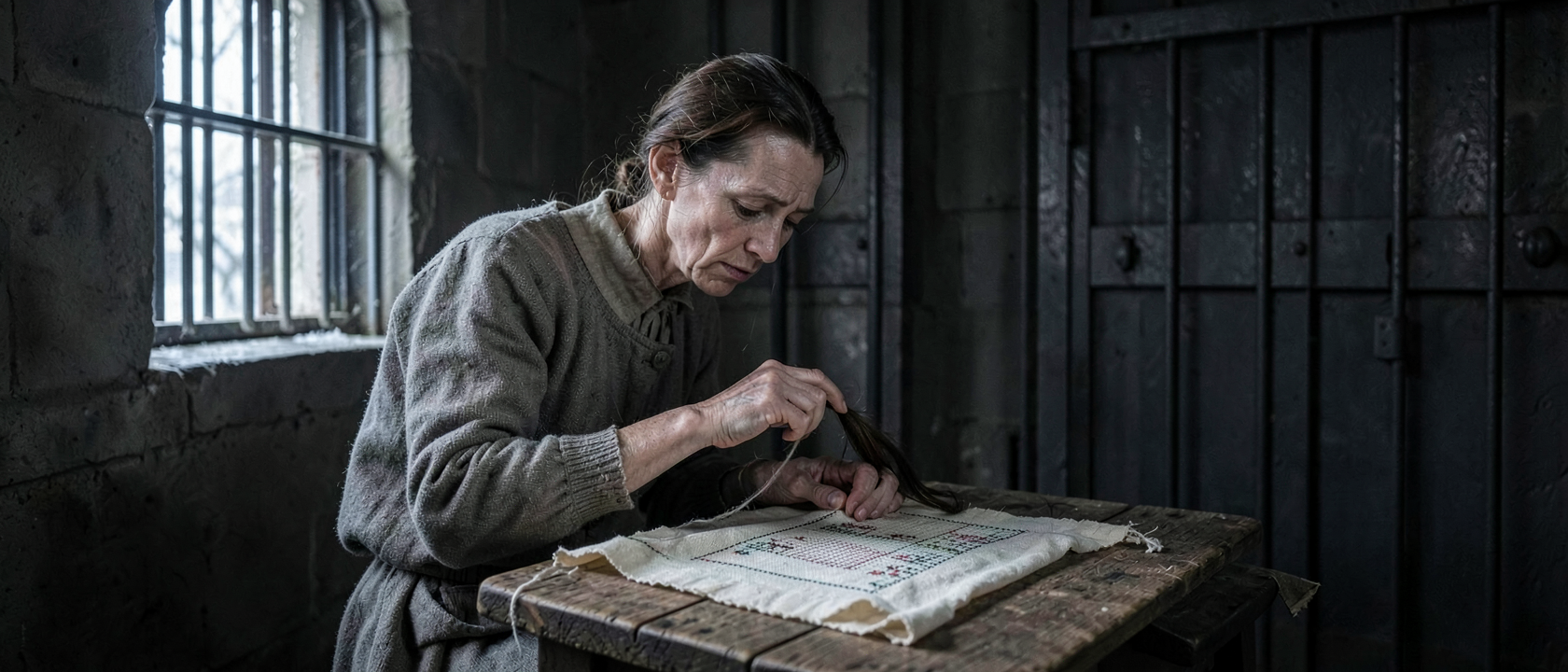
Before she died, she handed a sampler to Dr. Dixon, the assistant medical officer on duty. The piece was lace-bordered, stitched on bleached linen, and worked not with thread but with strands of her own brown hair. It was not the first she had made, and Dr. Dixon was not the first recipient. It was, as far as the record shows, the last.
What the Charge Sheets Left Out
Parker’s exact birthplace is unknown, as are her parents. She was closely associated with Deptford, in southeast London, and was born around 1847. In the January 27, 1872 edition of the Woolwich Gazette, she stated she had no father and a “bad” mother, though no independent record corroborates that account.
She married Thomas Parker, whose occupations varied and who was listed as a stationer at his death. On August 24, 1872, the Kentish Mercury reported Thomas charged with assaulting Annie, leaving her bleeding from the mouth with two teeth loosened. He died on January 6, 1879, aged 41, and was buried in the churchyard of St. Paul’s, Deptford.
Parker bore four children, each delivered inside Maidstone Gaol in Kent. All four died. An April 20, 1878 article in the Kentish Mercury recorded her stating that her fourth child had been born at Maidstone not long before publication. The charge sheets recorded none of this. They logged offenses: drunkenness, breaking windows, robbery, an attempted suicide for which she was sentenced to two years’ hard labor. Whether the bereavements and violence bore directly on her drinking is a reasonable inference that primary research frames as hypothesis. No surviving document makes the connection explicitly.
How the Numbers Compounded
From around 1871 onward, the pace of Parker’s arrests began to be measured in ways the records preserved. In the 12 months preceding January 1872, she had been in custody roughly 20 times. By 1877, a Greenwich workhouse register listed her as having no occupation, no home, and no friends.
In the 365 days before one documented imprisonment at Maidstone in 1879, she had spent an estimated 350 of them behind bars. She had also been released four months early from a two-year hard-labor sentence on the condition that she emigrate to America. She returned to England within a week.
It was during that 1879 Maidstone imprisonment that the earliest known hairwork piece was produced. Its inscription reads: “Come unto me all ye that labour and are heavy laden and I will give you rest / Annie Parker / Done by her in fond memory of Thomas Parker / Who died Jan 6 79.” The samplers were rectangles of bleached linen, approximately 1.5 ft (45 cm) in length, worked in cross-stitch and crochet, with occasional passages in red, light green, or colored thread alongside the brown hair. How she obtained linen, needles, or hooks inside prison is not accounted for anywhere in the surviving record.
What Horsley Showed and What the Papers Said
On June 23, 1882, the Reverend John William Horsley, chaplain at Clerkenwell Prison from 1876 to 1886, displayed one of Parker’s hair crochet works as an example of prisoner craftsmanship. A piece was also displayed in a private parlor belonging to a man identified only as Mr. James. A pin cushion worked in hair, stitched at its corners with the words “Prudence,” “Justice,” “Fortitude,” and “Temperance,” was donated by Horsley to the Metropolitan Police Crime Museum in 1884, according to one account not verified against museum accession records. The latest known dated sampler was produced in 1882.
After Parker’s death, newspaper coverage praised her conduct inside prison and described her as well-educated. No surviving record supports or denies it. Parker had stitched Charlotte Elliott’s hymn “My God, My Father, While I Stray,” first published in 1834, into multiple samplers. On December 22, 1883, the Sydenham and Penge Gazette recorded her saying: “The Almighty is good to me, if other people ain’t.”
Who Paid
Victorian law provided no practical protection from habitual assault that a working-class woman could readily invoke. No institutional treatment for habitual drinking existed. The same courts that sentenced Parker to hard labor for attempted suicide offered early release only on the condition that she leave the country. She came back within a week, which the record notes without explaining what she returned to.
The costs were borne by Parker. Six textile objects survive, five samplers and one pin cushion, each worked in her own hair, and together they constitute the most sustained record of her inner life that exists.
The Gaps the Archive Cannot Close
Parker’s exact birthplace and parentage remain unknown. The relationship between the deaths of her four children, the documented assaults by Thomas Parker, and the drinking that generated more than 400 arrests is, as art historian Isabella Rosner noted in her 2024 study of the surviving objects, an interpretive hypothesis. No surviving prison or workhouse record explains how Parker obtained the materials she used.
At least half of the surviving pieces are held in private collections, including some formerly or currently held by Witney Antiques in Oxfordshire. The remainder are split between the City of London Police Museum and the National Justice Museum in Nottingham. The full corpus has never been publicly assembled or subjected to systematic comparative study. What Parker intended by any of it, no document records.