The Comfortable Radical
Henry Gaylord Wilshire was born in Cincinnati on June 7, 1861, into the kind of family where money arrived before ambition was required. His father was a banker. Wilshire spent a year at Harvard, 1880 to 1881, without completing a degree, and moved through a series of ventures before settling in Los Angeles in 1884.
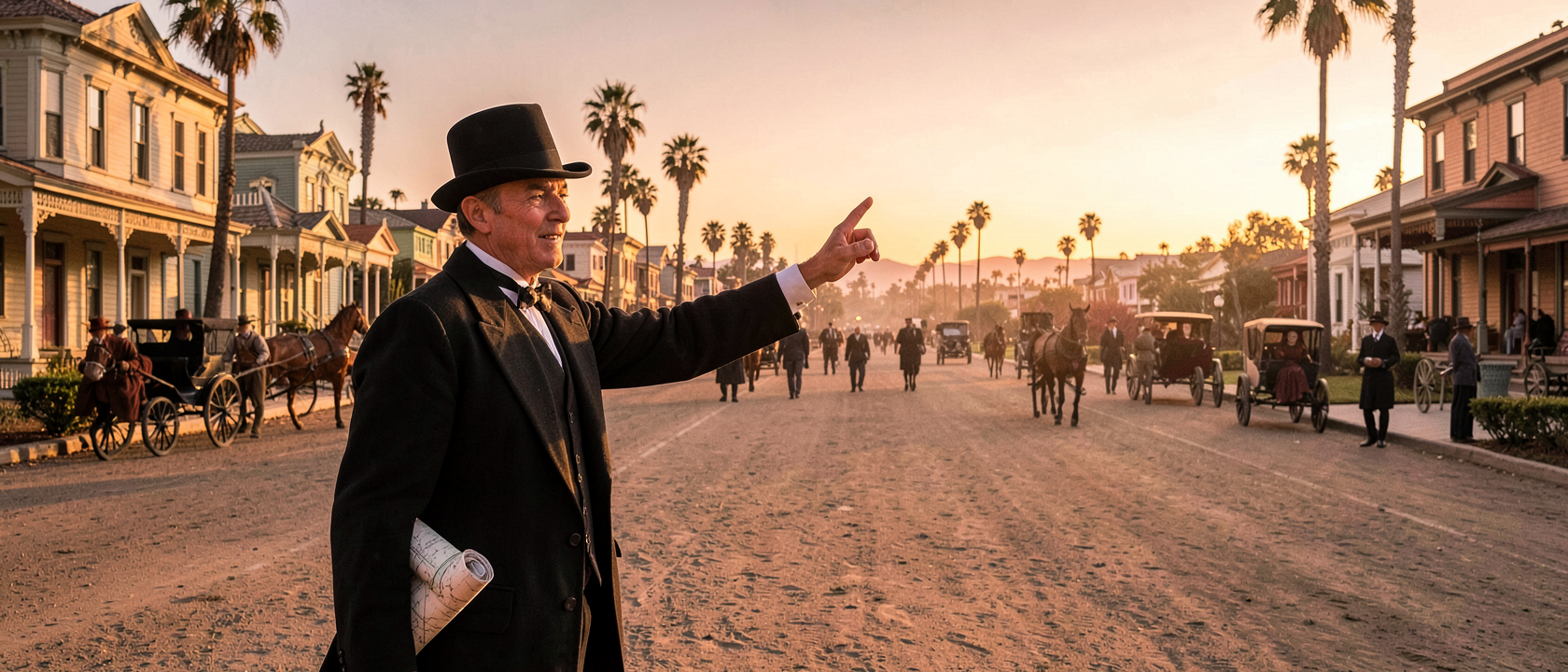
The 1880s were boom years in Los Angeles, and Wilshire arrived early enough to benefit. In 1887 he bought a 35-acre barley field west of Westlake Park (now MacArthur Park) for $52,000. He donated a strip of it, 120 feet (37 meters) wide and 1,200 feet (366 meters) long, to the City of Los Angeles for a public boulevard, with conditions attached: the road would carry his name, and railroad lines and commercial trucking would be barred from it. The boulevard first appeared on a city map under that name in 1895.
Also in 1887, he declared himself a socialist. He never explained precisely why. Wilshire did once claim he had joined a Nationalist Club partly because he found the club’s secretary attractive, but that explanation, offered in passing, settled nothing about the deeper commitment that followed it.
The Campaigns and the Losses
From 1890 onward, Wilshire pursued electoral politics with more persistence than result. He ran for Congress from California’s 6th district that year on a platform calling for the abolition of poverty, an eight-hour workday, and the nationalization of railroads, telegraph lines, and public utilities. He was among the first Americans to run for Congress on a socialist ticket. He lost. In 1891 he stood for California Attorney General as a Socialist Labor Party candidate and lost again.
In 1894 he was nominated to stand for the British Parliament but had to return to the United States before the election could take place. In 1900 he ran for Congress from California a second time and was defeated. In 1902 he stood for the Canadian Parliament, without success. In 1904 he ran for Congress from New York and lost. The defeats were not close enough to be documented as near-misses. They were simply losses, each one self-funded, each one stacking another layer of expense onto a man who was financing a vision with his own capital.
Wilshire’s Magazine and What It Published
In December 1900 Wilshire launched a publication in Los Angeles called The Challenge. It ran for at least forty issues before evolving into Wilshire’s Magazine (also issued as Wilshire’s Monthly Magazine), edited from New York. At its peak the magazine reached a circulation of 300,000, which made it, by one account in secondary sources, the largest-circulation socialist periodical in American history.
The contributors were not peripheral figures. Jack London, Upton Sinclair, Karl Kautsky, described in the historical literature as the world’s preeminent Marxist theorist of the period, and George Plekhanov, credited as the founder of Russian Marxism, all appeared in its pages. The editorial line was uncompromising: Wilshire had no use for gradualists or Fabian incrementalists. Sustaining that argument in print, month after month, at that scale, was not a financially viable enterprise. The magazine ran at a deficit, and Wilshire absorbed the losses personally, on top of years of self-funded campaigns that had returned nothing at the polls.
The Postal Ban, the Loophole, and the Sarcasm
The July 1903 cover of the magazine announced, in print, that it had been exiled to Canada by order of the US Postmaster General. The federal government’s mechanism was straightforward: deny a publication cheap second-class mailing rates and its distribution model collapses. Wilshire’s response was equally direct. He moved printing operations to Toronto, exploited a provision allowing foreign-produced periodicals to enter American mail, and kept publishing.
By April 1904 the magazine was back in US production. That issue credited President Roosevelt on the cover for permitting the return. The credit was sarcastic, a setback converted into a publicity event, with the opponent’s name in large type on the front page.
How the Magazine Finally Died
By 1909, with five completed electoral defeats behind him and the magazine still running deficits, Wilshire had turned to stock sales in a gold mine to keep the operation solvent. That made six losses in all once the 1909 Los Angeles City Council race was added to the ledger. Readers and supporters bought shares in the mine. The venture was later ruled fraudulent. Whether Wilshire understood at the time that the mine could not support what he was promising, or whether he was a convinced speculator who drew others into a loss he could not himself see coming, is a distinction the historical record does not resolve. In 1915, Wilshire’s Magazine folded. The money was gone.
What He Left, and What We Don’t Know
After 1915, Wilshire tried citrus farming in Pasadena, then returned to real estate. He also developed and marketed a device called the I-ON-A-CO, an electric belt he promoted as capable of treating cancer, diabetes, baldness, and constipation, among other conditions. Between 1925 and 1927, approximately 50,000 of these devices were sold. He died on September 7, 1927, in New York, from kidney disease, destitute. The American Medical Association moved to condemn the I-ON-A-CO; Wilshire died before the formal condemnation was published.
The boulevard carrying his name had, by then, grown well past the four original blocks he had donated. It now runs 15.83 miles from downtown Los Angeles to Santa Monica, through Beverly Hills and some of the most expensive real estate in the country. Two things about Wilshire himself remain unresolved. His biographer Mark W. Nelson argues that Wilshire was never a millionaire in any verifiable sense, despite the “millionaire socialist” label he applied to himself throughout his public life. And no account establishes why, in 1887, he committed to socialism in the first place. The irony of his name on that particular address is plain. Whether it was anyone’s intention is another matter entirely.