
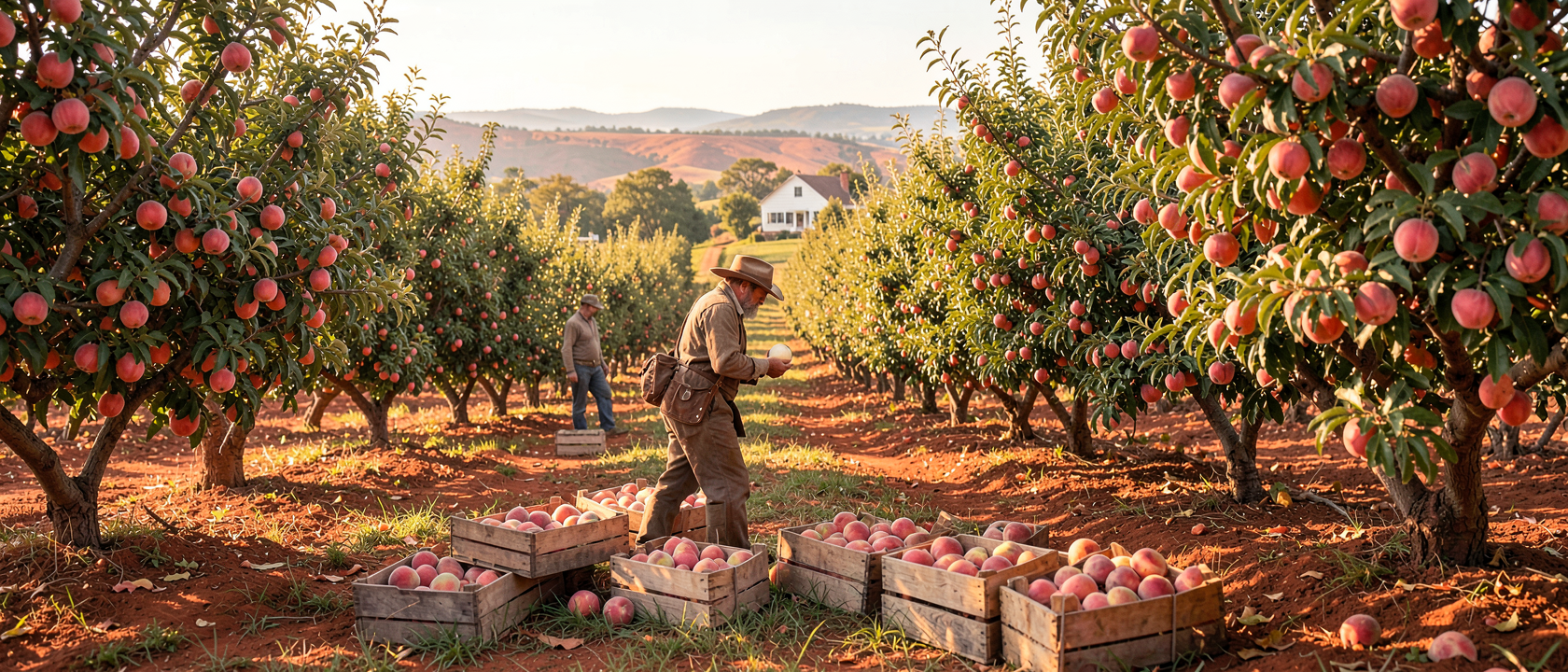
A Peach Out of Ruined Cotton Fields
In 1870, in the peach country around Marshallville, in Macon County, Georgia, a farmer named Lewis A. Rumph bred a new variety of peach. His family already had peaches in the ground; relatives had set out budded trees near Marshallville as early as 1857. Rumph himself worked as a farmer and nurseryman, not as someone tinkering for pleasure. He needed a peach that would actually sell.
The story often attached to that date is that the boll weevil, a cotton-eating beetle, had already wrecked Southern cotton fields and pushed farmers toward alternatives like peaches. That part doesn’t hold up for 1870. The boll weevil did not reach Georgia until roughly the 1910s and 1920s, decades after Rumph’s peach was already established. What can be said more plainly is that peach growing expanded across Georgia in the years that followed, as farmers diversified their fields for reasons broader than any single pest.
What Rumph produced, a seedling traced back to the old ‘Chinese Cling’ peach, had white flesh threaded with red veining, a red blush on the skin, a firm texture that held together, and a freestone pit that let the flesh pull cleanly away from the pit. Growers who tasted it called it sweet and fragrant. One account holds that Rumph named it for a Georgia woman, Mrs. Belle Hall; another simply reads the name as a nod to the fruit’s looks. Either way, it went to market as the Belle of Georgia.
Why a Peach Had to Do a Cash Crop’s Job
A new peach could not live on flavor alone. Southern farms leaned hard on cotton, and any fruit that hoped to matter as a business had to do more than taste good on the tree. It had to travel. It had to reach a distant market days after picking, still firm enough to sell, and it had to hold its own against peach varieties already established and selling well in other regions.
That is the tension the Belle of Georgia carried from the start: judged twice, once by the people who ate it and once by the people who had to ship it and get it to a buyer before it spoiled. For a few decades it satisfied both. Later, only one of those two judges kept a say in the matter.
America’s Favorite Peach
By the close of the 19th century, the Belle of Georgia had become, by most accounts, the most popular commercial peach in the country. It outsold and outlasted established rivals of the day, among them the Mountain Rosy and the Amelia varieties, largely on the strength of its flavor and its ability to hold up in transit better than those peaches did. No production ledgers or sales counts survive to put a figure on how far ahead it ran. What survives is the same claim, repeated across separate accounts written years apart: this was the peach growers wanted to plant and buyers wanted to eat.
Following the Fruit West and South
By the early 1900s, the Belle of Georgia had moved well beyond Georgia. Growers were planting it in Texas, in California, and in Florida, and it was being sold nationwide under that name. This is the widest the variety’s commercial footprint would ever reach, no longer a Georgia specialty but a peach grown in four states and shipped across the country. No acreage figures survive, no count of orchards, no tally of shipments. Only the fact of the spread itself is on record.
Built for the Truck, Not the Table
As the 20th century wore on, commercial growers began moving away from the Belle of Georgia. The record does not give a year for when this started, or name the varieties that replaced it. What it does say is why: newer peaches were bred and chosen for how well they traveled and how they looked on a stand, not for how they tasted.
The irony sits right there in the sources. Advocates writing later for the Slow Food Foundation’s Ark of Taste project argued that in a blind comparison, few people would pick the flavor of the newer commercial peaches over the Belle of Georgia. That specific claim rests on a single source and was never an independently documented study, but the broader point recurs in more than one account: the peach that traveled better was, by most tellings, the peach that tasted worse. It won anyway.
Erased from the Supermarket
The consequences were plain enough. The Belle of Georgia, once the standard other peaches were measured against, dropped out of supermarkets and commercial farm stands. It did not go extinct. Trees of the variety still exist and still bear fruit. What disappeared was its place in the market, the wide commercial distribution that once carried it into stores in states where it had never grown.
The cost here isn’t measured in dollars or acreage lost, because no such figures survive. It is a variety with a documented reputation as the finest peach in the country losing its shelf space to fruit that simply traveled better, with no mechanism in the market built to protect a peach for taste alone.
Still Growing in Somebody’s Backyard
The Belle of Georgia did not vanish. It is still counted among the small number of old peach varieties kept alive by home growers and small orchardists rather than large commercial operations, especially in Georgia, where families still plant it, can it, and bake it into cobbler when it ripens in late summer.
That is not a comeback. It is a variety that kept going in the one place the market had no reason to look: a backyard tree, tended for how it tastes rather than for how well it survives a truck. That pattern shows up elsewhere too, the object kept in someone’s kitchen or garden long after it stopped being profitable, kept there simply because whoever grows it still prefers how it tastes.