
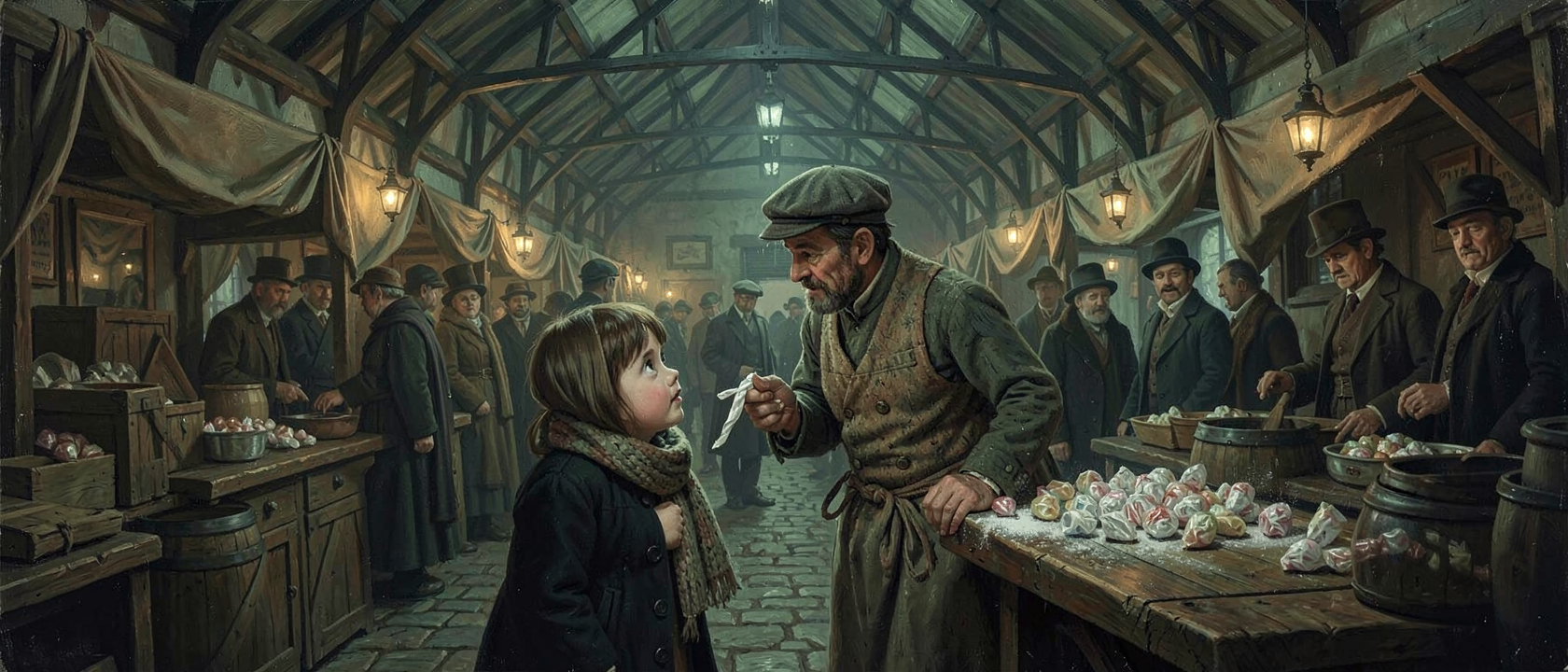
The Stall at Green Market
On the evening of October 30, 1858, a Saturday, William Hardaker set up his sweets stall at Green Market in Bradford, Yorkshire, in what is now Kirkgate Market. Locals knew him as “Humbug Billy,” an established fixture at the market rather than a manufacturer himself. He bought his stock wherever it was cheapest and sold it on.
That week he picked up a job lot of peppermint humbugs at a bargain price, the discoloration in the batch explained away as a minor flaw in the mix. It was payday for many of Bradford’s factory workers, and Hardaker moved about five pounds (2.3 kg) of the sweets that evening to people heading home with their wages in hand.
Three Weeks on the Job
The trouble had started roughly two weeks earlier, at a druggist’s shop in nearby Shipley. Confectionery wholesaler Joseph Neal sent an employee to buy 12 pounds (5.4 kg) of “daft,” a cheap bulking powder, sometimes spelled “daff,” made from substances like powdered limestone and plaster of Paris. Adding daft to a sugar mixture was standard practice in the trade: it stretched the sugar further and cut the cost of a batch.
The regular druggist, Charles Hodgson, was ill in bed that day. He left the sale to his apprentice, William Goddard, who had been on the job for three weeks. Goddard went to fill the order and, from an unlabeled container that sat where the daft was normally kept, scooped out arsenic trioxide instead.
The arsenic went to sweet maker James Appleton, who worked for Neal. Appleton combined the full 12 pounds of arsenic trioxide with sugar, gum, and peppermint oil to make at least 40 pounds (18.1 kg) of lozenge mixture. He did not test the batch before shaping it into humbugs. Later chemical analysis found that each individual sweet carried enough arsenic to kill an adult, and some estimates put it at enough to kill two.
A System With No Safeguard
None of this began with a crime. Cutting sugar with daft was legal and ordinary, done across the confectionery trade to keep prices down. The problem was that nothing in the system was built to catch a mistake once one occurred.
There was no rule requiring arsenic to be labeled differently from daft, no requirement that it be stored in a separate or distinctive container, and no register recording who bought it or how much. A sick druggist handed the counter to a novice with three weeks of experience. A sweet maker who trusted the delivery mixed a full batch without checking it. Each step was, on its own, unremarkable. Together they were enough.
Halloween Night
On the morning of October 31, 1858, two children were found dead in Bradford. At first the deaths were put down to natural causes, ordinary enough given how common child mortality and cholera already were in the city. Accounts differ slightly on the children’s exact ages, with one record giving eight and eleven, another nine and eleven.
Through the day, more deaths followed. Police found two brothers dead at 30 Jowett Street, ages two and five. Their father, Mark Burran, suspected the peppermint sweets he had bought at Green Market the evening before. His suspicion was confirmed when another man tried the candy and fell ill himself.
That night, police officers and bell ringers moved through Bradford’s streets warning people not to eat the humbugs, and official notices went up on walls around the city. Hardaker was found ill at his own home as well, having eaten one of his own sweets the night before.
The Bill
The final count came to 20 confirmed deaths: seven adults and 13 children, the youngest just 17 months old. Over 200 more people fell seriously ill from arsenic poisoning, though no source gives an exact figure for that total, only that it ran into the hundreds.
Tried and Acquitted
Goddard, Hodgson, and Neal were charged with manslaughter and stood trial at York Assizes in December 1858. All three were acquitted. The judge ruled that what had happened was accidental and that there was no case for any of them to answer.
Under the law as it stood, that was the correct outcome. There was no statute requiring arsenic to be labeled, stored apart from other powders, or logged at sale. Prosecutors could not point to any rule that had been broken, because no such rule existed. Twenty people were dead, and no law had been broken doing it. What became of Goddard, Hodgson, and Neal after the acquittal is not recorded in the sources.
Closing the Gap, a Decade Later
Ten years later, in 1868, Parliament passed the Pharmacy Act, which received royal assent on July 31 and took effect on December 31 of that year. For the first time, named poisons had to be sold in distinctively colored, textured glass containers, clearly labeled, with shops required to keep a register of buyers’ names.
Curators Laura Sellers of the Thackray Medical Museum in Leeds and Kitty Ross of Leeds Museums and Galleries have linked the Bradford poisonings to that reform, though the connection is a contributing factor rather than a proven single cause; other poisoning cases and public pressure built toward it too, including an earlier and weaker Adulteration of Food or Drink Act passed in 1860. Even after 1868, arsenic itself stayed legal for ordinary household use, sold for years afterward in wallpaper, fabric, and cleaning products. The law closed one gap in the system. It left the substance itself in every home in Bradford.