
The Faint Image
Lacock Abbey, 1835
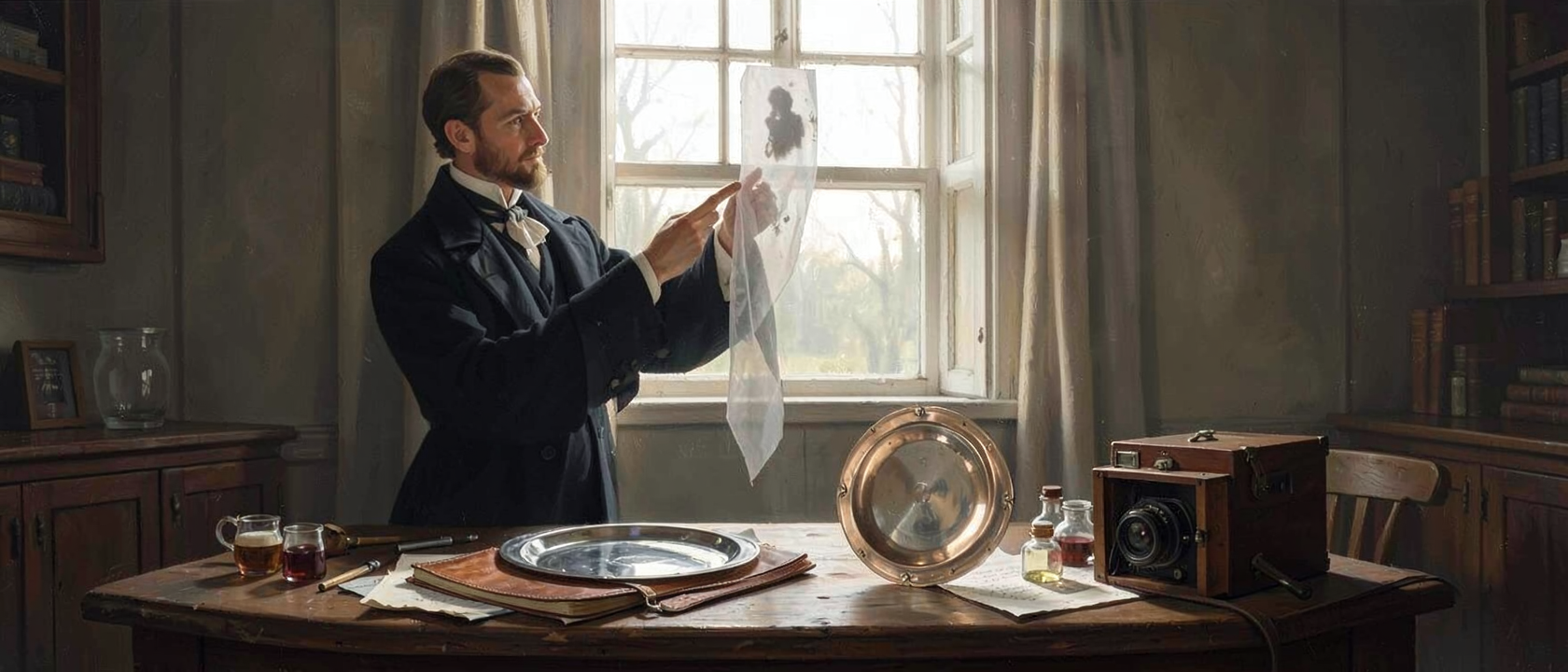
In 1835, William Henry Fox Talbot began pressing chemically treated paper against the windows of Lacock Abbey, his family home in Wiltshire, England. He had started, two years earlier, with a camera lucida, an optical drawing aid; when his attempts to sketch with it failed, he turned to paper coated with salt and silver nitrate, which darkens wherever light strikes it. Where an object blocked the light, the paper stayed pale. He called the results “photogenic drawings.”
Talbot was no stranger to disciplined work. Educated at Harrow and Trinity College, Cambridge, he had already published widely in mathematics, astronomy, and physics, and had briefly sat in Parliament from 1833 to 1834. Photography was one interest among several, and for years he told almost no one what he had found.
Then, in January 1839, word reached England that a Frenchman named Louis Daguerre had announced a way of fixing an image from nature. Talbot’s private discovery suddenly needed a public claim. On January 30, 1839, he read a paper titled “Some Account of the Art of Photogenic Drawing” before the Royal Society in London, racing to show he had captured light on paper years before anyone in Paris had spoken of it. The Society listened politely and declined to publish his findings.
The State Buys a Miracle
Paris, August 1839
Daguerre’s process fixed an image directly onto a silvered copper plate, producing one sharp, one-of-a-kind picture with no negative and no way to make copies. On August 19, 1839, the French government laid out the method to the Academy of Sciences and declared it a gift to the world, free of charge. In return, Daguerre received a lifetime pension, an estimated 6,000 francs a year, with a further 4,000 francs a year for Isidore Niépce, son of his late collaborator Nicéphore Niépce (one account puts Daguerre’s pension at 10,000 francs alone; the figure is disputed). Only in Britain and its colonies did the process carry a fee: Daguerre’s agent had quietly filed for an English patent on August 14, five days before the French giveaway.
Talbot had no pension and no comparable stage. What he did have, by 1841, was arguably the better process. The calotype produced a negative on paper, from which any number of positive prints could be made, the same principle behind photography to this day, and its exposure times fell from about an hour to minutes, then seconds. None of that translated into public reach.
The Man Who Fenced His Own Invention
London, 1840–1841
Talbot patented his developing process in 1840, then patented the refined version in February 1841, naming it the calotype from the Greek word for beautiful. By one account, he sold licenses for £20 apiece, later dropping the price to £4 for amateurs while asking working photographers for up to £300 a year, with an exemption for scientific research. Only two commercial licenses were ever sold. Beyond them, Talbot backed a single printing business, the Reading Establishment, run by his former valet, Nicolaas Henneman.
Patenting itself was not cheap: securing rights across England and Wales alone cost more than £100, worth over £8,000 today, and covering Scotland and Ireland required further fees. Talbot had spent that money securing exclusive rights to a discovery many felt belonged to the nation, and British amateurs noticed. The writer A. J. Stirling described real resentment among enthusiasts who felt shut out of a process their own country had produced, and the professor Robert Hunt went further, questioning whether some refinements in Talbot’s patent were truly his own or borrowed from other experimenters.
The Bill Comes In
Reading and London, 1846–1852
In 1846, the Reading Establishment ran a print job that came out badly, with prints that faded and failed. The business closed the following year, having never turned a profit. Talbot largely stepped back from photography after that, returning in 1852 only to sue a London gallerist for selling prints made with his patented technique, money spent defending a claim rather than earned from a sale.
By then Daguerre was gone. He had retired once the French state took over his process, spent his final years painting, and died of a heart attack on July 10, 1851, in Bry-sur-Marne, 7 miles (12 km) from Paris, having drawn his pension in comfort and left the invention’s fame behind him. Talbot was still in a London courtroom, fighting to be paid for his own.
The Exhibition That Embarrassed Him Into Letting Go
London, 1851–1852
The Great Exhibition opened in London in 1851 to showcase British industry to the world. Its organizing committee hired French photographers to document it, an awkward choice given that a British process had existed for a decade. The embarrassment reached far enough that, according to historian Geoffrey Batchen, committee members and the wider photographic community approached Talbot directly and asked him to loosen his patent so others could build on it. He agreed.
The change showed almost immediately. In 1852, the Society of Arts held its first photography exhibition, displaying an estimated 800 photographs, most of them calotypes. The innovation had been there all along, sitting behind a license fee. Once the fee came down, so did the wall.
What’s Still Argued
Historians’ table
Historians do not agree on how much of Talbot’s obscurity was his own doing. Geoffrey Batchen, an Oxford professor of art history who curated an exhibition of Talbot’s papers titled Bright Sparks: Photography and the Talbot Archive, frames the story around patent policy and the state support Talbot never had. Geoffrey Belknap, head curator at the UK’s National Science and Media Museum, calls the calotype a critically important innovation in its own right, whatever became of its inventor’s name. Others return to Robert Hunt’s older complaint, that Talbot’s claim to originality was never as clean as the patent suggested. This piece does not settle which weighs more; the sources do not settle it either.
Even Talbot’s own book, The Pencil of Nature, illustrated with his salted paper prints and issued in installments between 1844 and 1846, has no single fixed publication date in the record, a gap worth noting rather than smoothing over.
Talbot died at Lacock on September 17, 1877, at age seventy-seven, on the same estate where he had first watched an image gather on treated paper more than four decades before. He had published four books and twenty-seven scholarly articles across mathematics, Egyptology, botany, and philosophy. The process that made every modern photographic print possible carried his name on the patent. It did not carry his name into memory.