
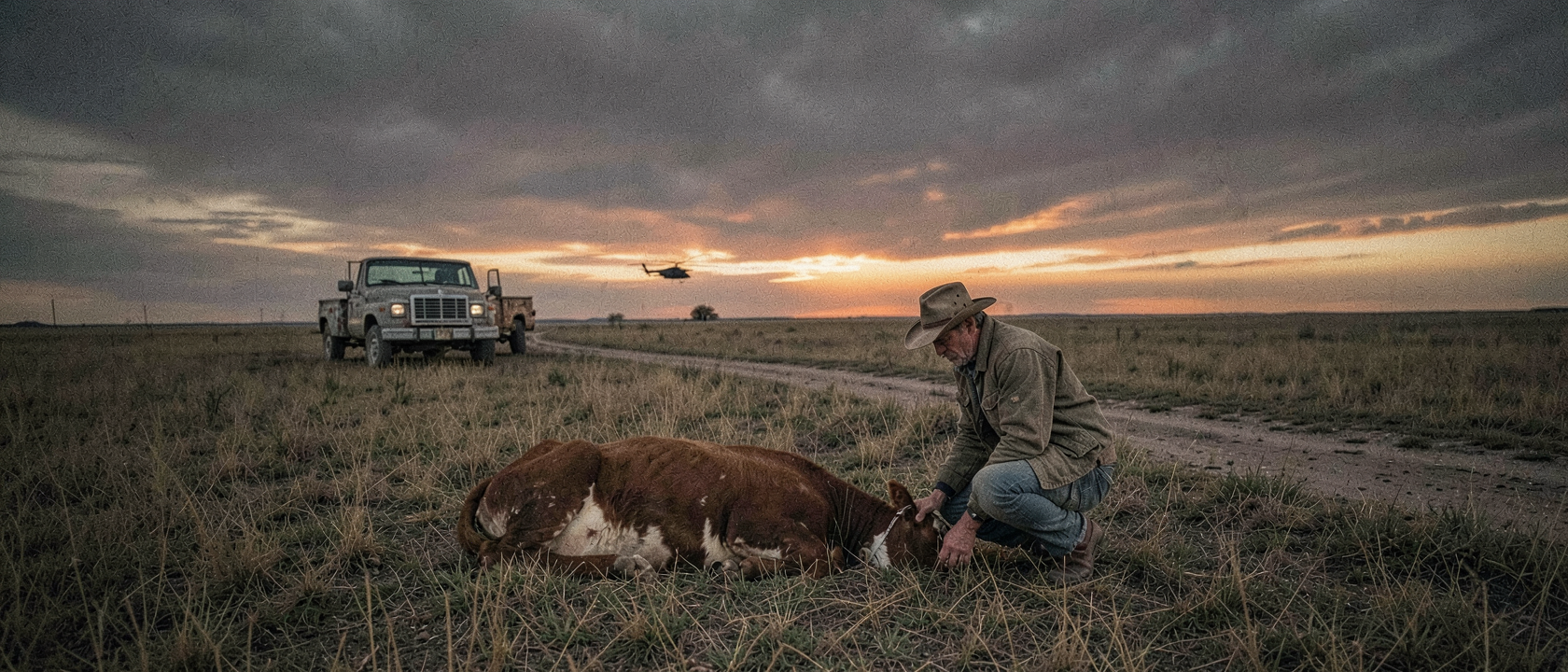
The Carcass in the Field
In 1973, ranchers across the American West and Midwest began finding something in their pastures that did not look like the ordinary business of death on the range. A steer would turn up dead with its eyes gone, its ears gone, its rectum and sex organs cut away. The edges of the wounds were clean. There was little or no blood pooled in the grass around the body, and no obvious tooth marks to the naked eye. To ranchers with no training in forensics or animal pathology, the missing parts and the tidy incisions looked deliberate, almost surgical. This was not one man’s story told once. It was reported again and again, across eleven states, by ranchers who had no way of comparing notes with one another.
The Wreck
The cattle were dying into an economy that was already failing the people who owned them. The early 1970s brought what many in the business called “the Wreck.” Inflation drove up the cost of feed, made worse by large federal grain purchases sent abroad to food-short countries, which pushed domestic grain prices higher still. New federal restrictions limited grazing on public land, land that small operations depended on more than the big ranches did. Then the Nixon administration froze meat prices to fight inflation, capping what a rancher could charge just as the cost of keeping an animal alive kept climbing. Small ranchers, without the lobbying weight of the large operations, absorbed most of the damage. Tellingly, the mutilation reports clustered in Colorado and New Mexico, states with a high share of small ranches, while Texas, which had far more cattle than anywhere else in the country, reported comparatively few. This was the ground the mutilation reports landed on: people already convinced that decisions made far away in Washington were working against them.
Theories Multiply
Newspapers picked up the story, and the explanations grew stranger by the season. Some pointed to UFOs. Others pointed to satanic cults. Ranchers increasingly leaned toward a different suspect: their own government, running some kind of secret biological or chemical weapons test on the herds. That theory was not pulled from nowhere. In March 1968, an Army aircraft testing the nerve agent VX at Dugway Proving Ground in Utah released the chemical at too high an altitude. It drifted roughly 27 miles (43 km) to Skull Valley, where it killed more than 4,500 sheep by the Army’s own compensation count, with press estimates running closer to 6,400. The Army did not publicly acknowledge the nerve agent was responsible until a report was made public in 1998. In the 1970s, ranchers only knew that the government had once quietly killed thousands of animals and said nothing about it. That history did not explain the cattle. It explained why the government seemed capable of it.
Shots at the Sky
The suspicion took a specific shape: unmarked helicopters. Ranchers reported seeing them near carcass sites, and some said the aircraft had chased them across their own land. In a handful of cases, ranchers fired on the helicopters. The response came from an unexpected quarter. The Nebraska National Guard raised the altitude of its training exercises from 1,000 feet (305 m) to 2,000 feet (610 m), specifically to stay out of range of ranchers who might shoot at low-flying aircraft. A rumor had produced a documented change in how a branch of the U.S. military flew its planes.
The Investigators Find Nothing
Law enforcement did investigate. The Colorado Bureau of Investigation examined carcasses and found no evidence that a human hand, or an instrument, had been involved. For most people, a finding of “nothing here” would close the question. Among ranchers primed by grazing restrictions, a price freeze, and the memory of Skull Valley, it did the opposite. An investigation that turned up no culprit was read as proof that the culprit had covered its tracks well. Absence of evidence became evidence of a cover-up. This is the point where the panic stopped being about dead cattle and became about whether an official finding could be trusted at all.
What It Cost
By the end of the decade, newspaper accounts put the number of reported mutilation incidents nationwide at more than 10,000. That figure comes from contemporary press coverage, not from any government tally or audited record, and it should be read as an estimate rather than a fact. The clearer cost is the less countable one: a rural population already squeezed by the Wreck came out of the 1970s with less trust in government agencies and law enforcement than it had going in, layered on top of financial strain that had never let up.
Coyotes, Magpies, and Badgers
The explanation that eventually took hold came from ordinary scavengers. Historian Michael J. Goleman’s research into the phenomenon found that coyotes, magpies, and badgers feed on a carcass in a predictable order, going first for the soft tissue: eyes, tongue, genitals, the rectum. Worked over by several animals across a day or two, that selective feeding can leave wounds that look clean-edged to anyone unfamiliar with how a carcass gets scavenged. Investigators who did not know the pattern mistook it for the work of a blade. Goleman also found that cattle death rates were no higher during the years of the panic than before or after it, which undercuts the idea that anything unusual was killing the animals at all. Veterinarians and larger, more experienced ranchers were skeptical of the mutilation theory from early on. That skepticism fell along economic lines: it was the smaller operations, already worn down by the Wreck, that were most likely to see a conspiracy in a dead cow.
What Isn’t Settled
None of this closes the file completely. Goleman’s account attributes the vast majority of cases to scavenger activity, not every single one, and it does not rule out other explanations for individual incidents that were never fully documented. The figure of 10,000 incidents remains what it always was, a press estimate from the 1970s rather than a verified record. What is settled is the shape of the episode itself: an economic squeeze that made a hidden hand feel more believable than a coyote, and a distrust that outlasted the panic which produced it.