
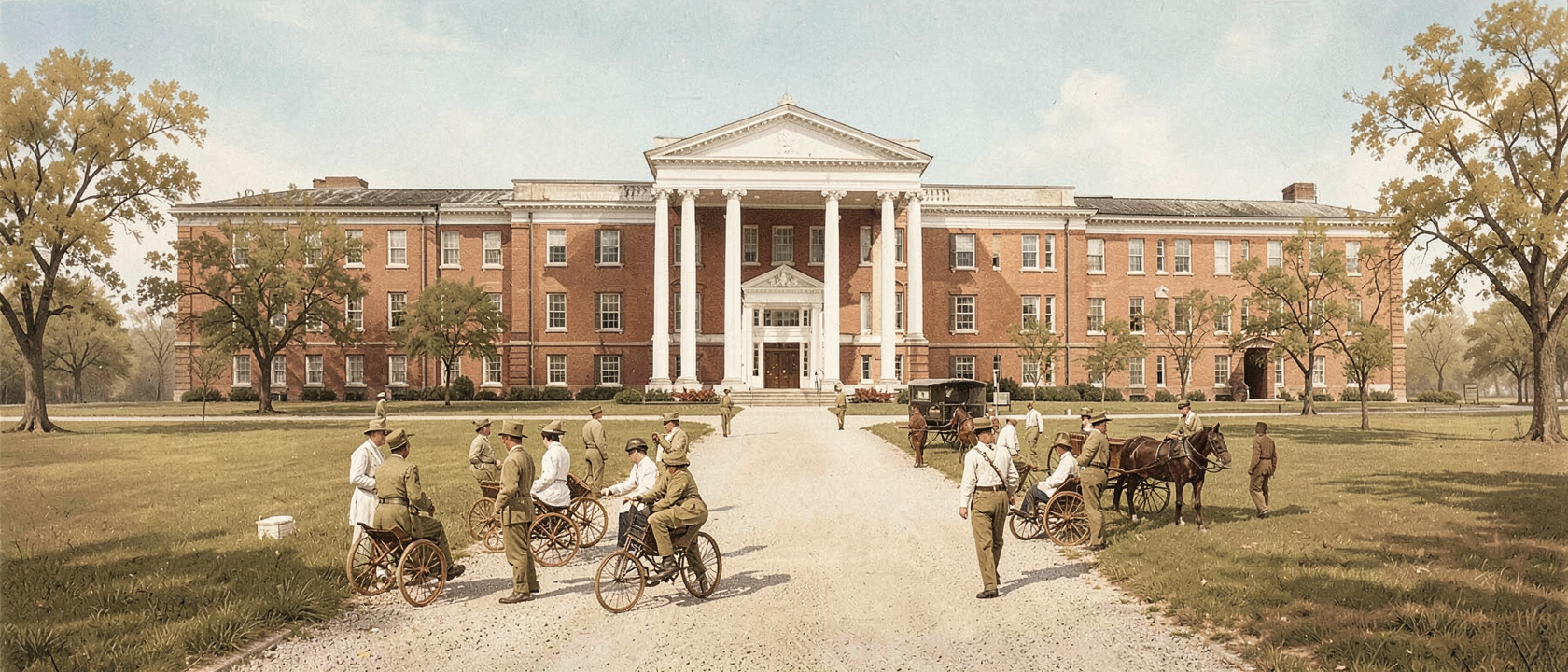
Camp Wikoff, Long Island
In August 1898, the US Army opened a camp on more than 5,000 acres near Montauk Point, at the eastern tip of Long Island, New York. Secretary of War Russell Alger had picked the site to quarantine troops shipping home from the war against Spain in Cuba. The camp took its name from Colonel Charles Wikoff, killed at the Battle of El Caney, and was built to process somewhere between 22,000 and 29,000 sick and convalescing soldiers.
Camp Wikoff ran for roughly two months before closing that October. In that short span, an estimated 250 or so veterans died there, not from combat but from malaria, typhoid, and dysentery that spread through a camp the Army had no real system in place to control. Other counts of the dead, taken at different cutoff dates, run as low as 126 and as high as 357; even by the most modest of those figures, the toll ran into the hundreds. These were men who had survived a war and did not survive coming home from it.
A War Won, and Lost, to Disease
Wikoff was not an isolated failure. Across the Spanish-American War as a whole, more American soldiers died of yellow fever and typhoid than were killed by Spanish fire. The war exposed a gap the Army had no answer for: it had built no institution to manage epidemic disease among its own men once they were off the battle line.
That gap did not get closed quickly. The war itself lasted only months, and once the fighting stopped, so did most of the urgency to fix a problem that had already done its worst. For roughly five years after the war’s end, the case for a permanent hospital had no live crisis behind it, only a set of numbers and a memory of Montauk.
A Year of Debate
One of the officers who kept the case alive was Major William C. Borden, commander of the Army General Hospital in Washington. Borden had taught for years alongside Major Walter Reed, the Army bacteriologist whose work with the Yellow Fever Board in Cuba, between 1900 and 1901, had shown that mosquitoes, not poor sanitation, carried the disease. On November 17, 1902, Borden operated on Reed for appendicitis and found the case worse than expected; Reed died several days later after peritonitis set in. Borden later pushed to have the new hospital carry his friend’s name.
Congress opened its debate on funding a permanent military hospital in Washington, DC, in January 1904. Lawmakers looked in part to European military medical systems, which paired hospitals with medical schools, though the record does not say which countries’ models they studied. The discussion ran for roughly a year, and what it produced broke with Army practice up to that point: a hospital that would be permanent rather than improvised, built in the capital rather than in the field, and run under the Army Surgeon General rather than assembled and dismantled the way Civil War hospitals had been around a campaign. Congress backed the decision with money over the following two years: $100,000 in 1905 to buy just under 43 acres of land in the northern part of the District of Columbia, then $200,000 in 1906 to build on it.
What the Hospital Was For
The 1904 debate itself was not argued around a construction budget; no dollar figure for it survives in the record. What survives instead is the case supporters made for why the Army needed the building at all. One argument was retention: a proper hospital meant fewer officers discharged for permanent disability, keeping trained men in uniform rather than losing them to conditions better treatment might have resolved. Another was research. Army doctors were by then stationed across Latin America, and a central hospital in Washington could gather their findings in one place instead of leaving them scattered across postings.
The number that actually anchors this story, then, is not a budget line. It is the roughly 250 dead at Camp Wikoff, six years earlier, the failure that gave the 1904 argument its force.
Compassion or Efficiency?
Here the story moves from record to interpretation. The historian Jessica L. Adler, who has studied the hospital’s founding, argues that the project was driven less by concern for soldiers’ welfare than by the Army’s interest in running what she describes, drawing on the language of the era, as a more efficient “military machine.” Part of her case rests on the later reflections of Edgar Erskine Hume, who served in the Army Medical Department from 1917 to 1952 and described the guiding motive of his era as applying sanitary science to strengthen the institution, not to care for the individual soldier as an end in itself.
No rival historian’s account challenges Adler’s reading here. What is not in question is the practical outcome. Walter Reed Army General Hospital opened on May 1, 1909, on the land Congress had bought four years before: 43 undeveloped acres, a central building in the Colonial and Georgian Revival style, capacity for around 80 patients. It opened with about 10. Within a decade, the First World War would push that number from 80 beds to 2,500.