
What the Dutch Found
In 1645, the Dutch held part of Pernambuco, taken from Portugal a decade earlier. They sent a party inland expecting a mocambo, a rough runaway camp likely to scatter at the first sign of soldiers. Palmares had already stood for roughly forty years by then, founded around 1605 by escaped slaves in the forested high ground of Pernambuco.
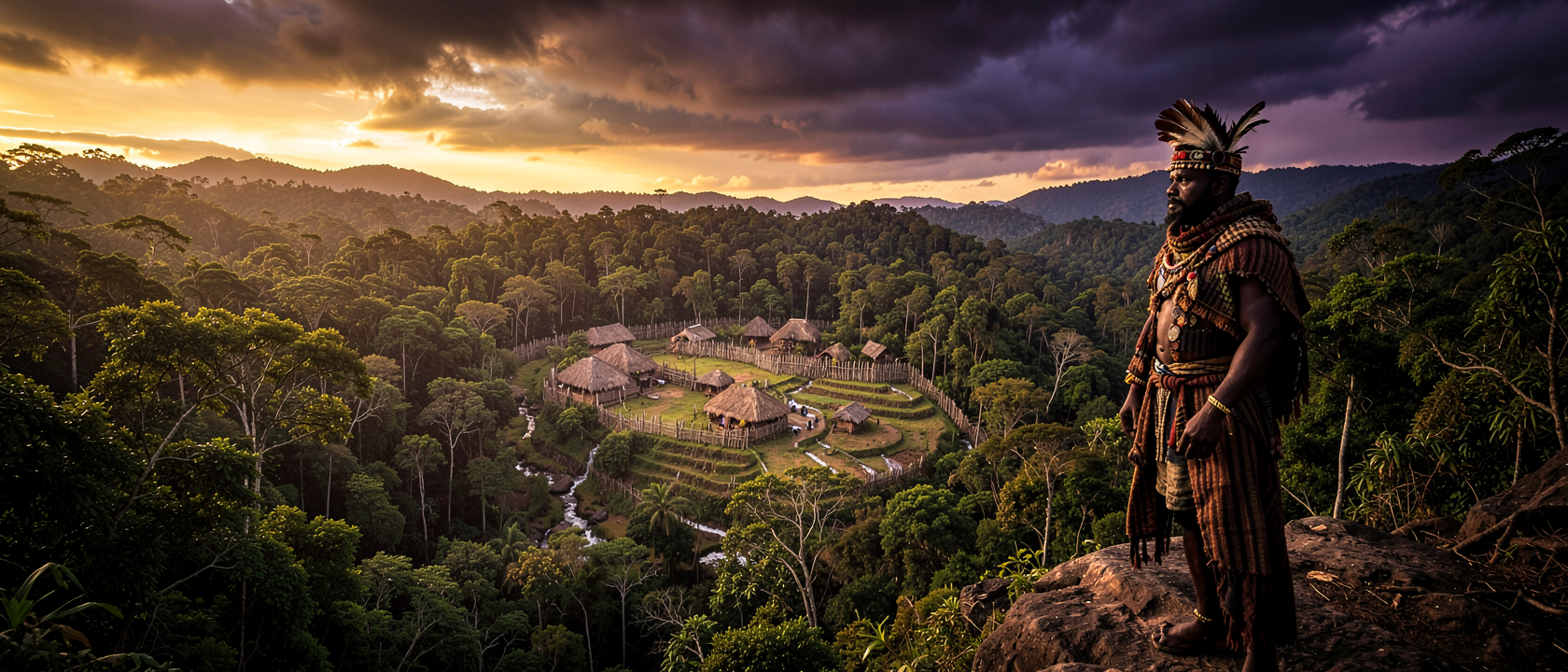
What the Dutch recorded instead was farmland: fields under cultivation, several kinds of grain, and streams channeled for irrigation. It is the earliest surviving outside account of Palmares, and it settled a question the Portuguese had not yet thought to ask: this was not a hideout but a working society, with crops planted season after season and water managed on purpose.
From Mocambo to Nation
The Mbundu word mocambo, carried to Brazil from Angola, meant hideout, the standard term for a runaway settlement, perhaps fifty people, thin on supplies, usually broken up by a slaveholders’ militia within months. Most left nothing behind but a mention in a court record.
By the early 1670s, Palmares no longer fit that description. It had grown into at least ten fortified settlements, with a population some estimates put as high as 30,000, though that figure is an estimate, not a confirmed count. What is not in question is that most of its people had been born inside its borders, free, to parents who had escaped slavery elsewhere. They called one another malungo: comrade. Plantation owners writing at the time had already stopped expecting it to fall; their word for it was invincible.
Fourteen Times It Held
Between 1672 and 1686, Portuguese forces launched fourteen separate expeditions against Palmares. Some later tallies count fewer, as few as six between 1680 and 1686, but on either count every campaign failed. Palmares’s defenses were built to punish an advance, not just stop it: walls and palisades ringed the settlements, with concealed traps and spike-lined pits beyond them. No casualty figures survive for either side across those attempts.
What finally changed the outcome was not the size of the force but its kind. When regular colonial troops kept failing, Portuguese authorities turned to bandeirantes, frontier fighters from São Paulo who made their living tracking escaped slaves and pushing into unmapped land. They knew the forest in a way garrison soldiers never had.
The Two-Year Collapse
Over roughly two years, the bandeirante campaign did what fourteen earlier expeditions could not. One settlement after another fell or was abandoned, until only one remained: Macoco, the fortress that had served as the seat of Palmares’s rulers. The exact dates of this campaign were never recorded; historians can fix its end, in 1694, but not its start.
Macoco was built around a cliff face, its approach lined with spikes set at three heights: foot, thigh, and throat, a defense that made the ground itself work against an attacker. By the time the bandeirantes reached it, it was also the only ground left to defend.
The Night of February 5, 1694
Macoco held under siege for 42 days. On the night of February 5, 1694, its defenders tried to break through the surrounding lines. In the dark, an estimated 200 people fell or leapt from the cliff. A Portuguese account written at the time said the height of the fall left the dead almost unrecognizable.
Zumbi, the settlement’s ruler, was among the last to leave the citadel. He was shot twice in the fighting and taken alive.
The Execution and the New Word
Zumbi was beheaded on November 20, 1695, roughly 21 months after Macoco fell. His capture had been the end of organized resistance; his death was its formal close.
After that, the word used for communities like Palmares changed. Mocambo, hideout, gave way to quilombo, another Mbundu term meaning war-camp. The shift in language followed the shift in scale: Palmares had outgrown the word built for a handful of people hiding in the woods, and Brazil kept the new one for everything like it that came after.
What the Record Doesn’t Say
The story of Palmares survives with real gaps. The population estimate of up to 30,000 cannot be checked against any census; other sources put the number at 20,000, or as low as 11,000, and no one at the time wrote down a count. The exact dates of the two-year bandeirante campaign are lost, and no casualty figures exist for Portuguese or Dutch forces across the fourteen failed expeditions. Accounts also disagree on Zumbi’s final days: one version has him held prisoner for close to two years before his execution; another places his capture and death on the same day in November 1695, at Serra Dois Irmãos, found with twenty companions. What happened to most of the rest of Palmares’s people was never written down at all.
One fact survives all of that uncertainty. As late as 1746, more than fifty years after Macoco fell, colonial records still show escaped slaves making their way toward the site where Palmares had stood. There was no fortress left to reach. They were walking toward what the place had once been to people who had never seen it standing: hope, and home.