What He Carried Across the Isthmus
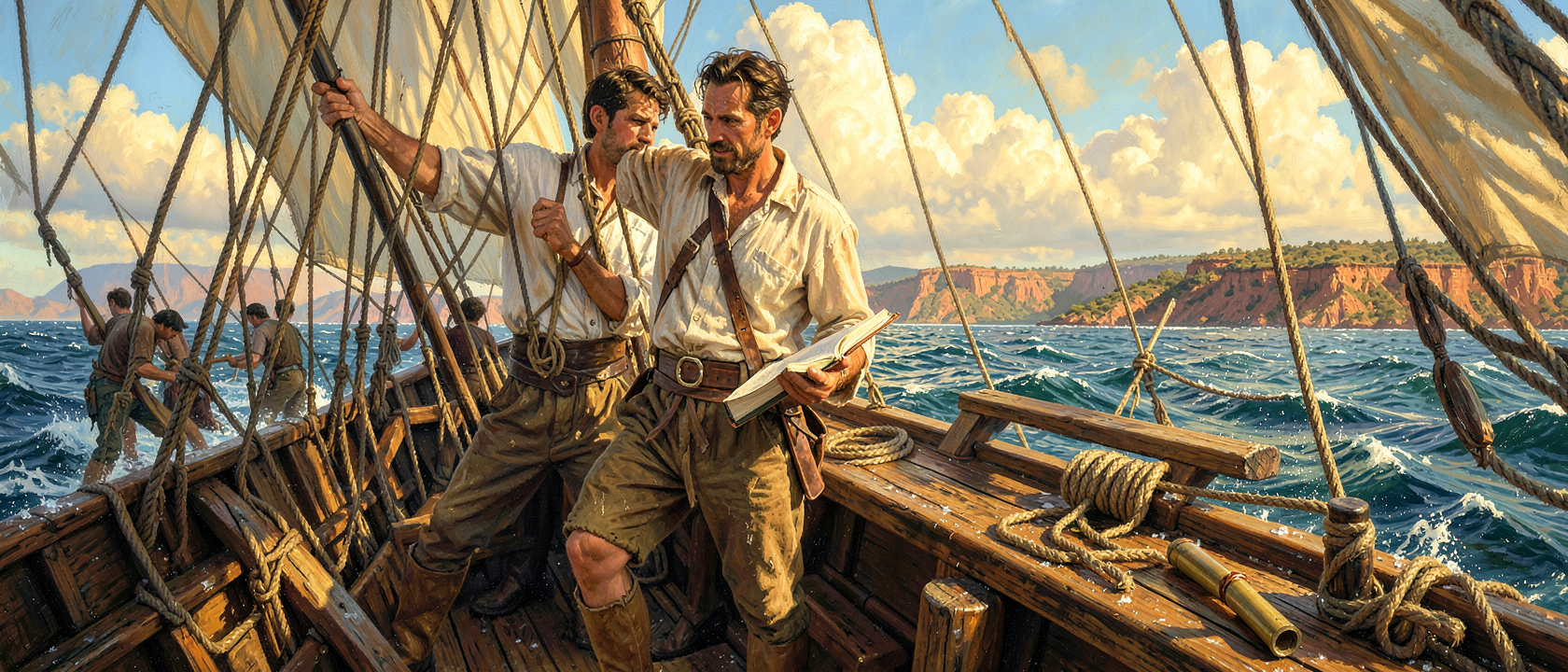
In 1680, William Dampier crossed the Isthmus of Darien (present-day Panama) with a party of 44 buccaneers over 21 days, raiding alongside crews who were there for plunder. He was also filling notebooks. At river crossings, he sealed them inside a bamboo tube stopped at both ends with wax and carried it on his person. The journals survived. A man who considered his records expendable would not have bothered with the wax.
When a Raid Log Could Pass for a Natural History
Through the 1670s, 1680s, and into the 1690s, buccaneers routinely produced journals mixing accounts of raids with observations on climates, animals, plants, and peoples. A voyage log from those decades might describe a Spanish settlement attacked in one paragraph and a flamingo’s coloring in the next. Without that overlap, the events of 1697 are simply inexplicable.
Historian Anna Neil, writing in Eighteenth-Century Studies, has argued that Dampier showed a deliberate effort to downplay violence and foreground inquiry. Whether that effort was calculated from the start or retrospective is a separate question. Dampier was not the only buccaneer who wrote. He was the one who wrote most carefully and edited most deliberately.
A New Voyage Round the World, 1697
Published in London in 1697 by James Knapton, the book covered his first circumnavigation, which had begun in the late 1670s and ended with his return to England, penniless, in 1691. Violent episodes are minimized; the voyages are framed as inquiry rather than profit. A second edition appeared before the year was out; a third followed in 1698.
Charles Montagu, President of the Royal Society from 1695 to 1698 and Chancellor of the Exchequer, had been named in the dedication. After publication, Dampier lectured at the Royal Society and dined with Samuel Pepys. Montagu then introduced him to Edward Russell, 1st Earl of Orford, First Lord of the Admiralty. The result was command of HMS Roebuck, a 292-ton warship of approximately 96 feet (29 meters) carrying 26 guns, to explore the coast of New Holland (present-day Australia). HMS Roebuck departed Deptford on January 14, 1699, the first British government-sponsored scientific expedition to that coast. Each link in the chain closed within roughly a year and a half of publication.
Three Circumnavigations and the Science They Produced
The Roebuck expedition mapped approximately 870 miles (1,400 kilometers) of Australian coastline and collected 20 plant specimens, later preserved in the British Museum. The ship foundered near Ascension Island on February 21, 1701; the crew spent five weeks stranded before rescue on April 3, 1701. Many papers went down with the vessel, though Dampier saved charts of coastlines, trade winds, and ocean currents. He published his account in 1703.
In 1699 he also published A Discourse of Trade Winds, Breezes, Storms, Seasons of the Year and Currents of the Torrid Zone Throughout the World (commonly cited as A Discourse of Winds), now regarded as a pioneering work in physical oceanography. Across three circumnavigations, the first completed in 1691, he became the first person on record to go around the globe three times. His books influenced James Cook, Joseph Banks, and Charles Darwin, who carried Dampier’s volumes on the Beagle during the 1830s voyage.
The Cost, Distributed Elsewhere
While Dampier accumulated institutional recognition, former crewmates from the same buccaneering voyages faced piracy prosecutions. Dampier faced none. His criminal past was not publicly examined; it was simply absent from the account he offered and that the Royal Society and Admiralty accepted. The men who lacked a manuscript had no equivalent transaction available. They stood trial for activities Dampier had participated in alongside them. The reputational cost did not fall on Dampier; it fell on crewmates who could not reframe what they had done, and on a historical record that absorbed the omission and repeated it.
The Claim He Made for Himself
Dampier’s stated motive was disinterested intellectual curiosity, a claim appearing in a book he edited strategically, accepted by institutions with their own reasons for finding a reformed buccaneer-naturalist convenient. Whether piracy and natural history were genuinely compatible pursuits, or whether science functioned as legal and social cover, is a question historians have not settled. What the record establishes is the sequence: the notebooks existed, the book worked, the commission followed, and former crewmates were prosecuted. He died in London in March 1715. His crewmates’ names do not appear in the scientific literature his work helped to found.