
The Knocking in the Walls
The Fox family had been in their Hydesville farmhouse only a few months when the sounds started. John Fox, a blacksmith and farmer, moved his wife and two youngest daughters to the hamlet in Wayne County, upstate New York, in December 1847. The sounds that began that winter were specific enough that the family’s mother signed a formal statement about them within two weeks of the events she described.
On the night of March 31, 1848, knocking sounds disturbed the household. Catherine, the younger girl, responded by clapping her hands. The knocks came back in kind. Questions were put aloud, answered by raps; then, with neighbors drawn in, the alphabet was recited letter by letter so the sounds could fall on particular letters and build words.
The girls’ mother signed a statement on April 11, 1848, describing Catherine as “about twelve years old” and Margaretta as being “in her fifteenth year.” Whatever their precise ages, the method the statement describes is not in dispute: the sounds had spelled out an identity. The spirit claimed to be a man of thirty-one, killed with a butcher’s knife and buried under the house. No documented excavation of the cellar produced a body matching that account. That absence leaves that part of the story unresolved.
The Stage Is Set
Leah Fox Fish, the eldest sister, was born in 1813 and was approximately thirty-five when the Hydesville events unfolded. Already living in Rochester, she brought the younger sisters before paying audiences. What is documented is the outcome.
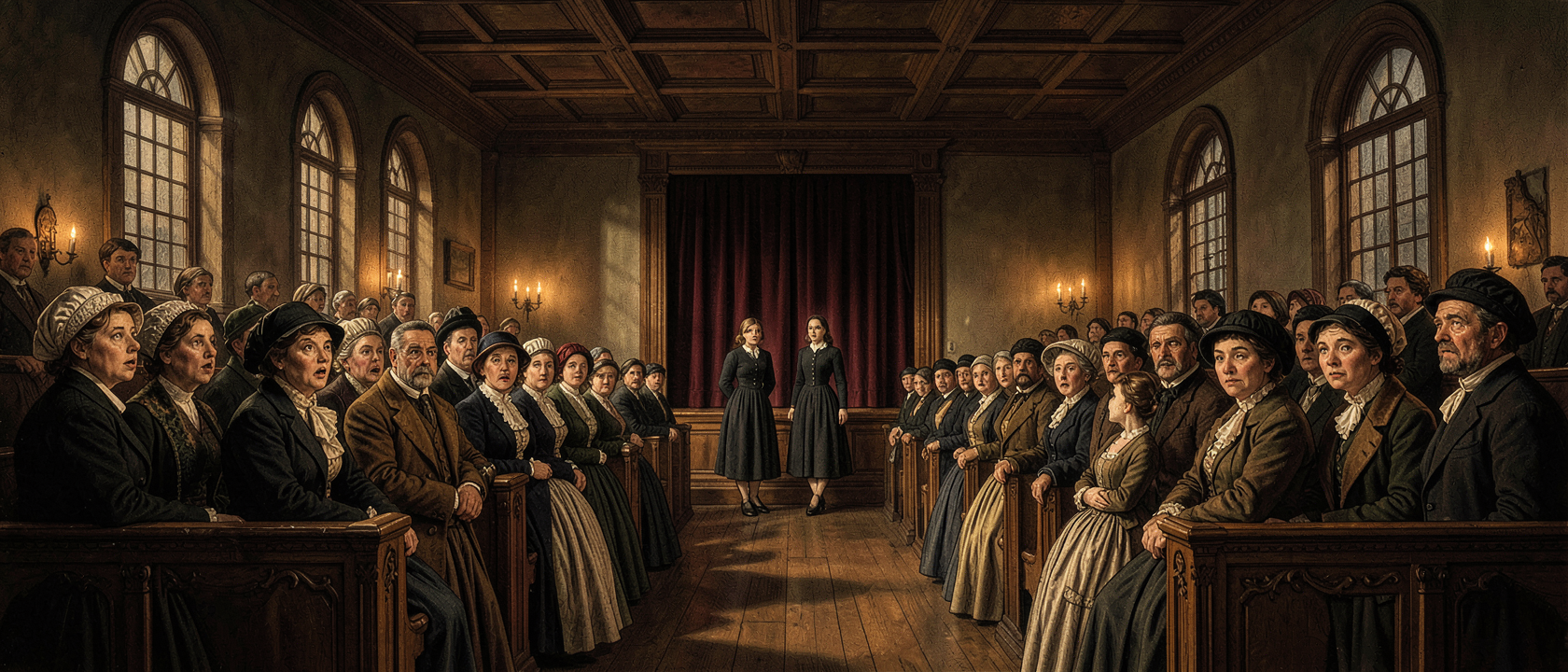
At Corinthian Hall in Rochester, the sisters held their first public paying demonstration. The date is disputed. The primary account from History Today gives November 14, 1848, but the contemporary 1850 printed report by Capron and Barron, along with multiple subsequent scholarly sources including the Society for Psychical Research’s encyclopedia, gives November 14, 1849. The weight of evidence favors 1849.
An estimated 400 people attended. Committees investigated on subsequent nights and produced no debunking. One contemporary observer described the communications as a “spiritual telegraph,” borrowing from Samuel Morse’s electric telegraph, which had sent its first message on May 24, 1844. A public already primed to believe that distance and silence could be collapsed by a wire was not difficult to persuade that death might present a similar problem with a similar solution.
Eleven Million
From Rochester, the sisters moved their demonstrations to New York City in 1850. The movement spread along lecture circuits, through periodicals, and through organized societies of believers. By the late 1860s, the estimated number of American Spiritualist adherents stood at roughly eleven million. That figure carries no documented methodology and historians treat it with caution. More easily verified is the infrastructure: a periodical press, a lecture circuit, and formal membership societies. The movement also developed ties, through Quaker reform networks in Rochester, to abolitionism and women’s suffrage. Amy and Isaac Post, Quakers who had known the sisters early, were among those who drew those connections explicitly.
What She Said to the World
In October 1888, Margaretta Fox gave a confession. The written statement appeared in the New York World on October 21, 1888; a public demonstration followed at the New York Academy of Music. By then Margaretta was widowed, and period accounts describe her as struggling with alcohol. Her explanation was specific: as a child, she had found that by manipulating the joints of her toes she could produce distinct cracking sounds that, in a quiet room, carried well enough to be mistaken for knocking from elsewhere. She and Catherine had used this to produce the Hydesville phenomena.
Contemporary accounts convey exhaustion rather than vindication. She was accounting, at considerable personal cost, for something started forty years earlier. The account did not hold: in 1889, Margaretta recanted, stating she had given the confession under pressure. Whether that recantation was itself made under pressure, the sources do not say.
What the Record Does Not Settle
Whether Catherine Fox independently confirmed her sister’s 1888 confession is not established beyond dispute. The confession with a named publication and a date is Margaretta’s alone. The figure of eleven million American Spiritualists carries no verified methodology. Leah Fox Fish’s role in building the sisters’ public career is documented through what she did, not through any written account of why.
Leah died on November 1, 1890. Catherine died on July 2, 1892. Margaretta died on March 8, 1893, less than five years after the confession and the subsequent retraction. The movement they had set in motion outlasted all three of them by decades.