
On August 27, 1935, Pope Pius XI stood before an audience in Rome and warned against unjust wars of conquest. He did not name Mussolini. He did not name Ethiopia. Within a year, the same pope would call the very war he had seemed to warn against a happy triumph.
The Pope’s Caution
By the summer of 1935, Italian troop transports were already massing for East Africa, and Rome’s ambitions there were an open secret across Europe. Pius XI’s speech on August 27 condemned wars fought for territory, in language general enough to avoid naming either the aggressor or the target. The Vatican had reasons to hold back. Six years earlier, in 1929, the Lateran Accords had formalized relations between the Holy See and Mussolini’s Fascist state, giving the Church a stake in staying on good terms with Rome’s government. A direct condemnation of the coming invasion risked that arrangement, so the warning went out without a name attached to it.
The Crusade at Home
Italy invaded Ethiopia in October 1935. By May 1936, Italian forces had taken the capital, Addis Ababa, and Mussolini proclaimed an empire. At home, the conquest met with genuine popular enthusiasm, amplified by propaganda that cast it as national vindication. Catholic cardinals and bishops did more than bless the war in general terms. They described Ethiopia’s people, followers of one of the world’s oldest Christian traditions in the Ethiopian Orthodox Church, as heretics whose conquest was righteous. Historian Ian Campbell’s 2021 book, “Holy War: The Untold Story of Catholic Italy’s Crusade against the Ethiopian Orthodox Church,” argues this was not stray rhetoric from a few overzealous clergy but organized ecclesiastical endorsement, which is why he gave the book its title. Ethiopia’s Christianity predated Italy’s own by centuries. The invasion was carried out partly in Christianity’s name, against Christians.
The Pope Changes His Mind
After Addis Ababa fell in May 1936, Pius XI made a public statement praising the conquest as a happy triumph. The reversal was more than a change of mood. It set the Church’s institutional posture for what followed in occupied Ethiopia: not resistance, but endorsement.
The Sack of the Monastery
On February 19, 1937, Ethiopian Patriots, as the resistance fighters were known, threw grenades at Rodolfo Graziani, Italy’s viceroy in Addis Ababa, wounding him during a public ceremony. Seven people were reported killed in the attack itself. Italian forces then killed civilians across the city for three days; estimates of the dead in that reprisal are disputed, ranging from at least 19,000 to more than 30,000.
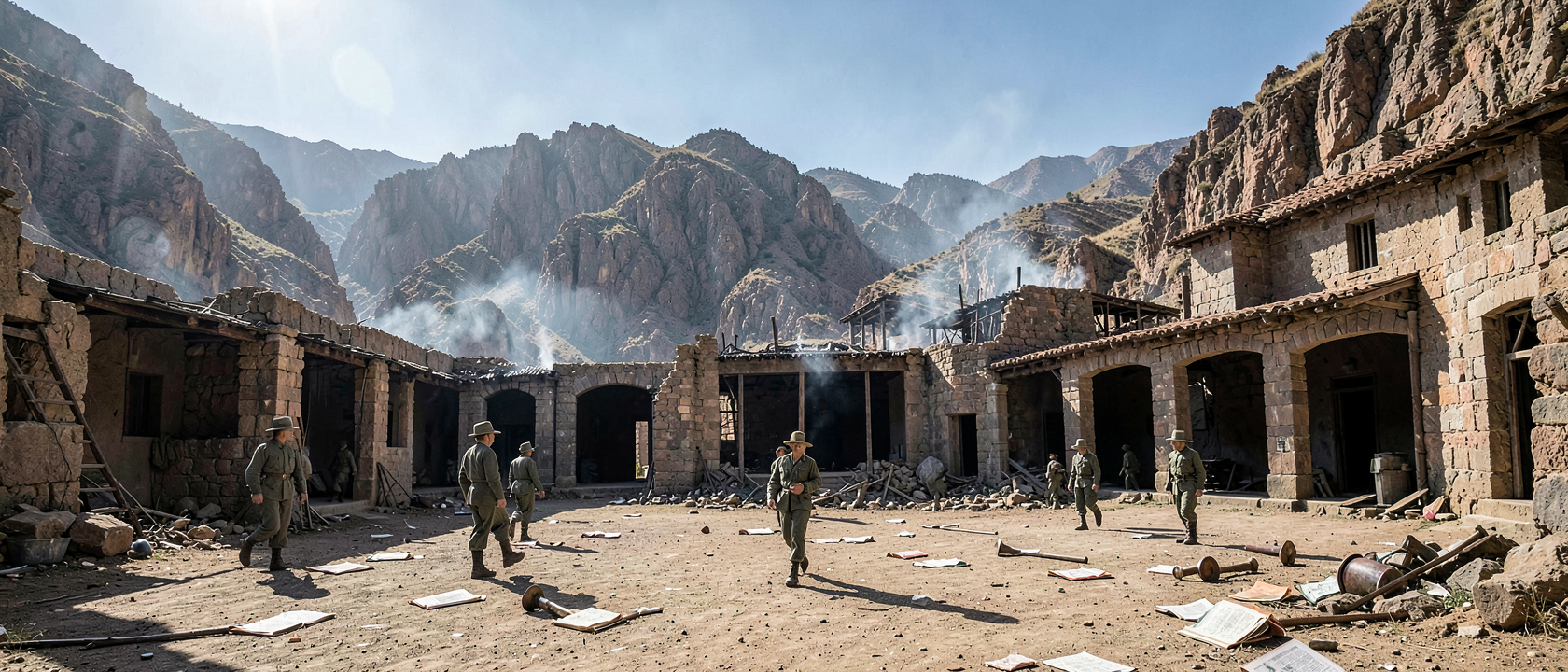
Months later, in May 1937, Italian troops moved on Debre Libanos, a monastery roughly 60 miles (97 km) north of Addis Ababa and one of Ethiopian Orthodoxy’s holiest sites. Under Graziani’s orders, General Maletti’s battalion of Muslim askari troops, recruited from Eritrea, Libya, and Somalia, carried out the killing. Graziani telegraphed Rome that 297 monks had been shot. Campbell’s research points to a toll far higher, and other accounts put the number of monks and parishioners killed at over a thousand, some as high as 2,000. Through the rest of 1937, while Graziani remained in command, Italian forces destroyed other monasteries and killed priests, monks, and civilians across the occupied territory.
760,300
Campbell’s full reckoning for the years 1935 to 1941 puts Ethiopian deaths at an estimated 760,300, alongside roughly 500,000 homes and other properties destroyed and about 2,000 churches plundered or damaged. Neither side kept reliable wartime records, so the number is a reconstruction, not a count, and Campbell suspects even it may fall short. It originated with Emperor Haile Selassie’s own government, which submitted it to the Paris Peace Conference in 1946. The international community did not pursue it. No tribunal followed. No reparations were paid. Of all non-Italians who died prematurely under Fascist rule, wherever Italy held territory, an estimated 90 percent died in Libya and Ethiopia combined, from war, starvation, and misrule, a toll that dwarfs the casualties usually associated with Italy’s alliance with Nazi Germany.
After Pius XI
By February 1939, according to Campbell, Pius XI had grown disillusioned with Fascism and troubled by Italy’s alliance with Germany. He died that same month. His successor, Pius XII, is judged by Campbell to have been even more silent on Nazi-Fascist atrocities than the pope before him, a verdict Campbell reaches, not one every historian would sign without qualification. Whatever unease had reached Pius XI at the end of his life did not translate into a changed institutional posture. The silence continued under new management.
Amedeo of Aosta
Campbell’s narrative in “Holy War” closes with the arrival of a new viceroy, Prince Amedeo, Duke of Aosta, who took over from Graziani. Campbell hints that conditions in occupied Ethiopia did not fully improve under the new administration, but the book does not document specific atrocities under Amedeo on the scale of Debre Libanos. That gap in the record is worth naming as a gap, rather than filled in with a guess.
Open Questions
Reviewing “Holy War” in History Today in February 2022, historian R.J.B. Bosworth raised four objections. The 760,300 figure rests on an Ethiopian government estimate that has never been independently verified. Some of Campbell’s evidence comes from interviews conducted as much as 80 years after the events they describe. Campbell’s portrait of Ethiopia as a unified, ancient nation with an imperial pedigree comparable to Rome’s is contested by historians who point to how ethnically varied the country actually was. And the largest question is left open entirely: whether Italy’s crimes in Ethiopia were a distinct product of Fascism, or a late and unusually brazen entry in a ledger of colonial violence that Britain, France, Belgium, Spain, Portugal, and the United States had been keeping for far longer, in territories much larger than Ethiopia. Bosworth does not resolve it. Campbell’s book, built to prosecute one empire’s record, was never built to weigh that wider comparison. What it does settle is smaller and harder to argue with: a war fought partly under a cross was blessed by the men who carried that cross, and the bill for it was never really paid.