
A Name Goes Missing
According to History Today, Caroline Merriman learned in October 1914 that her son John was missing near Ypres, Belgium. The fighting that autumn was the first battle for a town that would be fought over for four more years, and the front was already confused enough that units lost track of men within hours.
“Missing” was its own category, distinct from “killed” or “wounded.” It meant no body had been recovered, no death confirmed, and no grave for a family to visit. The word carried an open question that a death notice would have closed.
Over the four years of fighting that followed, an estimated 200,000 soldiers died defending Ypres. In October 1914, nobody yet knew how large that number, or the list of the missing folded inside it, would eventually grow. John Merriman’s name went onto that list at the very start.
A Town Fought Over Twice
By the time the fighting ended in 1918, Ypres had been shelled so many times that little of the old town remained standing. What to do with the wreckage became an argument of its own.
Winston Churchill wanted Britain to buy the ruins outright and preserve them exactly as the war had left them, calling the site sacred ground and arguing against rebuilding at all. Nobody acted on the idea, and Ypres was rebuilt.
But the traffic that arrived in the meantime unsettled observers. In 1919, The Times complained about the atmosphere among the ruins: souvenir sellers and sightseeing buses working ground that, for many visitors, was still a graveyard. By 1920, a published guide, The Pilgrim’s Guide to the Ypres Salient, offered seven suggested routes across the old front lines for anyone who wanted to walk the fields where a husband or son had fought.
The word attached to these trips, whoever made them, was pilgrimage. Charities paid the travel costs of bereaved mothers and widows who could not otherwise afford the crossing. Commercial operators sold something called “Battlefield Tours de Luxe,” five days by car for visitors who could pay their own way. Nothing in the record says which Ypres had become by 1920, a shrine or a stop on an itinerary. It seems to have been both, and no one settled the question.
Counting the Dead Who Have No Grave
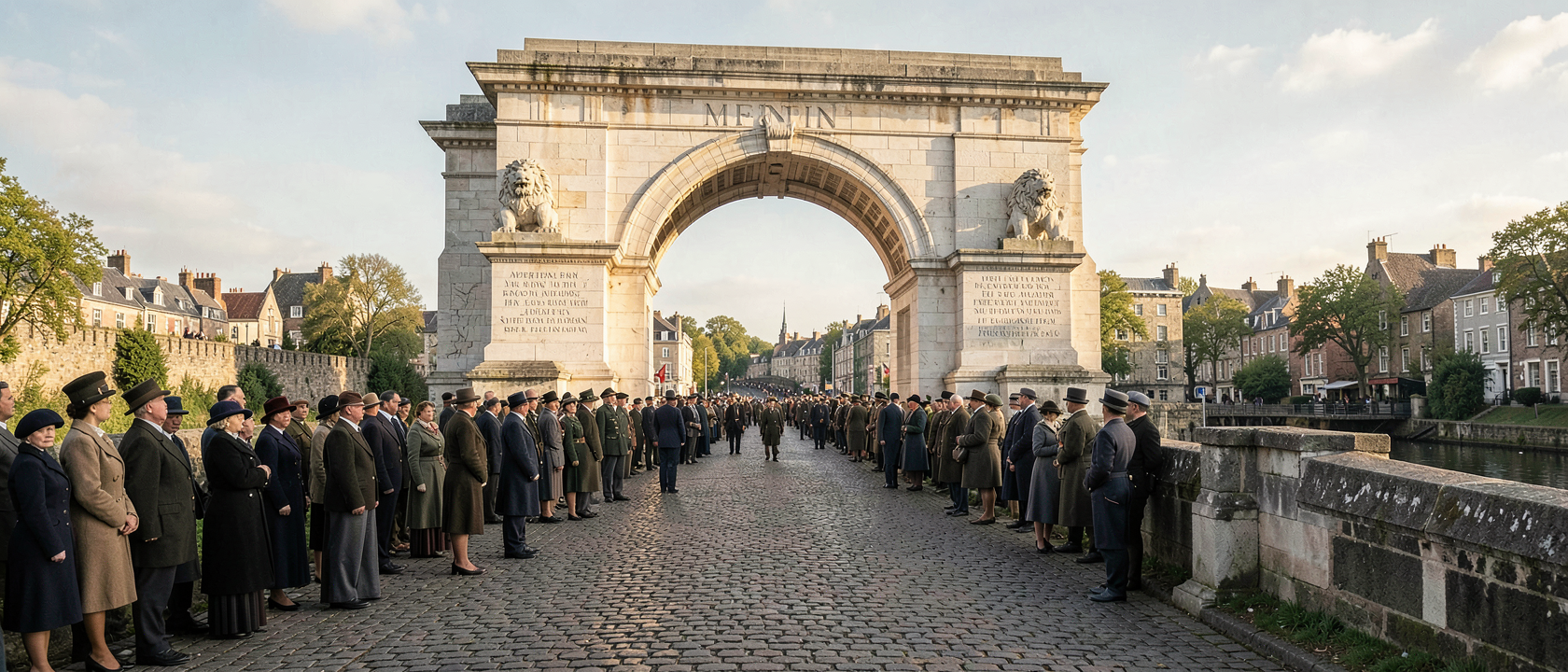
Designing a monument for men with no grave was, first of all, a counting problem. The Imperial War Graves Commission, later renamed the Commonwealth War Graves Commission, gave the job to Reginald Blomfield, one of its original principal architects. Blomfield planned around an estimate of 40,000 names, to be cut into stone panels beneath a new gate on one of the roads out of the town.
While he worked, a separate operation was underway on the ground. The Graves Registration Unit searched roughly 200 war cemeteries around Ypres, matching burial records against the names still listed as missing. Every match removed a name from the list. Every failure to match confirmed one, by elimination: no body found, no burial site recorded, nothing left to mark but a name carved somewhere else.
That process took years. The gate was not finished until 1927, more than a decade after John Merriman disappeared.
Even then, the Menin Gate was not the whole account. A second memorial at Tyne Cot, outside Passendale, would carry a further estimated 34,986 names, for men who went missing after an arbitrary cutoff date of August 15, 1917. The two memorials were, in effect, two volumes of the same ledger.
The Wall Runs Out of Room
By 1927 the gate itself stood over the Menin road: reinforced concrete faced in Euville stone and red brick, built to a design Blomfield borrowed from a seventeenth-century gate at Nancy, France, the Porte de la Citadelle, which he admired. Two stone lions carved by the Scottish sculptor William Reid Dick were set above the arch.
When the final count of names was ready, it came to 54,896. Blomfield had planned for 40,000. The difference, nearly 15,000 names, was space the original design had never accounted for.
The sources don’t explain the gap. Nothing on record says whether it came from a miscalculation at the drafting stage or from a casualty count that kept rising as the Graves Registration Unit finished its work. What the number shows plainly enough is that thirteen years after the fighting began at Ypres, the people building its memorial to the missing had still not grasped how many of them there actually were.
The Unveiling
The Menin Gate was unveiled on Sunday, July 24, 1927, by Field Marshal Lord Plumer, on a breezy, pleasant summer day. Buglers of the Somerset Light Infantry sounded the Last Post; pipers of the Scots Guards played a lament. The BBC broadcast the ceremony over the wireless, across the country.
History Today reports that charity funded the travel of 700 bereaved mothers and widows who attended. Caroline Merriman, thirteen years after she first learned her son was missing, was one of two women chosen to lay the official wreath.
What she received that day was not a grave. It was a name on a wall, one among 54,896, set beside tens of thousands of others whose families had waited just as long for the same kind of answer. Soon afterward, sounding the Last Post became a nightly ritual in Ypres, led by the town’s own fire brigade, carried on after the ceremony that had given it its reason.