
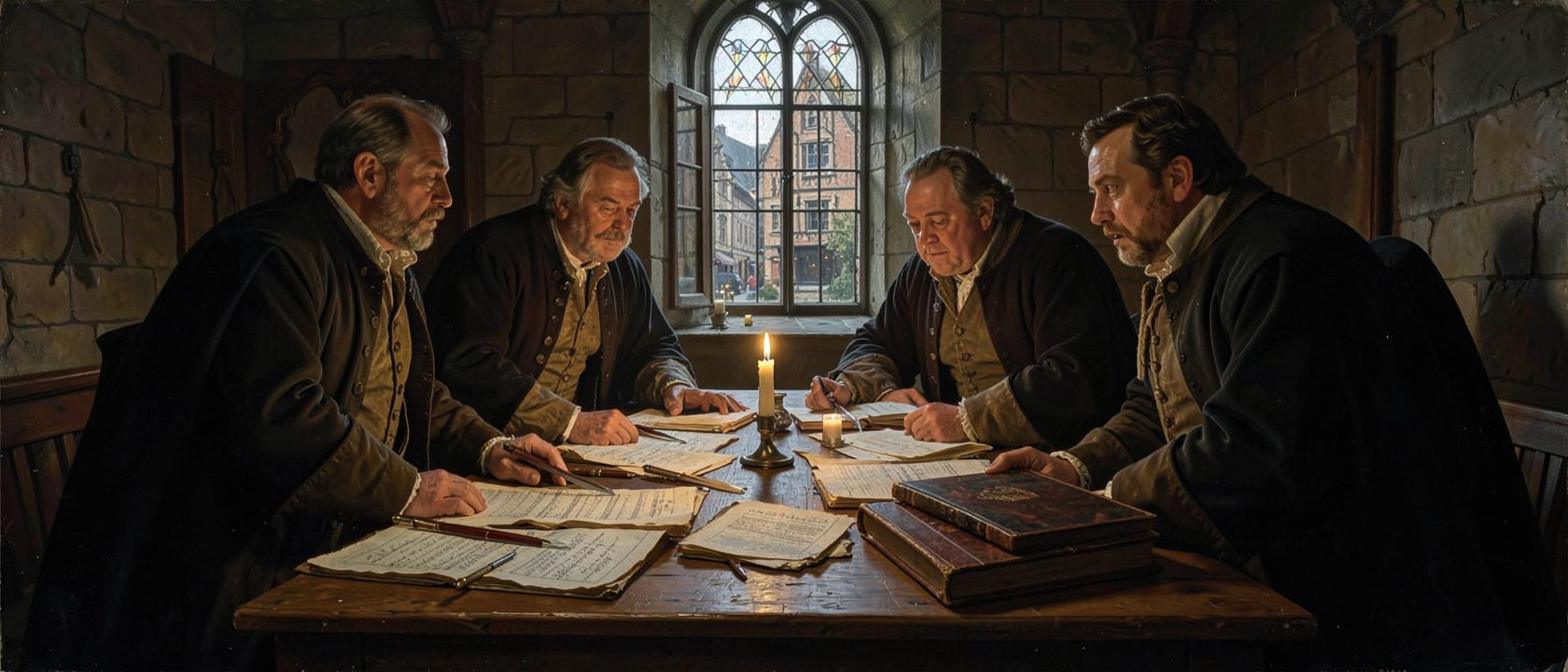
The Room at Valladolid
By December 1593, Robert Persons was finishing a manuscript inside the English seminary he had built at Valladolid, in Spain. Persons, born June 24, 1546, at Nether Stowey in Somerset to a yeoman family, had become the leading figure among the English Jesuits on the Continent, a priest for whom returning home meant risking arrest under England’s anti-Catholic law. Sent to Spain at the end of 1588 to smooth over a quarrel between King Philip II and Claudio Acquaviva, the Jesuit order’s leader in Rome, Persons succeeded, and used the royal goodwill that followed to found seminaries for training English priests on Spanish soil. Valladolid, the first English seminary on Spanish ground, opened in 1589. Seville followed in 1592. What is fixed in the record is the manuscript Persons brought to completion at Valladolid that December: he called it “A Conference About the Next Succession to the Crowne of Ingland.” He published it under the pseudonym R. Doleman. A period cataloguer later claimed the true authors were the exiled Cardinal William Allen and Sir Francis Englefield, with Persons contributing only a small share, though most historians since have still treated the book as primarily his.
A Queen With No Heir
Elizabeth I had reigned since 1558 and by 1593 was in her sixties, unmarried and without a child. She had never named an heir, and saying so out loud, on her behalf or against her, was dangerous. According to the Valladolid college’s own account, she had already gone so far as to issue a proclamation in 1591 condemning by name the priests and Jesuits training there, Persons among them. Writing about the succession in print, in England, counted as treason.
That silence left the field wide open, and Persons’s book weighed five rival claims: James VI of Scotland, a Protestant king eager to secure his position south of the border; his cousin Arbella Stuart; Edward and Thomas Seymour, sons of Katherine Grey and so descendants of Henry VIII’s sister; Henry Hastings, third Earl of Huntingdon, an English peer with a claim of his own; and Isabella Clara Eugenia, the Infanta of Spain, whose case rested less on blood than on power: since 1590 she had been put forward as Spain’s candidate, in the middle of a separate succession crisis already tearing France apart.
The Amsterdam That Never Met
The book’s frame is fiction, and Persons never pretended otherwise. He wrote of a gathering of English gentlemen “of divers nations, qualities, and affections, as well in religion as otherwise” who met, the text says, in April 1593, in Amsterdam, to talk through the one question nobody in England was allowed to ask aloud. No such meeting happened. Nobody knows why Persons chose Amsterdam over some other city. The choice put the conversation at a safe remove from both London and Valladolid, but the record does not say whether that was the point.
Inside the invented room, two lawyers do the real work, one trained in civil law, one in common law, taking turns to build and dismantle each candidate’s case. They lay out genealogy in careful detail, then argue that blood alone should not decide the matter, warning that treating the question carelessly could bring back the civil wars of the previous century, the Wars of the Roses. The book presses hardest on James VI, tracing his claim through the House of Lancaster back to an illegitimate son of Katherine Swynford, born at the end of the fourteenth century. It draws on English and foreign history more broadly, too, questioning whether hereditary right should settle the succession at all, and arguing instead for a right of resistance and a role for popular consent. Neither lawyer is named. What the form bought Persons was distance. He could lay out the case for the Infanta, the Catholic candidate backed by the same Spanish crown that funded the seminary where he sat, without ever appearing to argue it himself. The lawyers argued. Persons only reported what they said.
What the Book Actually Cost
Nothing in the record ties this manuscript to a death, a payment, or a mile of ground gained or lost. Its damage ran entirely through argument and reputation. Once it began to circulate under the name R. Doleman, it became exhibit one for the claim that Jesuits were meddling directly in English politics, working to hand the crown to a Spanish candidate backed by a hostile foreign power. That suspicion outlived the book and hardened opinion against Catholic exiles generally.
The publishing history is messier than the argument inside it. The title page carries the year 1594 and names Antwerp as the place of printing, but the book seems to have actually reached print around September 1595, and even the city is disputed: some scholarly citations still say Antwerp, others point to Amsterdam, the same city Persons had used, separately, as his fictional setting. How widely it circulated afterward is not established here. One later academic study calls it the most daring political tract of the Elizabethan era, which says something about how it was read, even if it says nothing about print runs.
Persons paid no fine and served no sentence for writing it. He stayed in Spain, hoped to succeed Cardinal Allen as the senior figure among English Catholics abroad, lost that contest, and was given instead the rectorship of the English College in Rome, where he died on April 15, 1610, at 63. The bill for “A Conference About the Next Succession” was never presented to him directly. It was paid, instead, in the suspicion that followed every English Catholic who might, in theory, have read it.