
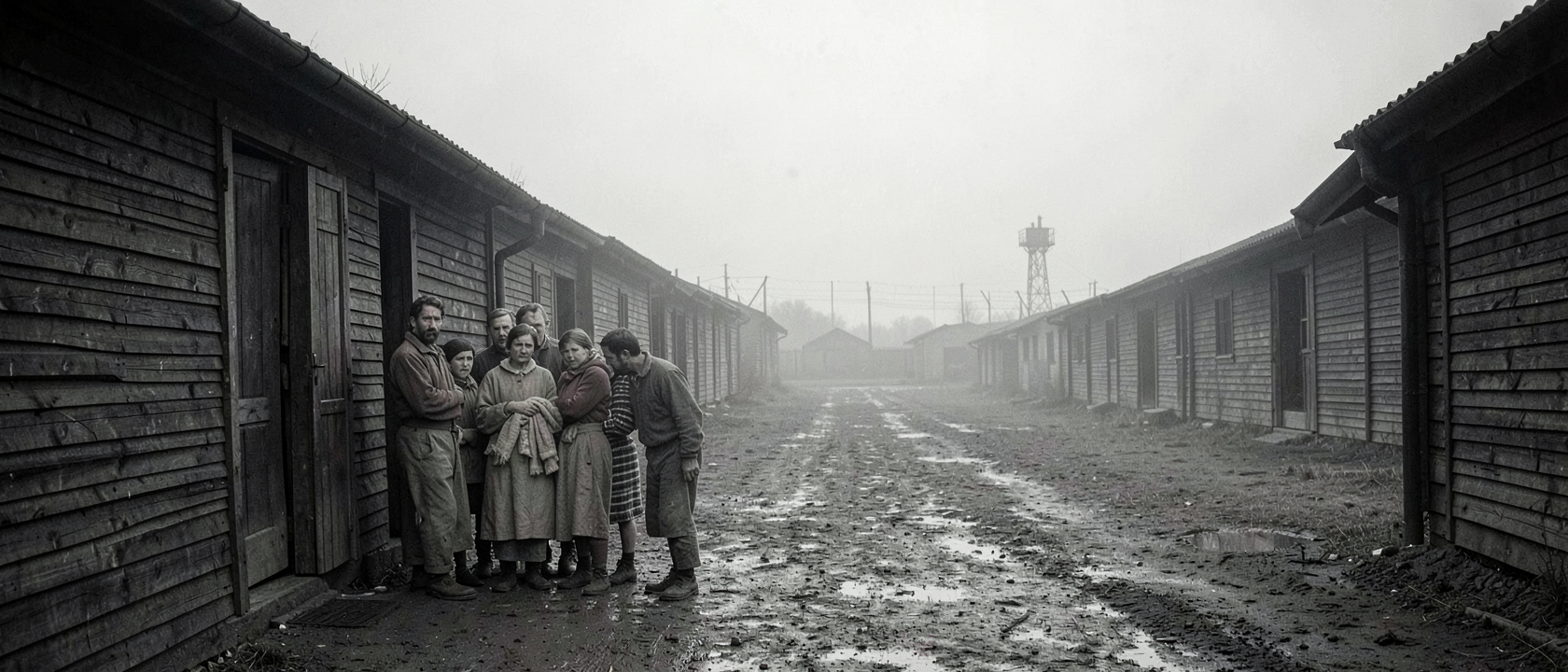
A Name on a List
In 1948, a Czech Roma forestry worker named Václav R. wrote to authorities in Prague asking to have his name struck from a register drawn up the year before, and his identification card canceled. The petition survives in Czech archives: one page, a request, a stamp waiting to be applied. Three years earlier, in May 1945, he had been liberated from the Terezín (Theresienstadt) camp and ghetto, where he had been held since his deportation in 1944.
The document doesn’t say how he thought of himself, or whether he used the word Roma, Sinti, or something else. It shows only that three years after a concentration camp, a Czechoslovak citizen still had to ask permission to stop being tracked by name.
A Register With a History
Officials called the 1947 list a “Gypsy register,” an outsider’s label long applied to Roma, Sinti, Manouche, and Jenisch alike, whether or not they identified with it. In 1893, Austrian criminologist Hans Gross published a handbook describing “the Gypsy” as an inherently criminal type; it became standard reading for investigators across German-speaking Europe. In 1927, the First Czechoslovak Republic wrote that view into law, restricting anyone judged to be “living like a Gypsy” and creating a legal category, the “wandering Gypsy,” to be tracked by police.
That tracking system did not vanish under occupation. Nazi authorities drew on the same registries, built to police so-called nomads, to locate Roma for deportation. After the war, Czechoslovakia kept the tool rather than dismantle it, reissuing a register and identification cards in 1947 on the same old assumption: Roma were a population to track, not citizens to count.
The Machinery Built
A register does not kill anyone by itself. What followed in Germany did, step by step. Within months of taking power in 1933, the Nazi government passed a sterilization law that singled out “Gypsies” on racial grounds. The 1935 Nuremberg Laws stripped Roma, along with Jews, of citizenship. In 1938, Heinrich Himmler ordered every “Gypsy” in the Reich registered as “pure” or “of mixed blood,” a project carried out by biologist Robert Ritter. Weeks after the 1939 invasion of Poland, the Reich Security Main Office ordered 30,000 Roma deported east. The 1941 invasions of Yugoslavia and the Soviet Union pushed policy toward outright killing: that autumn, roughly 5,000 Austrian Roma were sent to the Łódź ghetto, and survivors of typhus there were later gassed in vans at Chełmno. A dedicated “Gypsy camp” at Auschwitz-Birkenau was already under construction.
The Camp and Its Liquidation
Auschwitz’s Gypsy family camp opened on February 26, 1943, weeks after Himmler ordered the deportation of Roma still living in Germany, Austria, and the Protectorate of Bohemia and Moravia; a Reich Security Main Office directive that January named Auschwitz as the destination. An estimated 23,000 Roma and Sinti from at least fourteen countries passed through the camp; about 1,700 Polish Roma were killed on arrival without ever being entered in its records.
On the night of August 2-3, 1944, the SS liquidated the camp. The Auschwitz-Birkenau State Museum now puts the number gassed that night at roughly 4,200, revised upward from an older estimate near 2,900. Whether Roma prisoners mounted armed resistance against an earlier liquidation attempt on May 16, 1944, since commemorated by some as Romani Resistance Day, remains disputed, since many survivor testimonies from later decades make no mention of it. The killing was not confined to camps the Germans ran directly: Croatia’s Ustaša regime deported Roma to Jasenovac in 1942, and Marshal Ion Antonescu’s Romania deported Roma alongside Jews to Transnistria.
The Bill, Counted Unevenly
More than 20,000 Roma and Sinti died at Auschwitz, from gassing, hunger, disease, and medical experiments. At Jasenovac, estimates run from 16,000 to 40,000 dead. Of roughly 25,000 Roma deported to Transnistria, about half died of starvation or disease. Across Europe, the U.S. Holocaust Memorial Museum estimates as many as 500,000 dead; other serious estimates begin as low as 220,000. The range is the honest answer, so much went uncounted at the time, and the destruction of records since means it may never be counted in full.
Liberation Without Restitution
Liberation did not restore what had been taken. Roma returning to Romania from Transnistria, and Roma emerging from hiding in the Czech lands, commonly found their homes occupied and their belongings gone. In France, people classified as “nomads” faced a different danger once the Germans left: historian Lise Foisneau has documented violent local reprisals, including killings, against Roma wrongly accused of collaboration.
Recognition came slowly where it came at all. Postwar Czechoslovakia renewed its registration system in 1947, and the Communist government that took power in 1948 inherited it rather than end it, the same register Václav R. petitioned against. France waited until 2016 for President François Hollande to acknowledge the country’s responsibility for interning about 6,500 Roma in 31 camps. Not until April 15, 2015, did the European Parliament designate August 2, the date of the Auschwitz camp’s liquidation, as European Roma Holocaust Memorial Day, seven decades after the killing stopped.
What the Record Won’t Say
Historians still disagree about the shape of it. Michael Stewart calls it an “invisible genocide,” pointing to the absence of a single Nazi order commanding the destruction of Roma the way there was for the murder of Jews. Anton Weiss-Wendt reads the same evidence differently, arguing the planning behind the “Gypsy Question” matched the “Jewish Question” closely enough in scope and brutality that “invisible” undersells it.
Some things cannot be settled from what survives. Whether Václav R. thought of himself as Roma is not recoverable from a request to be left alone. Whether prisoners at Auschwitz stood against an SS liquidation squad on May 16, 1944, or the operation was simply called off, cannot be reconstructed from testimony that disagrees with itself. That gap is not a failure of scholarship; it reflects how thinly this genocide was written down at the time, next to the paperwork the same regime kept on its other victims. The register survives. Many of the people named on it do not, and neither does any certainty about how many.