
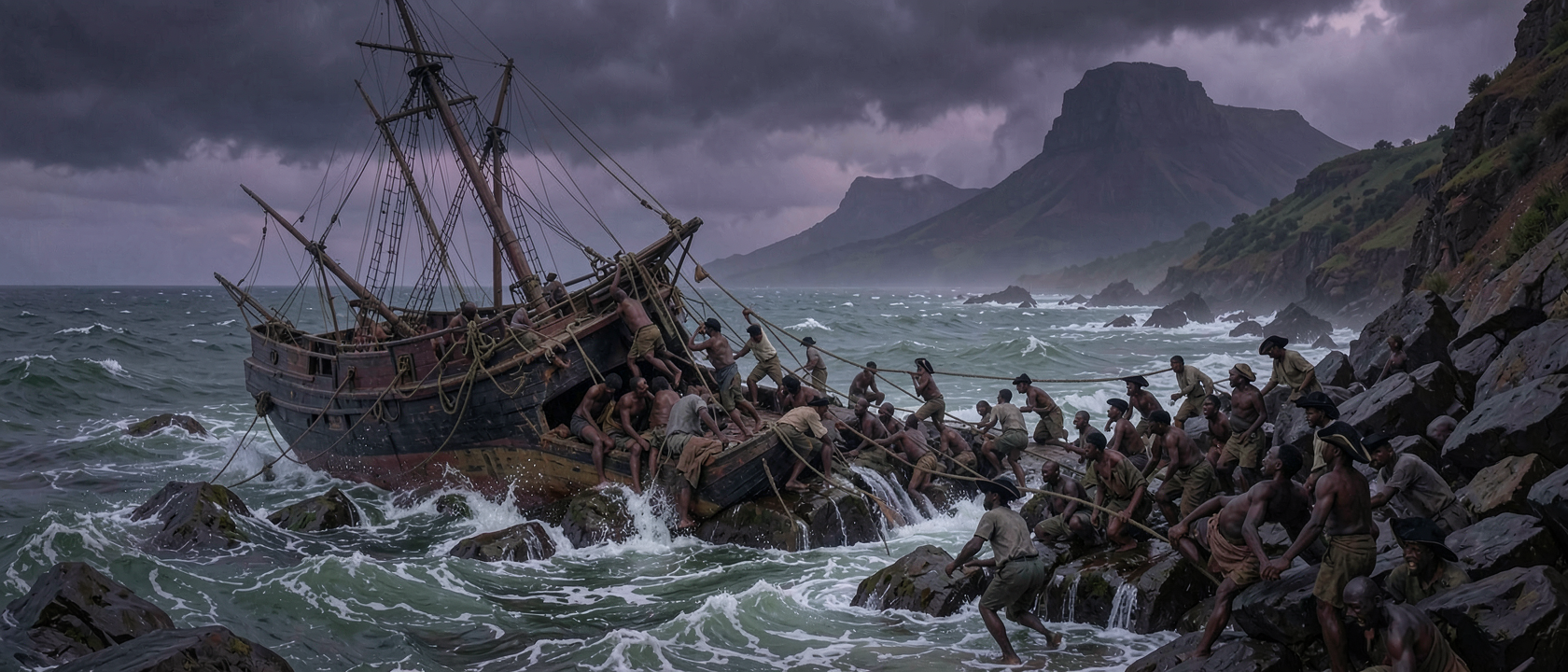
Off Cape Town, December 1794
The São José Paquete de Africa left Lisbon on April 27, 1794, bound for Mozambique’s coast to purchase enslaved people before sailing on to Brazil. Under Captain Manuel João, the ship took on between 400 and 512 enslaved Mozambicans, sources disagree on the exact count, and departed on December 3, 1794, for the port of Maranhão.
The crossing lasted 24 days. On December 27, 1794, caught in shifting winds and heavy swells off Cape Town, the São José struck submerged rocks close to shore, in a stretch of coastline recorded in different sources as Camps Bay and as Clifton. The ship was only about 328 feet (100 meters) from land when it broke apart.
A rescue was attempted. The captain, his crew, and roughly half of the enslaved Mozambicans made it out of the water. The remaining 212 did not. Survivors were not freed; they were resold into slavery in the Western Cape. Two days later, on December 29, 1794, the captain gave formal testimony before a local court, listing his losses, human and material, in the flat language of an insurance claim. A Dutch East India Company journal from that year noted, in passing, that a Portuguese ship had run aground at Camps Bay and that 200 of the 500 enslaved people aboard had died.
Twelve Million Crossings, Zero Confirmed Wrecks
Over roughly four centuries, tens of thousands of ships carried an estimated 12 million or more enslaved Africans across the Atlantic. Portugal, by one widely cited account, was the European nation most deeply and longest involved in that trade. Yet before 2015, maritime archaeology had never confirmed a single wreck of a ship lost specifically while carrying enslaved people.
This was not for lack of ships to find. Divers and archaeologists spent decades tracking down famous, well-funded wrecks while slave ships went unsearched and largely unrecorded with any precision. For descendant communities across West and East Africa, this meant there was no single site, no set of coordinates, tied to this part of their history.
The Slave Wrecks Project, 2008 Onward
In 2008, the Smithsonian’s National Museum of African American History and Culture joined institutions in Africa and the United States to launch the Slave Wrecks Project, whose partners came to include South Africa’s Iziko Museums, George Washington University, and the diver network Diving With a Purpose.
The project trained divers, archaeologists, and curators in Mozambique, Senegal, South Africa, and the Caribbean, building expertise inside the communities connected to this history rather than importing it from outside. By 2012, researchers had tracked down the São José’s manifest, confirming its route from Lisbon to Mozambique. What they still lacked was the ship itself.
2015, Cape Town, Then Mozambique
On June 2, 2015, in Cape Town, the Slave Wrecks Project announced it had confirmed the wreck of the São José, 221 years after it sank, the first slave ship wreck ever confirmed to have gone down with captured Africans still aboard.
Lonnie Bunch, then founding director of the NMAAHC and now Secretary of the Smithsonian Institution, traveled with a delegation to Mossuril, Mozambique, home to Makua descendants of those lost, to tell the community what had been found. Evano Nhogache, the Makua traditional leader of Mossuril, entrusted Bunch with a woven basket of soil from the community’s land, telling him that once the ancestors directed him to scatter it over the wreck, it would be the first time their people had slept again in their homeland.
The soil traveled to South Africa and, that same day, was scattered over the wreck site during a memorial ceremony held above the very rocks that had broken the ship apart 221 years earlier.
212 Lives, 221 Years, and What Comes Next
The first toll is fixed: 212 people who drowned or were crushed against the rocks in December 1794. The second is harder to put a figure on. For 221 years, the Makua and other descendant communities had no confirmed place to mourn at, and the maritime history of the slave trade sat largely unexamined in national memory, Portugal’s included.
The National Museum of African American History and Culture opened in Washington, D.C. in the fall of 2016, a year after the São José was confirmed. Under curator Paul Gardullo, the Slave Wrecks Project has kept working, investigating suspected wreck sites in Brazil, the Caribbean, West Africa, and North America. The lives lost in 1794 were counted in bodies; what followed, for more than two centuries, was measured in silence and neglect.
Open Questions
The public record does not spell out the technical methods, or cost, of the 2015 identification. Nor is there a public estimate of how many more slave-ship wrecks remain unfound on the ocean floor.
Portugal’s own reckoning with this history remains unsettled. The Council of Europe pressed the country in 2022 to reconsider how it teaches its colonial past. That December, Dutch Prime Minister Mark Rutte formally apologized for the Netherlands’ role in the slave trade, a step Portugal has not yet matched. In early 2023, Bunch and Gardullo took part in an international symposium in Lisbon on slavery, museums, and racism. No policy change from the Portuguese state has been confirmed to have followed; advocates who attended say only that they hope the symposium keeps the subject in view.