
The Tiger on the Throne
Seringapatam, the fortress capital of the Kingdom of Mysore, sat on an island in the Cauvery River (today’s Srirangapatna, Karnataka). Tipu Sultan was born Fateh Ali on December 1, 1751, in Devanahalli, and took the throne on the death of his father, Haidar Ali, crowned at Seringapatam Fort on December 29, 1782. A devout Muslim ruling a mostly Hindu kingdom, he was, by the descriptions that survive, a small, plump man with a round face and black mustache, his clothes glittering with jewels, and by British accounts vigorous, forceful, and cruel.
He built his rule around the tiger. He is said to have kept live tigers at the palace, and liked to say it was better to live two days like a tiger than two hundred years like a sheep. In the 1790s, though the exact date is unclear, he commissioned a wooden automaton shaped like a tiger mauling a European soldier, kept in his palace music room. A hand crank pumped hidden bellows that made the tiger growl and the man beneath it cry out, through eighteen small organ pipes built into the woodwork. None of this was decoration: it was a message about how he meant to be seen next to the East India Company.
Why London Was Watching
In 1798, Lord Mornington arrived in Calcutta as the Company’s new Governor-General, troubled by Tipu’s contacts with French officials in Paris and on the island of Mauritius at a time when Napoleon Bonaparte’s campaigns had raised fears of French ambitions reaching India. In Mornington’s view, a Mysore aligned with France could break the Company’s hold on southern India. In February 1799, he gave the order to invade.
Eighteen Square Miles on the Move
The army that marched from Madras that spring was assembled under General George Harris, joined by a contingent from the Nizam of Hyderabad and the British 33rd Regiment of Foot under Colonel Arthur Wellesley, Mornington’s younger brother. It moved with elephants, camels, thousands of baggage bullocks, flocks of sheep and goats for meat, camp followers, and a traveling market selling food and drink to the soldiers. Officers brought their own cooks, grooms, and laundrymen; Wellesley alone reportedly kept more than thirty servants and his own silver-plated tableware. Spread out, the column covered about 18 square miles (46.6 km²) of ground and advanced roughly 10 miles (16.1 km) a day in the heat, the largest force the Company had yet put into the field.
The Siege
By one account, Tipu’s troops were checked at Seedaseer on March 6, 1799, before the main army reached Seringapatam and laid siege to it on April 5. The siege ran four weeks and a day. Prisoners taken from the British side during the fighting are reported to have been executed inside the fortress. Tipu, for his part, tried to buy time, hoping to hold out until the monsoon arrived and forced a British withdrawal. For weeks the siege was as much a race against the calendar as a contest of guns.
The Breach
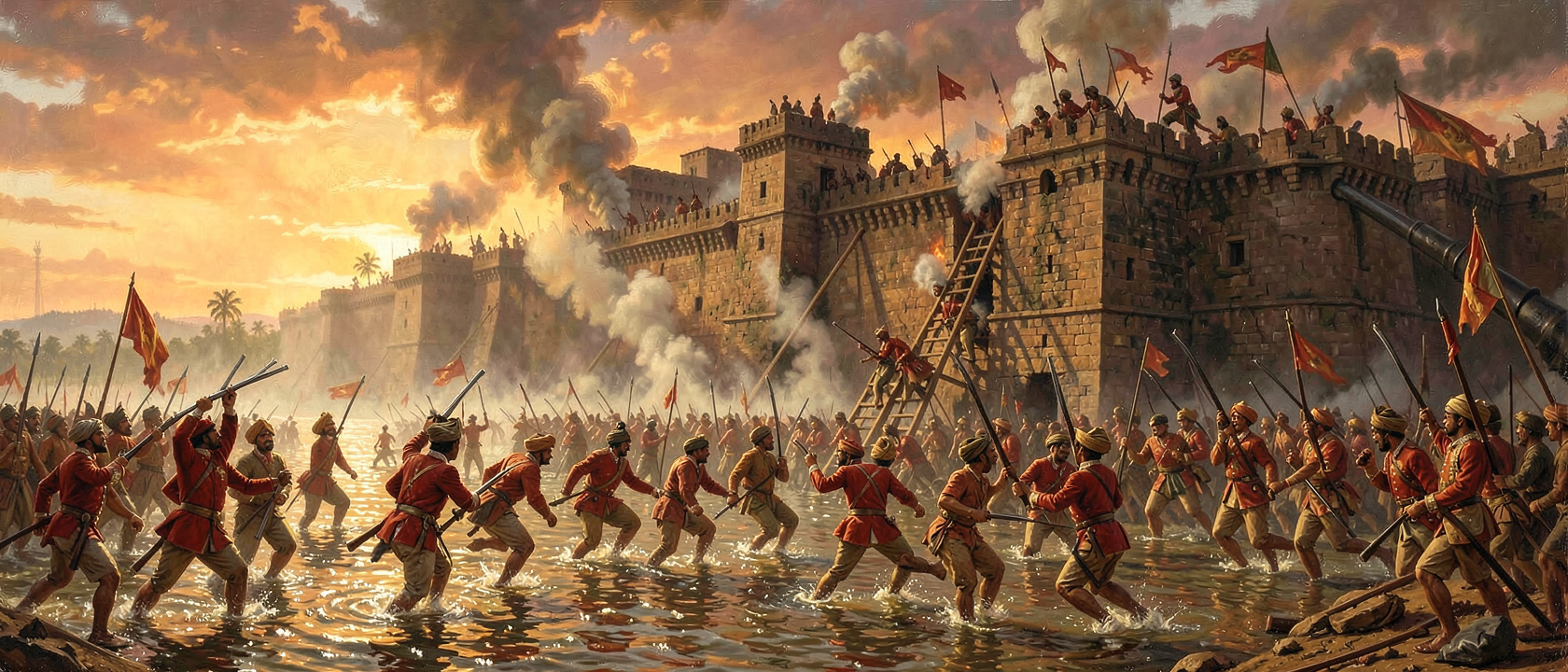
On May 4, 1799, word reached Tipu of bad omens ahead of the coming assault, and he sent gold, an elephant, animals, and clothing to his priests to counter them. The British stormed anyway. The Cauvery was at its lowest level of the year, and the assault parties forded it in water about 4 feet deep (1.2 m), covered by fire from British batteries. Within sixteen minutes they had scaled the ramparts and swept the defenders aside.
Tipu did not flee, but kept fighting as the walls fell around him. Accounts differ on exactly how the end came. One holds that he was recognized in the fighting as the stout officer firing on the attackers, then found gravely wounded, hit three times including a shot to the temple, in a choked passage near the fortress’s Water Gate. Another holds that an unidentified soldier killed him for the jewels he wore, and that his body was not recovered until it was pulled from a heap of the dead that evening. He was 47, and was buried the next day, May 5, with honors, in the family mausoleum at Gumbaz, Srirangapatna.
What Was Taken, What Was Given
Tipu’s treasury was seized and divided as prize money among the officers who took the city. Harris received a peerage for the campaign; Mornington was made Marquess Wellesley. Arthur Wellesley took charge of Mysore, and it took him a few days to bring the looting and pillaging inside the city under control. Tipu’s tigers were killed. An infant from the Wodeyar dynasty, the Hindu rulers Haidar Ali had displaced decades earlier, was placed on the throne: a child-king reigning in name while the Company ruled in fact. The palace’s mechanical tiger was shipped to London, arriving in 1800, went on public display at East India House, the Company’s own headquarters, in 1808, and moved to the Victoria and Albert Museum in 1880.
What the Record Doesn’t Say
The soldier who killed Tipu Sultan was never identified. Tipu’s own troop strength at Seringapatam was never reliably counted either: estimates range from about 20,000 regular soldiers and 10,000 volunteers to figures as high as 30,000, depending on the source. The total value of the treasure taken from his palace was never settled. Casualties are estimates too: roughly 1,400 killed or wounded on the British and allied side, and an estimated 6,000 to 10,000 killed among Tipu’s forces.
What Tipu Sultan was, in the end, depends on who tells it. British opinion at the time cast him as a vicious tyrant; Indian nationalist writers have since cast him as an early freedom fighter. Neither reading is fully provable, and as the historian Richard Cavendish has written, both owe something to wishful thinking. The tiger organ he built for his own music room is still in London, at the Victoria and Albert Museum, more than two centuries after it was carried off as a trophy of the siege that killed him.