
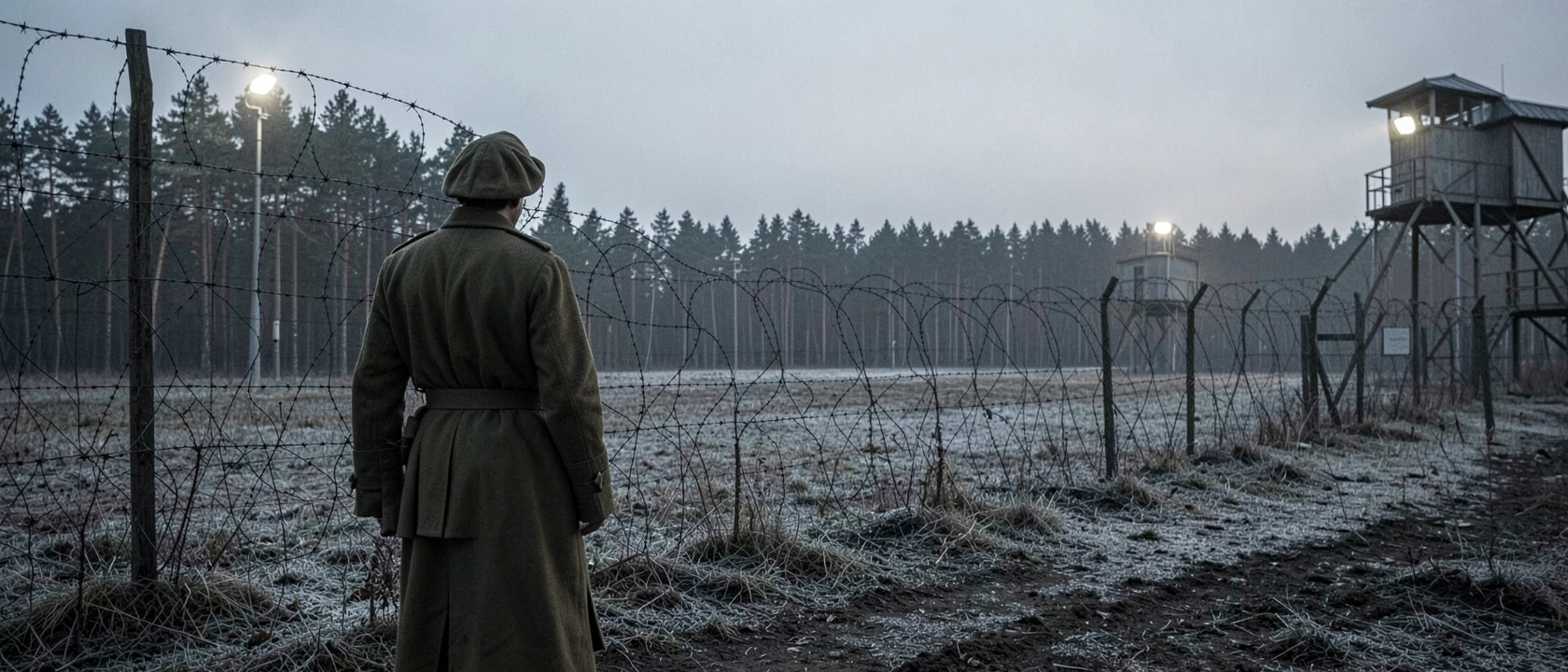
The Morning of April 14, 1943
On the morning of April 14, 1943, a prisoner at Sachsenhausen concentration camp walked toward the electrified perimeter fence and did not stop when a sentry ordered him to halt. The guard fired. The prisoner was Yakov Dzhugashvili, 36 years old, held in a section of the camp the Germans set aside for what they called prominent persons: a mix of Allied officers and relatives of enemy leaders, kept apart from the general camp population near Oranienburg, roughly 30 miles (48 km) northwest of Berlin. That status is the only reason his death produced a written record at all. What is documented is plain enough: a prisoner near the wire, a shot fired, a death logged. What his intent was that morning is a question the file itself does not settle.
A Son Who Was Never Quite Wanted
Yakov Dzhugashvili was born on March 31, 1907, near Kutaisi, then part of the Kutais Governorate of the Russian Empire. His mother, Ekaterine “Kato” Svanidze, died within months of his birth; accounts differ on whether typhus or tuberculosis killed her. His father, at the time still using his birth name, was largely absent, and Yakov was raised by his mother’s relatives in Georgia. In 1921, at age 14, he was brought to Moscow to live with a father who had become a senior figure in the young Bolshevik government. He arrived speaking little Russian. Sources describe him as a quiet, unhappy teenager who attempted suicide more than once, reportedly after a relationship his father opposed. One person in the household who took his side was Stalin’s second wife, Nadezhda Alliluyeva. She died by suicide in November 1932, and Yakov lost the one adult in that house who had gone out of her way for him.
Capture and the Refused Trade
Germany invaded the Soviet Union on June 22, 1941. Within weeks Yakov’s artillery unit was destroyed, and records place his capture in July 1941, during the fighting around Smolensk. Even that moment is disputed: his own daughter, Galina, later argued he was never taken prisoner at all and had been killed in combat that year. The version most historians accept has him held as a prisoner of war from 1941 onward, the highest-ranking Soviet captive with a direct family tie to the country’s leader. In early 1943, after Field Marshal Friedrich Paulus surrendered at Stalingrad, Germany reportedly offered to trade Yakov for him. Stalin refused. Different sources give different wording for what he said, and no single surviving order confirms either the offer or the refusal. Historians treat the story as probable, not proven.
The Report That Went to Ribbentrop
On April 22, 1943, eight days after the shooting, Heinrich Himmler forwarded a report on Yakov’s death to Foreign Minister Joachim von Ribbentrop. It described the shooting as an escape attempt, a prisoner who ignored a sentry’s order and ran for the wire. It also described friction in the hut Yakov shared with four British prisoners of war and another Soviet officer, Vassily Kokodin, a nephew of Soviet Foreign Minister Vyacheslav Molotov, including an argument over a fouled latrine. That detail comes from the SS file alone; no British account of the dispute has surfaced to confirm or contradict it. Ribbentrop had, on paper, a propaganda opening: proof that Stalin’s own son had died a prisoner in German hands. He chose not to release it.
Buried in a Garden
The report went into German government files and stayed there for the rest of the war. In May 1945, after Germany’s surrender, Allied intelligence officers recovered it, microfilmed and buried in the garden of a German diplomat. It was sent to London for examination. Two months later, Stalin, Winston Churchill, and Harry Truman met at the Potsdam Conference to settle the shape of postwar Europe. British officials reportedly considered telling Stalin what the file said about his son. They decided not to. The document went back into a file, this time in London rather than Berlin, and the question it might have settled stayed unresolved for years afterward.
A Story With Nowhere to Go
In January 1951, the Daily Telegraph reported that Soviet agents were still asking about Yakov’s disappearance, with a reward on offer, given as one million roubles in one account and as $250,000 in another. Neither figure was confirmed, and no follow-up story appeared. London did not volunteer what its own files held, and Moscow, if it knew more, said nothing further in public. Stalin died in March 1953, at 75, with the matter still unresolved on both sides.
The Bill
The direct cost of this story is one life: a Red Army lieutenant, 36 years old, shot at a camp fence after two years of captivity and a lifetime of distance from his father. Set against the scale of the war, that death was not unusual. An estimated 2.8 million Red Army prisoners of war died in German captivity in the first twelve months after the invasion alone, from starvation, exposure, and disease. What set Yakov’s death apart was not the manner of it but the paperwork. It was recorded, filed, and deliberately withheld, first by the government that caused it and then by the government that found the file. The report came out of classification roughly three decades after the war ended, by which point most of the people who might have wanted the answer were also dead.
What Still Isn’t Known
Three questions remain open. The German report called the shooting an escape attempt. A Russian investigation completed in 2000, drawing on the work of historian John Erickson, concluded instead that Yakov died by electrocution on the fence and that the guard’s shot went into a body already dead, a reading that points toward a deliberate act rather than a bid to get out. Whether Stalin ever learned any version of this is unknown; the file that might have told him sat in a London office, and there is no record he was shown it. And it is worth asking why British officials, weighing whether to pass the document on, appear to have accepted an account written entirely by the SS, with no way to check it against anyone who had actually shared that hut. What survives from a war is what someone chose to write down, and someone else chose to keep.