St John’s Field, Late February 1461
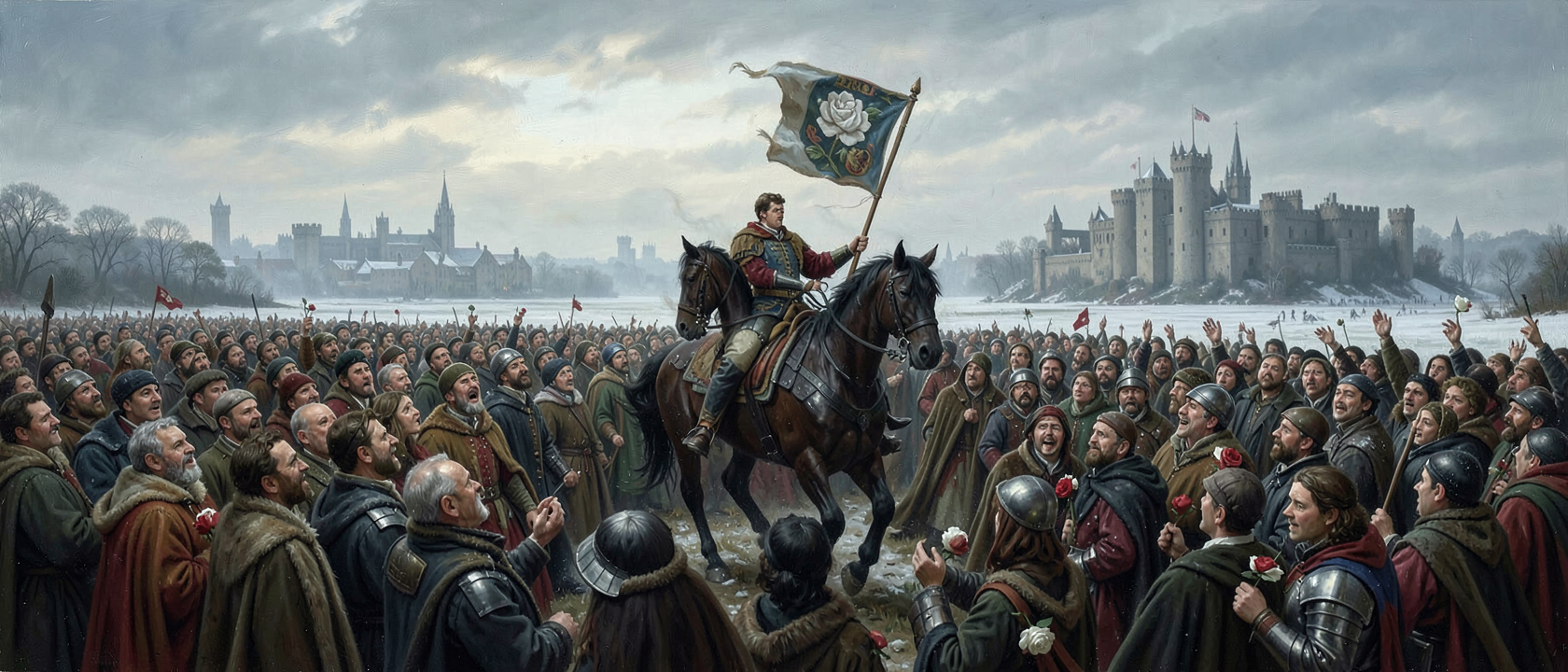
Sometime around the turn of March 1461, a crowd gathered at St John’s Field, open ground outside London’s walls in what is now Clerkenwell. One chronicler, writing later in the 15th century, puts the date at February 28; most other secondary sources place it a day later, on March 1. The exact day is disputed and probably always will be. The land belonged to the church of St John of Clerkenwell and had long served the city as a gathering place too large for any hall. People had come by proclamation, not by chance, and what waited for them was not a sermon or a market notice. It was a list, read aloud, of the ways King Henry VI had failed the realm: his offenses against it, laid out point by point for a crowd that had come specifically to listen.
Nothing about the scene suggested a battle or a coronation. There was no throne set up, no army in ranks. It was a summons to hear a case made against a sitting king, inside a city still nominally his.
Two Kings, One Crown
By the last days of February 1461, England had two men who could plausibly call themselves king. Henry VI had been crowned and anointed decades earlier, and that fact was not in dispute. What was in doubt was whether anointing still counted for much when a king could not hold the field. The rival claimant was Edward, Earl of March, eighteen years old, son of Richard, Duke of York, who had been killed at the Battle of Wakefield in late December 1460.
Edward had momentum but no crown. On February 2 he had won at Mortimer’s Cross. Fifteen days later, on February 17, Lancastrian forces beat the Earl of Warwick’s army at the Second Battle of St Albans and recovered Henry VI, who had been held by the Yorkists. So by the last week of February, both sides had a recent battlefield win to their name and neither had a settled claim to Westminster. A charge sheet and a shouted verdict in a London field offered a way to break that stalemate without another battle, at least on paper.
The Question and the Answer
Once the list of grievances had been read, the crowd was put a direct question: should Henry VI remain king? The answer, as the chronicle has it, was a single word: “Nay.” A second question followed: should Edward, Earl of March, be made king instead? The answer was “Yea.”
That is the whole exchange as it survives. No argument back and forth is recorded, no show of hands, no dissenting voice, no abstention. The chronicle gives two words and stops. It reads less like a debate than a script with two lines, delivered and answered on cue.
Manufacturing Consent
Whatever it actually was, the scene at St John’s Field did real work for Edward’s camp. A crowd’s shouted “yea” was something his supporters could point to as proof that Londoners, not just soldiers, wanted him on the throne. That mattered because his claim still had to survive contact with the political class, the lords and bishops who would decide who actually sat in Westminster Hall.
None of this looks like a spontaneous rising. It has the shape of a location chosen for its size, a list prepared beforehand, and a crowd that answered as expected, organized most likely by allies of Edward already in London. On March 1, a related sermon was preached by George Neville, Bishop of Exeter, before a large crowd that likewise called for Edward to take the throne, whether the same gathering described two ways or a separate one close in time, the record does not say. Two days after the acclamation, on March 2, Edward was formally proclaimed king. A great council met on March 3, with the Nevilles, the Archbishop of Canterbury, and the Duke of Norfolk among them, and accepted his claim. On March 4, just over two months after his father’s death at Wakefield, Edward took the formal coronation oath at Westminster Hall, the moment usually marked as the start of his reign. No surviving record ties the shouted verdict at St John’s Field to those later steps by any formal rule. It simply came first, and it fit.
One Chronicler, No Corroboration
The whole episode rests on a single anonymous chronicle, compiled later in the 15th century, not on an eyewitness account or an official record of the kind that survives for council meetings. The chronicler never says who organized the crowd, who read out the charges, or how many people actually stood in the field that day. As already noted, other secondary sources place the acclamation itself a day later than this chronicler does, on March 1 rather than February 28. Whether the sermon and the acclamation were one event described two ways, or two gatherings close together in time, no source settles the question.
Historians treat the account with caution for exactly that reason: one late source, a disputed date, and no clear thread linking the shouted “yea” to the formal steps that followed. It is worth naming plainly what this was not. It was not an election and not a referendum in any sense a modern reader would recognize. Fifteenth-century England had no concept of democratic consultation, and Edward was not leading a popular movement. Reading St John’s Field as an early vote is a mistake worth setting aside before it takes hold.
What It Cost
A shouted verdict in a London field did not end anything. Four weeks after Edward claimed the throne, the two sides met at Towton, in Yorkshire, on March 29, 1461. The fighting lasted roughly ten hours and is often described as the decisive, and bloodiest, battle of the war’s first phase. One widely cited estimate puts total combat deaths across the entire Wars of the Roses at around 105,000, though that figure is an aggregate tally rather than a documented count and should be read as a rough estimate. After Towton, Henry VI, his wife Margaret of Anjou, and their son fled to Scotland.
Acceptance of Edward’s rule was not immediate either. About a week after Towton, townsmen in Bedford’s marketplace publicly declared Edward and his supporting lords traitors. Later that same month, a London grocer named Walter Walker was executed at Smithfield for words spoken against the new king. It took three more years of campaigning, concentrated in Northumberland and backed by Scottish and French support, to break organized Lancastrian resistance, through battles at Hedgeley Moor and Hexham in 1464. Henry VI himself was not captured until the middle of 1465, taken in Lancashire and shut in the Tower of London. The “yea” shouted at St John’s Field had cleared a path to Westminster Hall. It took years of fighting after that to make the throne it pointed to worth holding.