
The Ice on the River
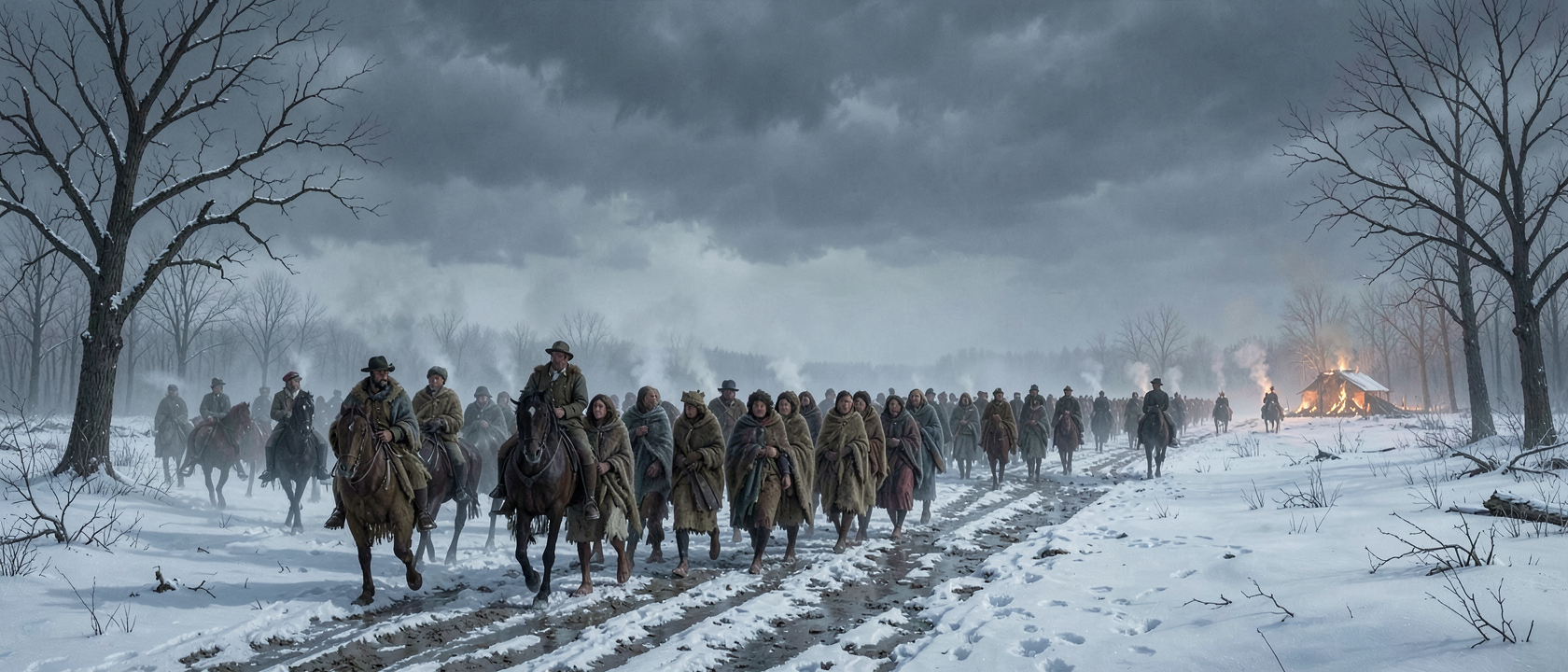
In December 1831, a French magistrate named Alexis de Tocqueville stood on the bank of the Mississippi River at Memphis and watched a group of Choctaw families cross the river in the cold of December. He had no stake in what he was watching. Tocqueville and his traveling companion, Gustave de Beaumont, had arrived in America seven months earlier, in May 1831, sent to study the United States penal system. What he found at Memphis had nothing to do with prisons.
The people crossing were Choctaw, on their way to the region the US government called Indian Territory (present-day Oklahoma). Tocqueville counted 373 of them boarding to cross that day, a figure he recorded himself. What struck him was the quiet. “No cry, no sob, was heard among the assembled crowd; all were silent,” he wrote. Of the crossing itself, he added only one more line: “Never will that solemn spectacle fade from my remembrance.”
Tocqueville was not a government official and not an activist. He was a visitor with no policy to defend, which is why his account still matters: almost every other surviving record of the removal comes from the government that was carrying it out.
Ninety Percent Gone Already
Land loss for the Cherokee started long before 1830. Between 1684 and 1819, they signed 28 treaties with colonial and then US authorities, and by the last of them they had given up more than 90 percent of their original territory.
By 1830, Georgia and Alabama had gone further, declaring that state law now applied on Native land inside their borders and that tribal law there no longer counted. Mississippi and Tennessee followed. This directly contradicted federal treaties that had already recognized self-government for the Cherokee, Creek, Choctaw, Chickasaw, and Seminole nations. President Andrew Jackson backed the states, not the treaties. “My white children have extended their law over your country,” he told the Creek nation. “You must be subject to that law.”
Before Jackson signed anything, the legal ground had already shifted under all five nations.
The Signature
On May 28, 1830, Jackson signed the Indian Removal Act. On paper it authorized a trade: the federal government would negotiate an exchange of eastern land for land west of the Mississippi, and it promised to cover the cost of relocation, a year of support after arrival, and compensation for property left behind. The law described the whole process as voluntary.
In practice, promises gave way to deception, broken agreements, and, where those failed, soldiers. The Choctaw were the first of the five nations moved under the new law, and their removal began almost at once. It was that removal, the following winter, that brought Choctaw families to the Memphis riverbank where Tocqueville stood. The phrase later attached to the whole era, “Trail of Tears,” comes from an 1838 newspaper account of the Choctaw removal, in which a Choctaw chief described the migration as a trail of tears and death.
Rounded Up at Gunpoint
The Cherokee removal is the best documented of the five, and the record is grim. Families were driven from their homes at gunpoint and marched into stockades built to hold them. Behind them, their houses were looted and burned. Their graves were dug up and robbed for the silver buried with the dead.
Inside the stockades, cholera and dysentery spread. The march west itself came in the fall and winter of 1838 and 1839. Some Cherokee walked as far as 1,000 miles (1,609 km) over roughly four months to reach Indian Territory. This is the passage now remembered as the Trail of Tears.
The Bill
Around 20,000 Cherokee were forced onto that road. An estimated 4,000 of them died, from the disease that spread through the stockades and from the hardship of the march itself. Some estimates put the toll twice as high, at 8,000. The number is not a confirmed count. No one took a final tally at the time, and historians still argue over the range.
One soldier who took part in the roundups, later a Confederate colonel, had already seen large-scale combat. He said he had watched men “shot to pieces and slaughtered by thousands” in battle, and that what happened to the Cherokee was worse than any of it.
“Without Any Apparent Reluctance”
In December 1838, with the march still underway, President Martin Van Buren, who had succeeded Jackson in office, sent Congress a report on the removal. The measures, he wrote, “have had the happiest effects,” and the Cherokee “have emigrated without any apparent reluctance.”
Jackson had used the same kind of language eight years before, telling Congress in 1830 that the policy of removal was “approaching to a happy consummation.” Neither report mentions the stockades, the burned homes, the disease, or the thousands who did not survive. On paper, both stand as accounts of a policy that worked.
What the Record Doesn’t Say
The figure of 4,000 to 8,000 dead belongs to the Cherokee alone. The Chickasaw, Choctaw, Creek, and Seminole nations walked roughly the same 800 miles (1,287 km), under the same law and, by most accounts, under similarly brutal conditions. No comparably documented death toll survives for any of them here.
One broader estimate, covering all five nations together, puts the dead at between 12,000 and 17,000, a rate of 14 to 19 percent of everyone forced to march. But that figure is a blend, not a breakdown. It cannot say how many Creek died, or how many Choctaw, or how many Seminole. What survives from the removal era is a partial ledger: one nation’s toll recorded closely enough to argue over, and four more where the count was simply never kept.