The Last Man in a Habit
On August 4, 1540, guards led a prisoner named Thomas Epsam from Newgate, the London gaol, to stand before the king’s justices. Epsam had once been a Benedictine monk of Westminster Abbey, one of England’s grandest religious houses. He had spent the previous three years locked up in Newgate for one refusal: he would not swear allegiance to Henry VIII or ask the king’s pardon.
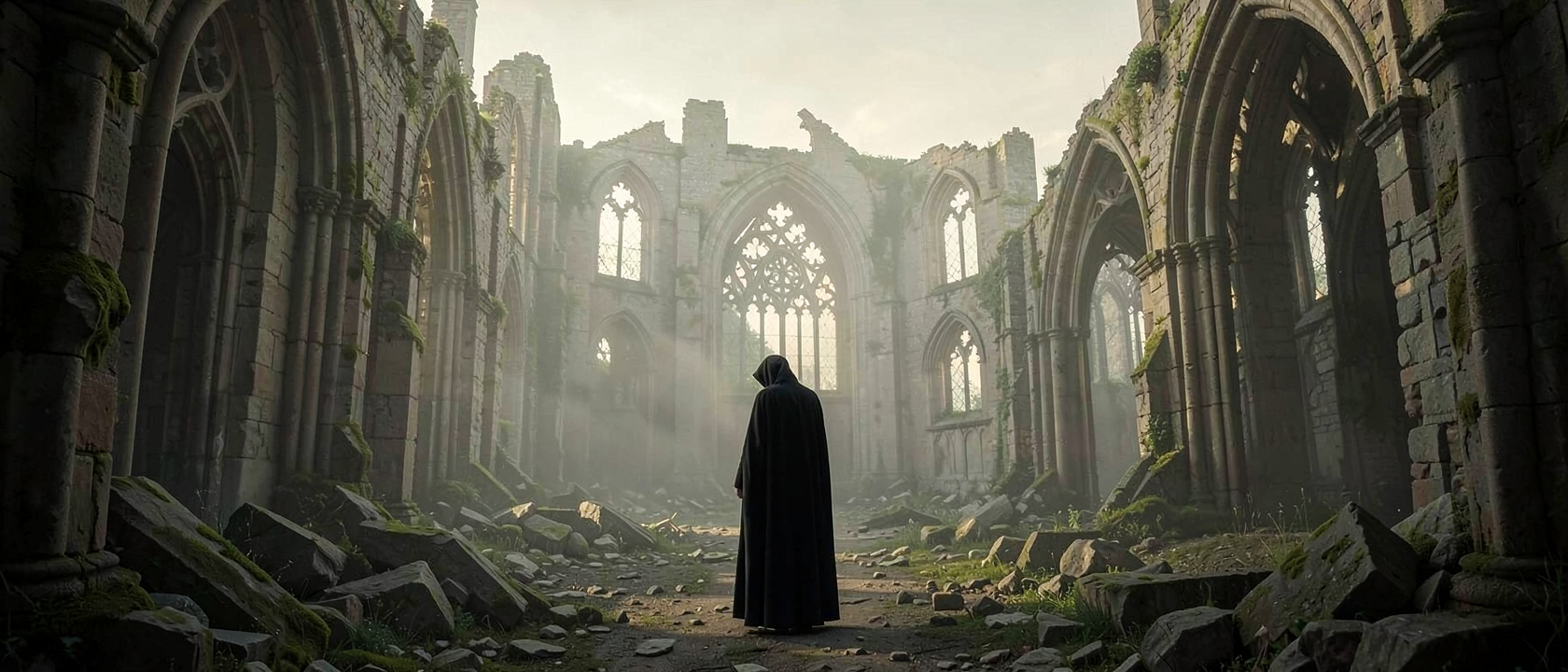
The justices had him stripped of his cowl, the black habit of his order, on the spot. The chronicler Edward Hall recorded the charge against him as “malicious obstinacy,” then added something almost in passing. Epsam, he wrote, was “the last Monke that was seen in his clothing in Englande.”
A System in Good Health
To understand what ended at Newgate, it helps to go back more than thirty years, to the reign of Henry VII, who died in 1509. He had planned a family chantry, a chapel endowed for masses to be said for the dead, centered on Westminster Abbey but reaching out to thirty churches across the country. It was a statement of dynastic ambition, and it was also proof that the crown still saw monastic religion as central to national life.
That confidence held for some time. Building programs continued at English monasteries into the early sixteenth century. Recruitment stayed strong: Hyde Abbey took in five new monks at Easter 1535, Peterborough seven at Michaelmas, Tynemouth four. According to James Clark’s research, at least one house was still taking in novices as late as the winter of 1539, a detail drawn from a single source and worth noting as such. Over the final three decades before the dissolution, more monks went on to university than in the previous century and a half combined, a sign that some houses were building toward an educated future, not drifting toward closure.
No One Was in Charge
Parliament opened the process in 1536, targeting the smaller houses first. A second act in 1539 reached everything that was left. In between, the closures did not move as a single campaign run out of London. They moved house by house, county by county, at whatever pace the local agent set, under Thomas Cromwell, the king’s chief minister, who was supposed to be overseeing the whole machine.
In July 1538, one of Cromwell’s agents, a visitor named Ingworth, wrote asking what he was meant to do about the friars in his district. He waited five weeks for an answer. Cromwell had oversight on paper. In practice, the process ran on delay, improvisation, and whatever instructions eventually caught up with the men doing the work on the ground.
The Reckoning
By the time Epsam stood before the justices, there was almost nothing left to close. In the week before Easter 1540, the Augustinian abbey of the Holy Cross at Waltham, in Essex, became the last monastic house dissolved on the English mainland. A small Cistercian community at Rushen, on the Isle of Man, held on until June 24, 1540.
Five years earlier, there had been roughly 850 monastic houses across England and Wales, and an estimated 10,000 monks, nuns, canons, and friars living in them (other counts run as high as 12,000, depending on how the different orders are tallied). Those houses were not separate from the world around them. Monastic communities had shaped field systems, cleared woodland, built roads, bridges, and ferries, and given towns much of their physical layout. Most religious received a pension when their house closed; a handful of abbots who refused to surrender were executed instead. Epsam’s case sits between those two outcomes: three years in prison, then a public stripping of his habit, and after that, nothing more recorded of him at all.
Design or Drift? A Historian’s Case
Historian James Clark, a professor at the University of Exeter, argues in his 2022 book that both the standard Protestant version of this story, reform overdue, and the standard Catholic version, sacrilege by design, get the mechanics wrong. Reviewing the book, Mathew Lyons lays out Clark’s case plainly: there was no master plan. What closed England’s monasteries was a run of decisions and indecisions made by a government that was often distracted, carried out by agents who were frequently under-resourced and working out policy as they went.
Lyons also points to what the book leaves out. It says little about the inner religious life of monks and nuns in their final years, the part of the story hardest to document from letters, inventories, and acts of Parliament. That gap stays open. It is not resolved here, and it is not claimed to be.