
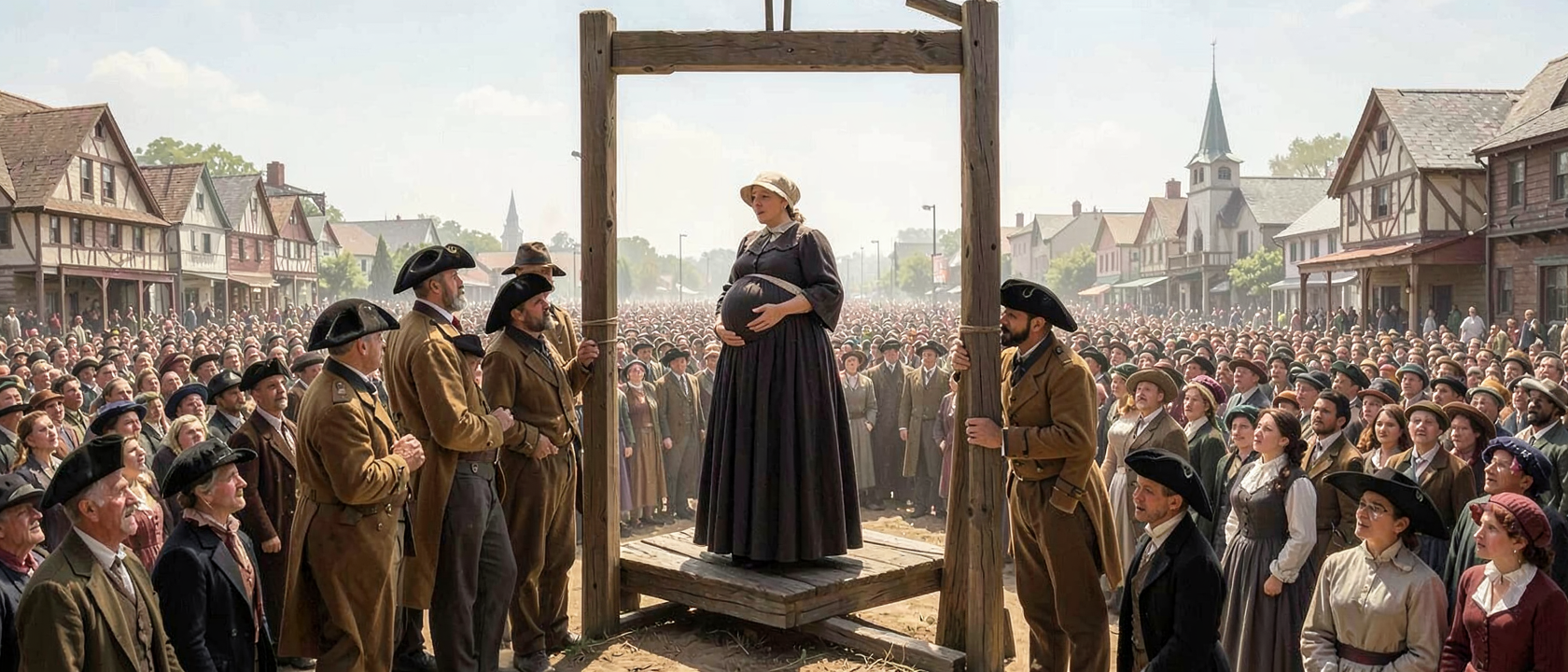
The Gallows, 1778
On July 2, 1778, four people condemned for murder were led out to a gallows near Worcester, Massachusetts. An estimated 5,000 spectators had traveled in to watch, in what accounts from the day describe as a carnival-like atmosphere. Among the condemned was Bathsheba Spooner, convicted of arranging the killing of her husband, Joshua Spooner, a well-to-do farmer in Brookfield whose body had been beaten and dropped down a well. Beside her stood her three co-conspirators: Ezra Ross, a sixteen-year-old she had taken as a lover, along with Private William Brooks and Sergeant James Buchanan.
The trial had taken a single day, held at Worcester’s Old South meetinghouse on April 24, 1778. The court set the hangings for June 4. In late May, Spooner petitioned the judge, recorded in the surviving account only as Cushing, to delay her execution. She said she was pregnant, and asked for the protection English common law gave to a woman in that condition. Cushing granted a stay and moved her execution date to July 2, the day the crowd had gathered for.
A Law Older Than the Country
The protection Spooner invoked was old. English courts had used some version of it since at least 1387, when the surviving record already treats it as routine practice. Under the rule, a woman sentenced to death could ask to be examined for pregnancy, and if she was found “quick with child,” meaning far enough along that she herself could feel the fetus move, her execution was postponed until after she gave birth. The plea became known informally as “pleading the belly.” Historians give different figures for how long the custom ran in England, from roughly seven centuries to close to a thousand years, depending on which starting point they use.
The examination behind it was never medical in any modern sense. The court convened a jury of matrons, usually a panel of twelve married women, to inspect the condemned woman and give a verdict by physical judgment alone. What qualified them was not training but status: they were wives and mothers, and the court treated that experience as a substitute for clinical knowledge. That was the system Massachusetts inherited from England and still relied on in 1778, two years after declaring independence from the government that had built it.
The Matrons Convene
For Spooner’s case, the court assembled a panel of twelve women along with two male midwives. They examined her and swore, as a group, that she was not quick with child. Her confessor, the Reverend Thaddeus Maccarty, protested the finding. So did some of the examiners themselves: four of the original panel, joined by another midwife and by a physician who was Spooner’s own brother-in-law, broke with the verdict and said she was pregnant.
The protest changed nothing. The court let the original ruling stand. On July 2, Bathsheba Spooner went to the gallows alongside Ross, Brooks, and Buchanan.
Her Last Request
Before she died, Spooner asked for one more thing: that her body be opened afterward, to settle the question the matrons had already closed. That evening, a group of surgeons carried out the examination. She had been pregnant after all, carrying a male fetus of roughly five months’ gestation.
The matrons had been wrong. Massachusetts had hanged a convicted woman and, along with her, a fetus old enough that the very law Spooner had invoked was supposed to have bought it more time.
What the Record Doesn’t Say
The surviving record is precise about some things: the meetinghouse, the April trial date, the July execution, a crowd near 5,000. It goes quiet on others. No source names the physician who argued, correctly, that Spooner was pregnant. No source explains what the examiners looked for or why twelve women and two midwives reached the verdict they did. A sermon Maccarty preached on the day of the execution survives in print and is the likely source for what is known about the autopsy, but the exact wording describing the fetus has not been confirmed outside that single document.
Sources also describe Spooner’s trial as the first capital case to come before a Massachusetts court since the Revolution began, and they describe her as the first woman executed in the United States under American rather than British authority. Both claims are given across more than one account and treated there as settled fact, not speculation.
Separately, some accounts suggest, more cautiously, that the case drew less public outrage than it might have because wartime attention was fixed elsewhere. That claim is offered as a probability rather than a documented fact, and it should be read as one.
A Pattern, Not a One-Off
Spooner’s execution was not the only time a jury of matrons got the question wrong, and it was not the only time one got it right. The practice continued in English and American courts long after 1778, fading only as capital crimes grew rarer and medical understanding of pregnancy improved. It was not abolished until 1931. In the twentieth century alone it was used at least eleven times, accounting for more than one in ten of the death sentences handed to women in that period.
One of those cases ran the other way. In 1913, Ada Annie Williams was convicted of murdering her four-year-old son. After sentencing, she claimed to be pregnant. This time the jury of matrons agreed, her execution was postponed until she gave birth, and by then her sentence had been commuted.
Two juries of matrons, working from the same doctrine, more than a century apart. One found a claim false and let a hanging proceed. The other found a claim true and the hanging never resumed. The law offered both women the same safeguard. What decided the outcome was who sat on the panel, and what they were willing to see.