
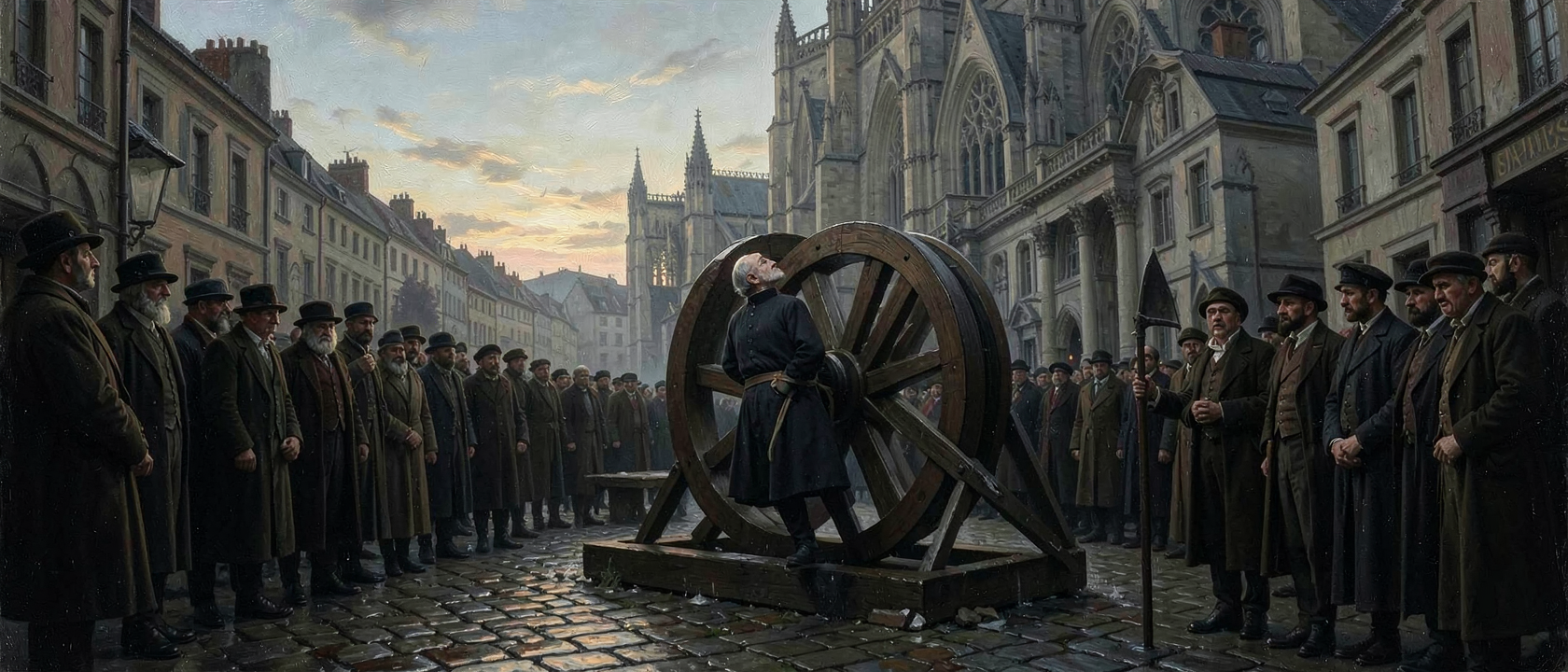
A Body in the Doorway
On the evening of October 13, 1761, the Calas family sat down to dinner above their shop on a cloth merchants’ street in Toulouse. Jean Calas, a Huguenot textile merchant in a city that was almost entirely Catholic, was at the table with his wife, Anne-Rose, two of his sons, and a family friend named Gaubert Lavaysse, who was staying the night. Marc-Antoine, the eldest son at 29, left the table early. Some time later his younger brother Pierre went downstairs and found him hanging in the doorway that opened onto the street.
Why a Dead Son Was Dangerous
Marc-Antoine had trained as a lawyer, but he could not practice. French rule required a certificate from a Catholic priest attesting to a candidate’s religious orthodoxy, and the Calas family was Protestant. That barrier fed a rumor after his death: that he had meant to convert to Catholicism, and that his father had strangled him to stop it. Toulouse had its own rule for the other explanation. The body of anyone who died by suicide was dragged face down through the streets by a horse and left on the city’s rubbish heap. Murder invited a charge of religious violence against the father. Suicide condemned the son to public disgrace. There was no safe story to tell, and the family would be judged by whichever one they chose.
The Investigation Turns
News of the death spread fast. Rumors held that Jean Calas had strangled his son to stop a conversion, and soon everyone who had been in the house that night was under arrest, including Jean, Anne-Rose, Pierre, the household’s Catholic servant, and the guest, Gaubert Lavaysse. The family had first called it murder. Now they said their son had hanged himself. The official running the inquiry, David de Beaudrigue, who held the Toulouse municipal office known as capitoul, did not accept that account. Questioning stretched from October 1761 into February 1762, and what had started as a family’s loss had narrowed, decision by decision, into a case against the father’s life.
March 10, 1762: The Wheel
On March 9, 1762, the Parlement of Toulouse, the region’s high court, convicted Jean Calas. The sentence was death by breaking on the wheel, in a public square called the place Saint-Georges, in front of the cathedral. First the court used torture to make him name accomplices. He endured what was called the ordinary question, a stretching device, and then the extraordinary question, in which large amounts of water were forced down his throat, pitcher after pitcher, to produce the sensation of drowning. Calas implicated no one and kept saying his son had taken his own life. He was then taken to the square, strapped to a wheel with his face to the sky, and his limbs were broken with an iron bar. By one account it took about two hours, not a precise figure, before the executioner strangled him as a form of mercy. His body was burned afterward.
What the Family Was Made to Pay
The torture carried a second threat that had nothing to do with guilt. If Jean broke and named his family, Pierre would face his father’s death and Anne-Rose would hang. He said nothing that could be used against them. What happened to Pierre and Anne-Rose after the execution is not something the record covers here. That gap stands as it is; it is not a place for guesswork.
Voltaire and the Reversal
In 1763 the philosopher Voltaire published his Traité sur la tolérance (Treatise on Tolerance), built around the Calas case. He had examined the evidence himself and concluded suicide was the likelier explanation, pointing to gambling losses Marc-Antoine had suffered shortly before his death. The book turned the case into a public campaign. In 1764 the Royal Council annulled the Toulouse court’s judgment, and on March 9, 1765, three years to the day after the Parlement had voted to condemn him, a panel of judges formally declared Jean Calas innocent. What evidence or argument carried that panel, beyond the verdict itself, is not spelled out in the record consulted here. Afterward, the family’s confiscated property was restored, and the king sent money to the widow.
The Magistrate’s End
David de Beaudrigue, the capitoul who had rejected the suicide account and driven the case toward execution, later tried to take his own life. The first attempt failed. The second did not. The record states that it happened. It does not say why, and it does not tie the act to the Calas case. Whatever connection a reader draws between the two is the reader’s own to make.