
Indianola, May 1856
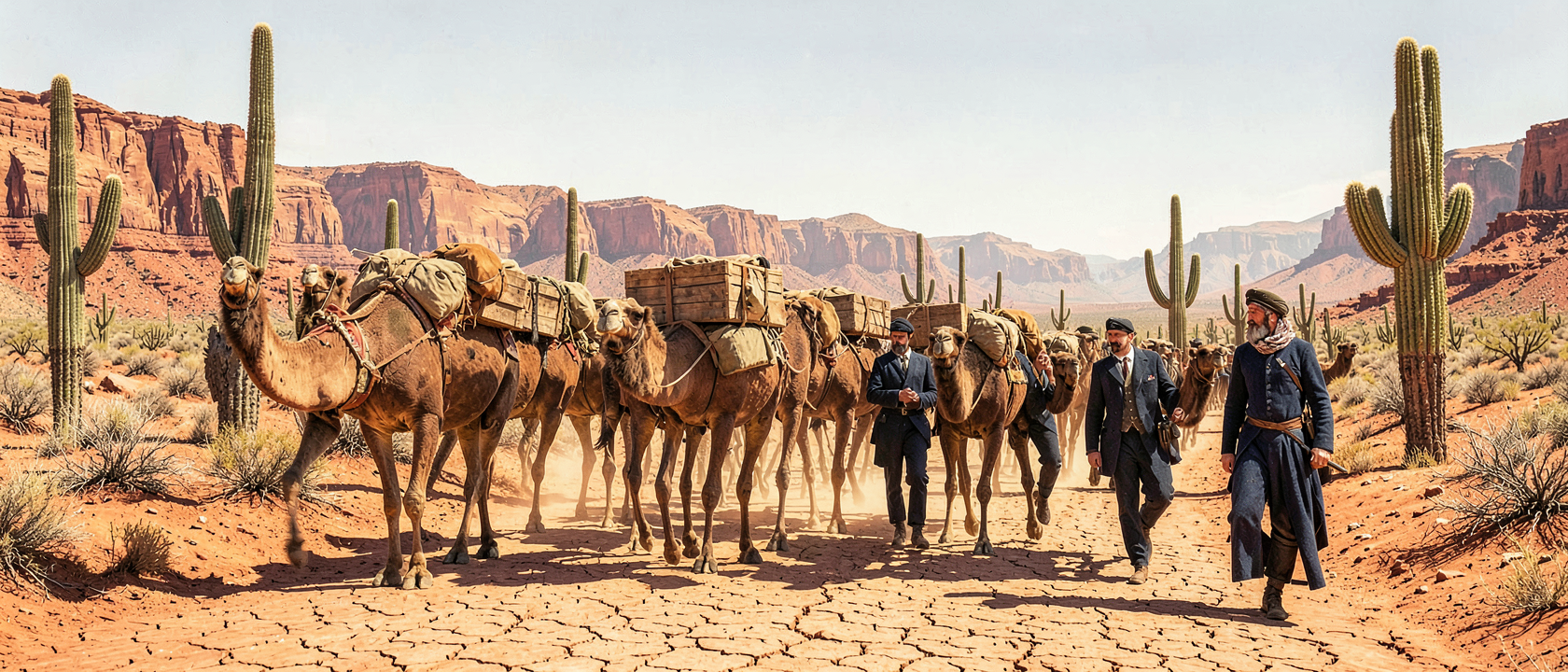
The USS Supply came into the harbor at Indianola, Texas, in May 1856, carrying one of the odder cargoes the US Navy ever delivered. On board were 34 camels, bought during a months-long buying trip through Tunisia, Malta, Greece, Turkey, and Egypt. One animal had died crossing the Atlantic, but two calves were born at sea and survived, so 34 came down the gangway onto Texas sand. Other accounts put the original number procured at 33, before losses and births reshuffled the count. Either way, the idea had finally become a cargo manifest.
The idea behind them was two decades old by then. Major George H. Crosman had written to the War Department as early as 1836, arguing that camels could carry loads and endure labor no horse could match. George Perkins Marsh picked up the thread later, while serving as US envoy in the Ottoman Empire in the early 1850s. He watched Arab and Bedouin drivers work camels alongside French and British agents in the region, and in an 1854 speech at the Smithsonian he called the camel both a “beast of burden” and an “animal of war.” By the time the Supply tied up at Indianola, the idea had survived two advocates and a long silence in between.
A Problem Horses Couldn’t Solve
The reason any of this mattered went back to the Mexican-American War. When it ended in 1848, the United States gained a vast stretch of new territory: Arizona, California, Nevada, Utah, and parts of several other states, most of it desert. The Gadsden Purchase of 1853 added a further strip of land in southern Arizona and New Mexico. None of it came with roads.
Moving soldiers and supplies through that country meant crossing the Sonoran, Mojave, Chihuahuan, and Great Basin deserts without reliable water or forage along the way. Horses and mules needed both, often, and the Army’s outposts sat far enough apart that resupply was slow and uncertain. In 1853, Jefferson Davis took over as Secretary of War under President Franklin Pierce, and he treated the camel as a logistics fix rather than a curiosity: an animal built to cover more ground between water stops than anything the Army had on four legs. He pressed Congress for the money to try it.
The Buying and the Second Shipment
Congress appropriated $30,000 for the experiment on March 3, 1855, enough to send Major Henry C. Wayne across the Atlantic to buy camels and ship them home. Wayne had been pushing the idea since the 1840s and had first raised it with Davis himself. He sailed that June aboard the Supply and spent months working ports between Tunisia and Egypt, buying animals without much expert guidance on which breeds suited desert work. The result was a mixed herd: mostly Arabian dromedaries, a couple of Bactrian camels, and at least one hybrid.
A second voyage brought 41 more camels to Texas in February 1857, after five animals from the first group had died in the interval between shipments. Add it up and the Army now had something close to 70 camels on the ground, bought and shipped for $30,000 that Congress had approved for one specific experiment, not an open-ended program.
Trials in Texas, Then West to California
The Army tested the animals close to home first, marching them on short treks out of Texas to see how they carried real loads over real ground. Then, in June 1857, Edward Fitzgerald Beale took about 25 of the camels on a bigger test: a wagon-road survey running roughly 1,000 miles (1,609 km) from New Mexico toward California. His report back to Congress was favorable. The camels, he wrote, went long stretches without water, by some accounts as long as 36 hours, and carried loads horses could never have managed on the same rations.
In 1858, a camel caravan reached San Francisco, and the city noticed. The San Francisco Evening Bulletin described the animals as giving the streets an Oriental look unlike anything else in the city. For a brief stretch, the experiment was not just working on paper. It was a public event, with crowds turning out to watch.
The Program That Wasn’t Scaled
What followed was mostly nothing. Beale’s report sat in Congress as a favorable record, and the War Department did not act on it. No second buying voyage followed the 1858 spectacle in San Francisco. No wider rollout reached other desert garrisons. Between 1858 and 1860, the Camel Corps stayed exactly the size it had been since February 1857: tested once, praised once, and left alone after that.
Camp Verde, 1861
The Civil War reached the program directly. Camp Verde, Texas, had served as the Camel Corps’ headquarters since the animals arrived, and when war broke out in 1861, Confederate troops took the post, along with some of the camels still stationed there. The Army that had spent $30,000 to ship camels across the Atlantic had, by the time the war began, a brief logistical trial to show for it and no lasting military unit. Natalie Koch, a geographer who has studied the episode, places it inside a broader pattern: American settlers importing “Old World” desert models and dressing the military groundwork of westward expansion in romance.
What the Record Doesn’t Say
The sources do not say exactly when the Camel Corps formally ended, only that it happened not long after the war started. Nor do they say what became of most of the roughly 70 camels beyond the handful seized at Camp Verde. Something else is missing too: any contemporary voice doubting the project while it was still running. Beale’s praise survives in detail. If anyone in the Army thought camels were the wrong answer while the experiment was active, no record of that view has come down with the rest of the story.
This gap deserves acknowledgment rather than invention. The camels were real, the $30,000 was real, and for a few years in the 1850s a desert supply plan rode on animals bought off Mediterranean docks. What the record doesn’t say stays unsaid here too, rather than filled in to make the ending feel tidier than it was.