
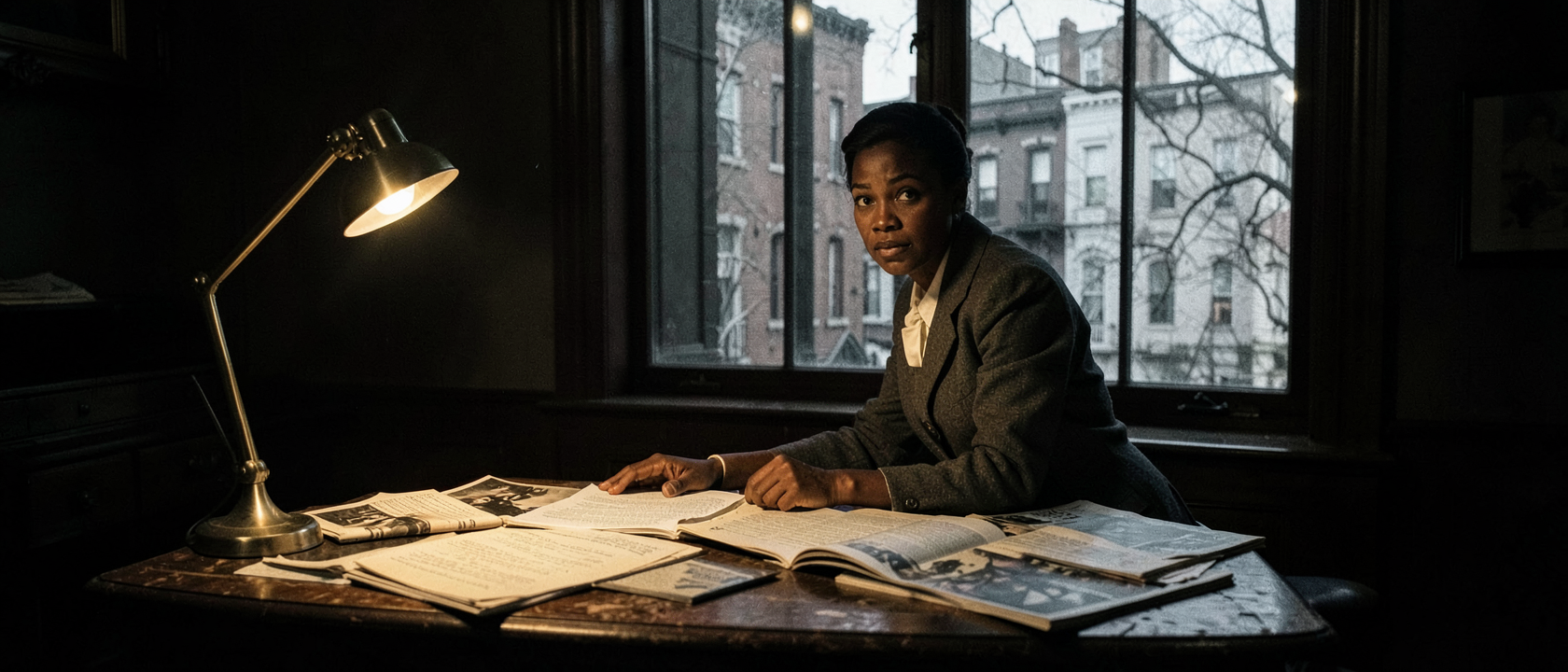
A Story in Forum
In January 1930, the magazine Forum printed a short story called “Sanctuary.” It ran only a few pages: a Black mother shelters a wounded man fleeing the law, only to learn partway through hiding him that he is the one who killed her son. The story ends without spelling out what that knowledge changes, since her choice to protect him has already been made.
The author, Nella Larsen, had trained as a nurse before she published a word of fiction. She studied at the Lincoln Hospital Training School for Nurses in New York and later worked, from 1915 to 1921, at John A. Andrew Hospital in Alabama and for the New York City Department of Health. Larsen said she first heard the story behind “Sanctuary” during her training years, sometime between 1912 and 1915, from a patient who told it to her the way folklore gets told, passed along rather than composed.
A Writer at Her Peak
By 1930, Larsen was not a newcomer. Her first novel, Quicksand, appeared in 1928, and her second, Passing, in 1929. Both put her among the central figures of the Harlem Renaissance, the wave of Black literary and artistic work centered in New York City during the 1920s. In 1930, Larsen became the first African American woman to receive a Guggenheim Fellowship, a grant meant to fund her travel in Europe while she kept writing.
That kind of visibility cut both ways. More readers meant more critics, and Black writers of the period were already judged under a sharper, often harsher scrutiny than their white peers. A story published by a writer at the height of her reputation had more eyes on it than one published by nobody in particular.
A Familiar Plot
It did not take long for someone to notice. Readers in Harlem’s literary circles began pointing out that “Sanctuary” matched, almost beat for beat, a story the British writer Sheila Kaye-Smith had published eight years earlier, in 1922: “Mrs. Adis.” There, too, a wounded man takes shelter in a woman’s house after telling her he has shot someone, and she hides him before learning who he actually killed.
The arts patron Harold Jackman wrote to the poet Countee Cullen that year laying out the resemblance, noting that the dialogue matched Kaye-Smith’s story in places and urging Cullen to get both texts and compare them himself. It did not turn into a public accusation right away. It moved the way this kind of thing moved among writers who knew each other, letter by letter, before it hardened into something that could not simply be dropped.
Forum Opens a File
Forum did not ignore the talk. Its editors went back through Larsen’s drafts of “Sanctuary,” the notes and revisions behind the published version, and concluded there was nothing in them pointing to deliberate copying. What exactly in those drafts persuaded them is not recorded. In the magazine’s April 1930 supplement, Larsen published her own account: that she had heard the story as oral folklore from a patient years before she wrote any of it down, and that the resemblance to Kaye-Smith’s work was coincidence, not theft. The editors accepted it and cleared her.
That should have settled the matter. An official finding of no wrongdoing does not erase an accusation once it has already traveled through the circles that decide a career.
A Tale With No Owner
There is an irony in the record that complicates the whole episode. Kaye-Smith herself later acknowledged that “Mrs. Adis” was not original material either. She traced it back to an account written by a French bishop in the 1600s, a version of the same premise, a fugitive sheltered by a woman who comes to learn what he did, apparently retold for centuries before either woman put it on paper.
If that is right, neither writer held any true claim to the story. It had been circulating long before Kaye-Smith wrote it down in 1922, and long before a patient told it to a student nurse sometime around 1912 to 1915.
The Cost
None of that undid what had already happened to Larsen’s standing. In the early 1930s, she wrote three more novels. None found a publisher. “Sanctuary” turned out to be her last appearance in print.
At some point afterward, a point the record does not fix to a year, Larsen stopped writing and went back to nursing, the work she had left in the 1920s to become a novelist. Her marriage to the physicist Elmer Imes, begun in 1919, ended in divorce in 1933. She spent the following decades largely outside literary circles, working as a nurse for the rest of her life, into the early 1960s, before her death in 1964.
What Historians Still Argue
Scholars who have gone back over the case do not agree on how to read it. Kelli A. Larson, writing in the Journal of Modern Literature, finds the overlap between the two stories too extensive to be pure accident, yet also places “Sanctuary” inside a long tradition of writers reworking existing material, closer to adaptation than theft. Rosemary V. Hathaway argues the story should be read on Larsen’s own terms, as a literary retelling of folklore she carried from her nursing years, not a lift from Kaye-Smith at all.
Hildegard Hoeller, in African American Review, takes a different angle: whatever the truth of the borrowing, the scandal itself did the damage, and Larsen’s reputation never recovered from it. The three readings do not agree, but the record underneath them does not move. Forum cleared Larsen within months of the accusation. She never published another book after “Sanctuary.”