
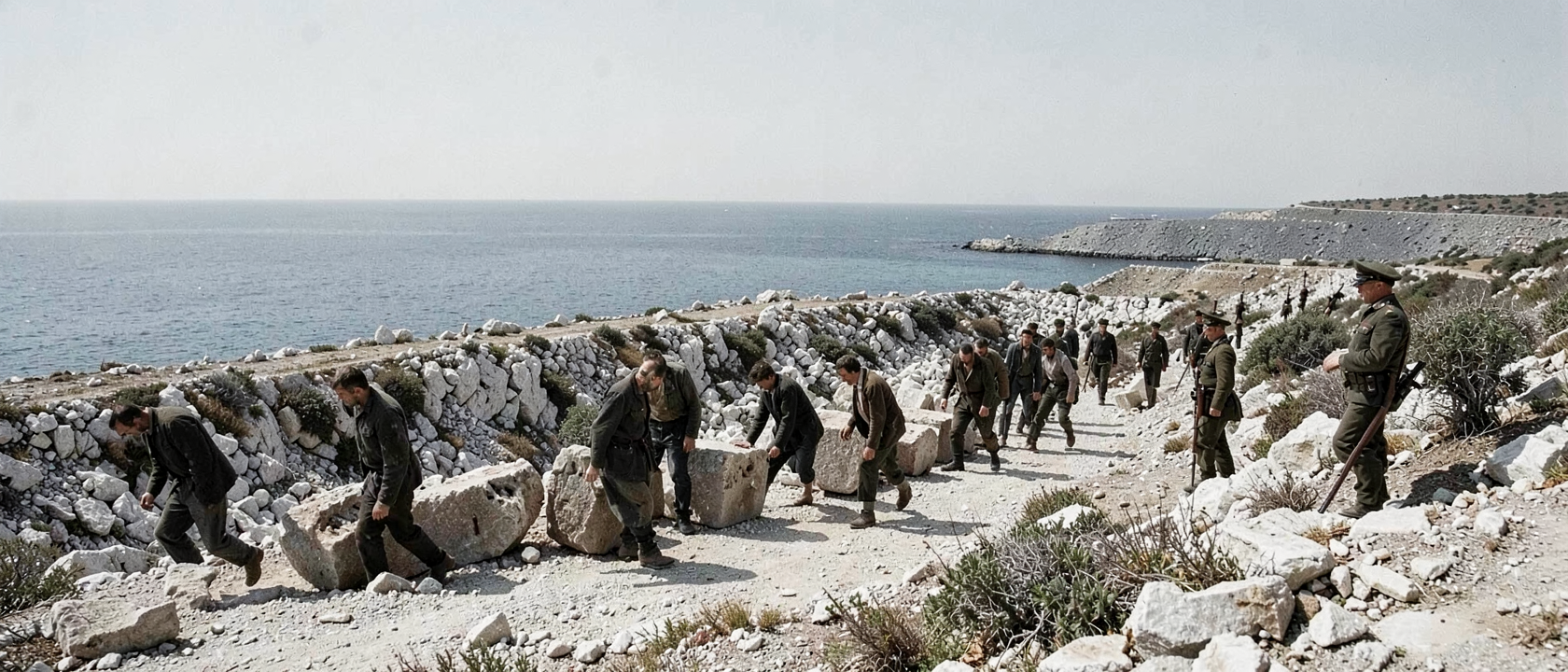
The Marble Worksite
In the summer of 1949, the first prisoners came ashore on Goli Otok, “Barren Island,” a treeless rock in the northern Adriatic Sea off the coast of what is now Croatia, then part of Tito’s Yugoslavia. There was no camp waiting for them, and no fresh water anywhere on the island. Their first order was to build the place that would hold them: quarry stone, lay it, and raise the barracks they would then sleep in.
In the paperwork of the day, the site had a bureaucratic name, the Mermer Worksite, the Marble Worksite. Goli Otok produced no marble at all. The men who built it gave the place a different name of their own, one with a different edge to it: Hawaii.
A Split from Moscow, a Hunt at Home
The camp existed because of a quarrel that had nothing to do with the island itself. In 1948, Joseph Stalin’s Cominform, the Communist Information Bureau linking Europe’s ruling and aspiring communist parties, expelled the Communist Party of Yugoslavia, citing what it called nationalist elements inside it. Josip Broz Tito did not back down, and relations between Belgrade and Moscow stayed hostile for the next seven years, until 1955.
The expulsion left Tito’s own party exposed from within. Some of its members, real or only suspected, still looked to Stalin rather than to Tito. Sorting one group from the other became the job of the UDBA, the Directorate for State Security. For ordinary party members, the UDBA was judge and jury in one body: denounce, interrogate, discipline. The camp did not come first. The fear did.
Sorting the Suspect
Previšić’s research gives a sense of how wide that net was cast. Roughly three-quarters of the civilians the UDBA investigated were sent on to Goli Otok. Several thousand more arrived by a separate route, convicted in military courts. Previšić’s own count puts more than 15,000 people through the broader crackdown; the camp’s own memorial site and other historians give a lower figure, closer to 13,000, specifically for Goli Otok itself. The two counts describe overlapping groups, and the gap between them has never been closed.
Arrival followed a fixed pattern. New prisoners were made to run a gauntlet, a line of inmates, often hardened criminals or former fascists the camp’s authorities used as enforcers, who beat each newcomer as he passed. It was sometimes fatal. Men judged most dangerous, veteran communists and suspected ringleaders, were held in a separate section the prisoners called Peter’s Pit, where conditions were worse still. Previšić’s book records one of them, Milojko Filipčev, answering interrogators there by invoking his father, who had died in 1941 defending Moscow.
Typhus, 1951
According to Previšić’s account, the deadliest single episode in the camp’s history was not an act of violence. In 1951, an outbreak of typhus moved through the crowded barracks. Prisoners kept working through it with little medical care, and Previšić’s research identifies the disease as the single biggest killer on the island, ahead of beatings or exhaustion in any one year.
Aco Singer, Accused Twice Over
One case, as the reviewer Richard Mills points out, shows how little evidence the system actually needed. Aco Singer had survived Auschwitz. On Goli Otok he was accused of having been a Gestapo informant during the war and, separately, of being a Soviet spy afterward. The two charges could not both be true. Neither had to be, for the accusation to hold.
The Death Toll and What Came After
Previšić puts the camp’s direct death toll, from beatings, suicide, heatstroke, and disease, at an estimated 287. He calls it an estimate, not a settled count, and he adds that more prisoners died after release than that figure captures, from injuries and illness carried off the island and never formally attached to it.
Some of the cost never showed up as a death at all. The book records that Zlatko Hill, a survivor, spent the rest of his life avoiding any road along the Adriatic coast that offered a view of the island. Other former prisoners took a different path afterward: some went on to serve for years as informants for the same UDBA that had put them there.
What No One Wrote Down
Large stretches of the record stop short. No document gives an exact date for when the camp’s political prisoners were released; it is tied only loosely to a partial reconciliation between Belgrade and Moscow. Goli Otok itself stopped holding Cominformist prisoners in 1956 and became an ordinary penitentiary, though some political prisoners stayed on until the whole complex closed in 1988. Previšić’s figure of 287 dead may never be firmed up further; other accounts, covering a narrower span of years, put confirmed deaths and serious injuries somewhere between 100 and 400. For decades under Yugoslav socialism, the camp was barely spoken of in public. During the country’s breakup in the 1990s, its memory was put to political use, and by several accounts inflated well past what the archive supports.
The Last Witnesses
Between 2009 and 2012, Previšić interviewed 25 former inmates, one of them already 100 years old, work he called a race against time. By the time the Croatian edition, Povijest Golog otoka, appeared in 2019, more than half of those he had interviewed were dead. None lived to see the English edition. It was translated by Desmond Maurer and Johannah Maurer and published by Stanford University Press in October 2025, 576 pages long, with a foreword by Norman M. Naimark. The last people who could describe Goli Otok firsthand were gone before the book reached English readers at all.