
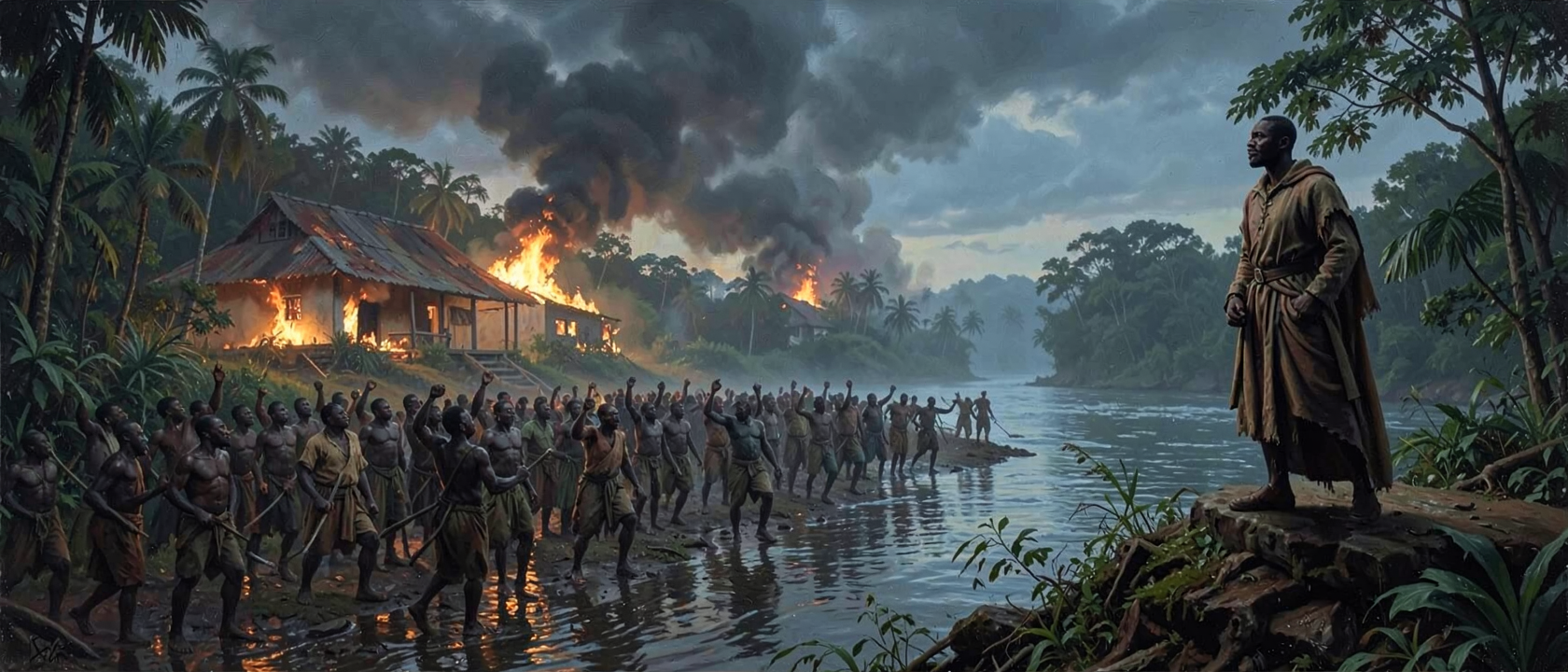
In February 1763, on the coastal plain where the Berbice, Demerara, and Essequibo Rivers meet the Caribbean Sea, in what is now Guyana, an enslaved man working under the name Coffij helped lead an uprising that held Dutch authority at bay for close to a year. By the time it was over, he had declared himself governor of the very colony built to keep people exactly where he had started.
A Name Given, Not Chosen
When a Dutch buyer purchased an enslaved African fresh off a slave ship, giving that person a new name for the plantation register was routine. The man later known as Coffij carried an Akan day-name, pointing to origins in what is now Ghana. In Berbice he worked as a house slave on the Lilienburg plantation, on the Berbice River.
Berbice belonged to the Sociëteit van Berbice, a private trading company operating under Dutch sovereignty. By the early 1760s, the colony held somewhere between 4,200 and 5,000 enslaved people (one period count puts the figure closer to 3,800), alongside about 350 Europeans and roughly 300 indigenous residents.
Fourteen to One
At the high end, that worked out to roughly fourteen enslaved people for every European in Berbice. That ratio shaped daily life on every plantation, and it helps explain why overseers stayed watchful and punishments stayed harsh. A rebellion that spread across plantations would not be a local disturbance; it would be a contest for the colony itself. For the enslaved population, success meant more than escaping one estate. It meant holding ground, building some form of government, and surviving in swamp and forest terrain that few of them knew well enough to call home.
The Governor of Berbice
The uprising began on the Magdalenenburg plantation, on the Canje River, in late February 1763 (the 23rd by one record, the 27th by another). Within weeks, thousands more enslaved people across Berbice had joined. The rebels were not only enslaved Africans and American-born Creoles, mutinous white soldiers fought alongside them too.
Coffij rose to lead this coalition, appointing a man named Accara as his military captain and declaring himself governor of Berbice. On April 2, 1763, he wrote to the colony’s Dutch governor, Wolfert Simon van Hoogenheim, proposing not war but partition: the company would keep the coast, and the freed population would hold the interior. Van Hoogenheim replied that the decision belonged to Amsterdam and could take three to four months to come back. That was a delay, not a refusal, and it gave the Dutch time to bring in reinforcements.
What Broke the Rebellion
The standoff lasted close to a year, by one account roughly ten months of active fighting, by the fuller military record about fourteen months from first attack to final capture. It ended through three forces acting together. The rebel camp broke from within first: months into the conflict, a dispute split Coffij from Accara, whose faction turned on him and won; Coffij died by his own hand. Around the same time, Kalina and Lokono fighters, indigenous to the region, sided with the Dutch, scouting rebel positions and harassing their movements to protect their own trade relationships and land, not out of loyalty to Dutch rule. Then, on January 1, 1764, six Dutch ships arrived with reinforcements, signaling a renewed offensive. The last rebel fighter was captured on April 15, 1764.
The Toll, As Far As It’s Known
Modern estimates put Dutch and allied losses at around 50 dead, against roughly 1,800 among the rebels, approximations, not an official count. How many of the thousands who joined the uprising were recaptured, escaped into the interior for good, or simply vanished from the plantation registers is not stated with any precision.
What is certain is that Berbice remained under Dutch and company control for roughly another half-century after the revolt, until it passed to Britain in 1815.
Found in The Hague
None of this survived in Berbice itself, as monument or local memory. It survived in the Netherlands, in roughly 900 transcripts of interrogations conducted after the revolt’s defeat, along with reports and letters, held in the National Archives in The Hague. Historian Marjoleine Kars worked through that cache and turned it into “Blood on the River: A Chronicle of Mutiny and Freedom on the Wild Coast,” winner of the 2021 Cundill History Prize and the Frederick Douglass Prize. Kars has been candid about the limits of that evidence: the accounts were taken under duress, translated out of Creole into Dutch, summarized by a clerk, and recorded in the third person rather than in the rebels’ own words.
Those documents do not give a full day-by-day account of the fighting, nor a settled count of the dead on either side. Thirty years before Toussaint L’Ouverture led a successful uprising in Haiti, thousands of people in Berbice had already tried, and very nearly managed, to hold a colony of their own. The record of that attempt sat unread for generations, in a language and a filing system built for someone else’s business.