
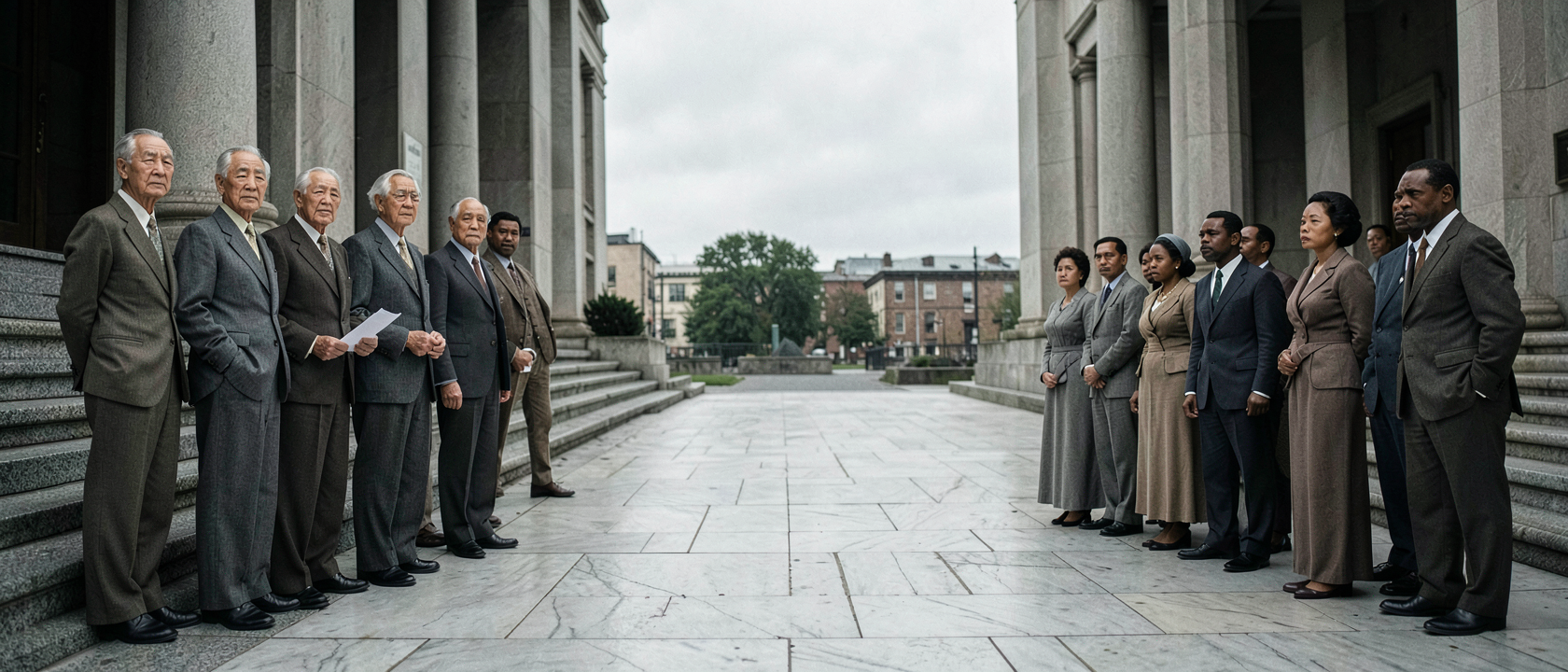
In the summer of 1952, Congress passed an immigration law that did two things at once. It let a generation of immigrants become citizens after thirty years of being barred from it, and it shut a door that another generation of immigrants had used for just as long. Same act, same vote, same year.
The Veto That Wasn’t Enough
On June 25, 1952, President Harry Truman vetoed the Immigration and Nationality Act, which soon carried the names of its sponsors, Senator Pat McCarran of Nevada and Representative Francis Walter of Pennsylvania. Truman called the bill discriminatory, objecting to a quota system that still measured newcomers against the nation their ancestors had come from. Congress disagreed: the House overrode him 278 to 113 on June 26 (some records list it as 278 to 112), and the Senate followed on June 27, voting 57 to 26. The law took effect that same day as Public Law 82-414, over the objection of the one man whose signature it never got.
Two Communities, Two Waiting Rooms
Two groups had something riding on this bill, and they rarely appeared in the same sentence. The first were the Issei, Japanese immigrants barred from citizenship since the Supreme Court’s 1922 ruling in Ozawa v. United States, a bar the Immigration Act of 1924 hardened by cutting off new arrivals from Japan altogether. By the early 1950s some Issei had lived in the United States for three decades, raising American-born citizen children while remaining, under the law, non-citizens themselves. Lobbying for them was Mike Masaoka of the Japanese American Citizens League, an American-born citizen whose own parents stood to gain if the bar fell. The second group was Caribbean immigrants, many of them Black, who had been entering the country for a generation through the route described below. Neither group yet knew the same bill would treat one as the exception and the other as the target.
The Loophole the Caribbean Used
That route went back to the 1920s. US law assigned each country an annual immigration quota, and colonial territories were charged against the quota of the European power that ruled them, not any quota of their own. Britain’s allotment went largely unclaimed by Britons themselves, leaving room to spare. For two decades, people from Britain’s Caribbean colonies filled that room, entering the United States legally through an allotment no one else was using, a settled, functioning path that carried thousands of Caribbean families into the country between the 1920s and the 1940s, with nothing to suggest it would close.
McCarran’s Other Law
Two years before his name was attached to immigration policy, Pat McCarran had already shown what kind of legislator he was. In 1950 he sponsored the Internal Security Act, expanding the government’s power to detain people it judged subversive. Truman vetoed that bill too, on September 22, 1950, warning it posed, in his words, the greatest danger to freedom of speech, press, and assembly since the Alien and Sedition Laws of 1798. Congress overrode him anyway: the House by 286 to 48 without debate, the Senate by 57 to 10 after a twenty-two-hour fight. McCarran’s second major law would carry some of that same instinct for control into immigration.
The Empire Quota
The 1952 act abolished the Asiatic barred zone, which had excluded immigrants from most of Asia outright. But the same law built a mechanism that ran the opposite way for someone else. Under what became known as the empire quota, colonial subjects were counted against the quota of the power that ruled their territory. For Caribbean immigrants from Britain’s colonies, overwhelmingly people of African descent, that meant being charged against Britain’s own allotment, the very allotment they had filled for thirty years precisely because Britain’s citizens rarely used it. The route closed. The Chicago Defender, writing at the time, described the result as a cross-fire between minorities, a sign the trade was visible to people living through it, not something historians had to dig up later.
What Each Side Got, By the Numbers
The arithmetic shows how uneven that trade was. Most countries in what the law called the Asia-Pacific Triangle received about 100 visas a year. Japan’s allotment was larger, though accounts differ, ranging from roughly 135 to 185 visas a year. Estimates put total Asian immigration under the new quotas at around 2,000 people a year, while by one estimate roughly 85 percent of all immigration slots nationwide stayed reserved for northern and western Europeans. The barred zone was gone, but what replaced it was a narrow opening, not an open door. Caribbean immigrants got no equivalent opening at all: their route closed, and nothing replaced it. How many Caribbean immigrants were actually turned away, and how many Issei went on to naturalize under the new law, are numbers the record does not supply.
A Fracture Between Allies
The JACL backed the bill anyway, because Issei naturalization was the goal it had organized around for years. That decision had a cost. Some Chinese and Korean American organizations objected to a law still built on quotas that ranked nations by race, and Masaoka later said he regretted the compromise. Inside the JACL, the critic S. I. Hayakawa went further, saying that buying naturalization for the Issei at the price of the bill’s more troubling features looked like shortsightedness or cynical dealing, and he stopped contributing to the Chicago chapter’s civil rights committee over it. The same trade complicated what cooperation existed between Japanese American organizations and Black civil rights groups, who had watched the empire quota close one door while Asian immigrants got a narrow one open. How long that strain lasted is not something the record settles.
Where It Led
The rift did not stay fixed at 1952. In the years that followed, the JACL moved from a narrow focus on Japanese American naturalization toward broader civil rights and immigration reform, work that helped build support for the Immigration and Nationality Act of 1965, which abolished national-origin quotas and equalized Asian immigration with that of Western Hemisphere nations. McCarran’s other project took longer to unwind: the detention provisions of his 1950 Internal Security Act, which critics called a concentration-camp law, were not repealed until 1971. Even after that repeal, the authority for a president to order mass detention by executive order, the same kind of power used against Japanese Americans in the 1940s, did not disappear from American law. The 1952 act closed one exclusion and opened another. What it did with the power to detain was never fully closed at all.