
Three Months In
In the summer of 1799, the Directory, the five-man executive that governed France after the Revolution, appointed Joseph Fouché as its Minister of Police. Accounts differ on the exact month, July or August, but the timing matters less than what the job controlled: a network of spies and informants, the paperwork that tracked every faction in Paris, and the machinery that could expose a conspiracy before it moved or let one pass unnoticed.
By early November, Fouché had held the post for about three months. That is not long enough to have built loyalty in any direction, Directory or otherwise. The Directory was the government he nominally served. General Bonaparte, recently back from Egypt, was already meeting with men who wanted that government gone. No coup had happened yet. There was only the position, newly filled, and the man sitting in it.
What a Wrong Guess Would Cost
If the plot against the Directory failed, the people behind it faced arrest, and possibly worse. Bonaparte, Sieyès, Ducos, and the others gathered around them had no guarantee of success when they started moving. Any official who had visibly backed them would be exposed the moment the Directory reasserted control.
A police minister could not solve this by doing nothing. Silence was itself a signal. If he moved against the plotters, he committed himself to the Directory’s side. If he stood aside and let the plot proceed, that too would be read, by whoever ended up in power, as a choice. Fouché had to decide, or appear to decide, with no way of knowing which side would still exist by the following week.
November 9: Paris Moves
On November 9, 1799, the first day of the coup, Bonaparte and the men around him, Sieyès, Ducos, Talleyrand, Lucien and Joseph Bonaparte among others, began the move against the Directory in Paris. A plot of this size would normally run straight through the Ministry of Police. Fouché, with his spies already placed across the city, sat at the center of exactly the information network a conspiracy either needs on its side or has to work around.
What the record shows of his actions that day is limited. He did not block the plotters. He also did not step forward and publicly commit the ministry to them. He had, by the account that survives, never backed the losing side in a coup before. On November 9, that record stayed intact simply because nothing had been decided yet.
November 10: Saint-Cloud, Without Fouché
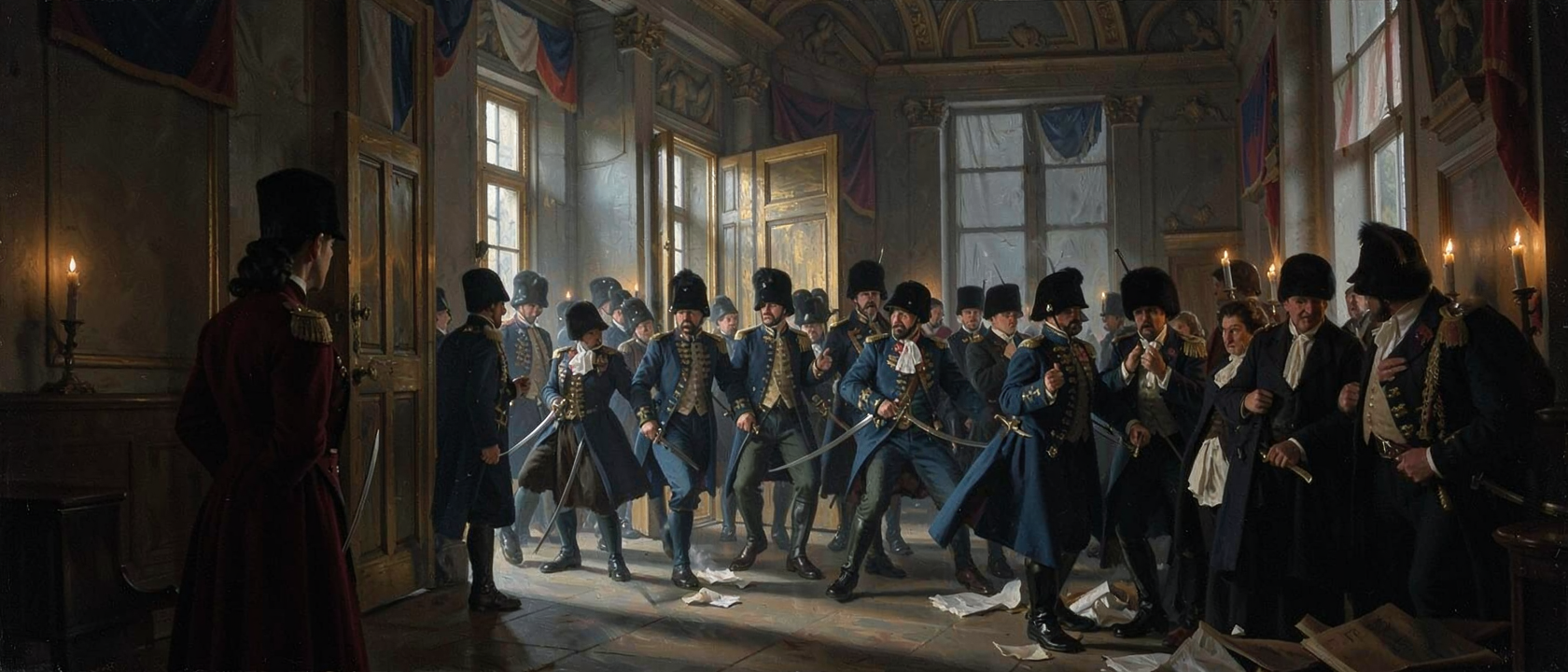
The second day moved the confrontation out of Paris entirely. The legislative councils convened at the Château de Saint-Cloud, and Bonaparte went to persuade the elected representatives of France to accept the change of government he was proposing. The persuasion did not go well.
Fouché was not there. He stayed in Paris and sent his Secretary-General, Thurot, to Saint-Cloud with instructions to watch and report back. This is the hedge in plain view: a police minister, fully aware a coup against his own government was underway at that moment, chose not to be present for its decisive scene. Thurot is said to have warned a colleague, Lavallette, that failure would carry a price, telling him success was essential because he knew his minister well enough to know what the cost of failure would be.
When Argument Failed, Grenadiers Didn’t
Bonaparte’s attempt to talk the councils into accepting the new order broke down. Words were not going to settle this. Joachim Murat’s grenadiers were sent in, and the councils were cleared by force rather than convinced by argument.
This was the hinge. Not the speeches at Saint-Cloud, not the maneuvering of the previous day, but the moment soldiers entered the hall. Before that, the coup’s outcome was still genuinely open. After it, it was not.
The Insurance Policy
Bonaparte later learned something Fouché had not mentioned at the time. While the confrontation at Saint-Cloud was still undecided, Fouché had quietly arranged to have Bonaparte and his fellow conspirators arrested in Paris, in case the attempt collapsed.
This is the second half of the hedge, and it is the core of the whole episode. Staying away from Saint-Cloud was passive caution. Preparing arrest warrants against the man he might soon be reporting to was active preparation for the other outcome. Fouché had committed to neither side until one of them was no longer in doubt.
The Bill
No deaths and no sums of money attach to Fouché’s choice in the surviving record. That does not mean nothing was at stake. His position, and quite possibly his safety, depended on guessing right in a situation where guessing right was not yet possible.
The price he was prepared to pay was not paid in coin. It was paid in flexibility and nerve: the willingness to withhold commitment from both sides for as long as the outcome stayed uncertain, and to accept whatever suspicion that silence drew from either direction. That is a different kind of cost than a coup narrative usually delivers, and it is the one this episode actually has.
Confirmed in Office
The coup succeeded. Bonaparte became First Consul, and a new constitution concentrated power in that office. Fouché was confirmed in the Ministry of Police rather than removed from it.
The same caution that could have ended his career, had Saint-Cloud gone the other way or had the plotters learned what he was arranging in Paris, was the thing that kept him in the post once the outcome was settled. Bonaparte and his colleagues chose to keep him. The sequence runs in that order: the hedge, then the confirmation.
What the Record Doesn’t Say
Three things stay open. When exactly Bonaparte found out about the arrest arrangement, and how, is not recorded; the source only says he learned of it later. Why Fouché chose to stay in Paris instead of attending Saint-Cloud in person is not stated outright, only implied by the caution he showed elsewhere. And what became of the legislators removed from the councils that day is not addressed at all in the surviving account used here. These are gaps in the record, not details smoothed over for the sake of a clean story.