
King’s Lynn, October 9, 1216
On October 9, 1216, King John rode into King’s Lynn, then called Bishop’s Lynn, on the Norfolk coast. The townspeople turned out for him, and the chroniclers who recorded the visit called the welcome a warm one, which was not something John could count on that autumn. Magna Carta had been sealed a little over a year earlier at Runnymede, the barons who forced it on him had risen against him anyway, and in May 1216 Louis, son of King Philip Augustus of France, had landed an invasion force at the rebels’ invitation. John was still crowned and still fighting. During this stretch of the war he was reportedly covering 40 to 50 miles a day, a fast pace for the period, moving his court and his baggage through country where loyalty could not be assumed from one town to the next.
Two Crowns and a King’s Ransom
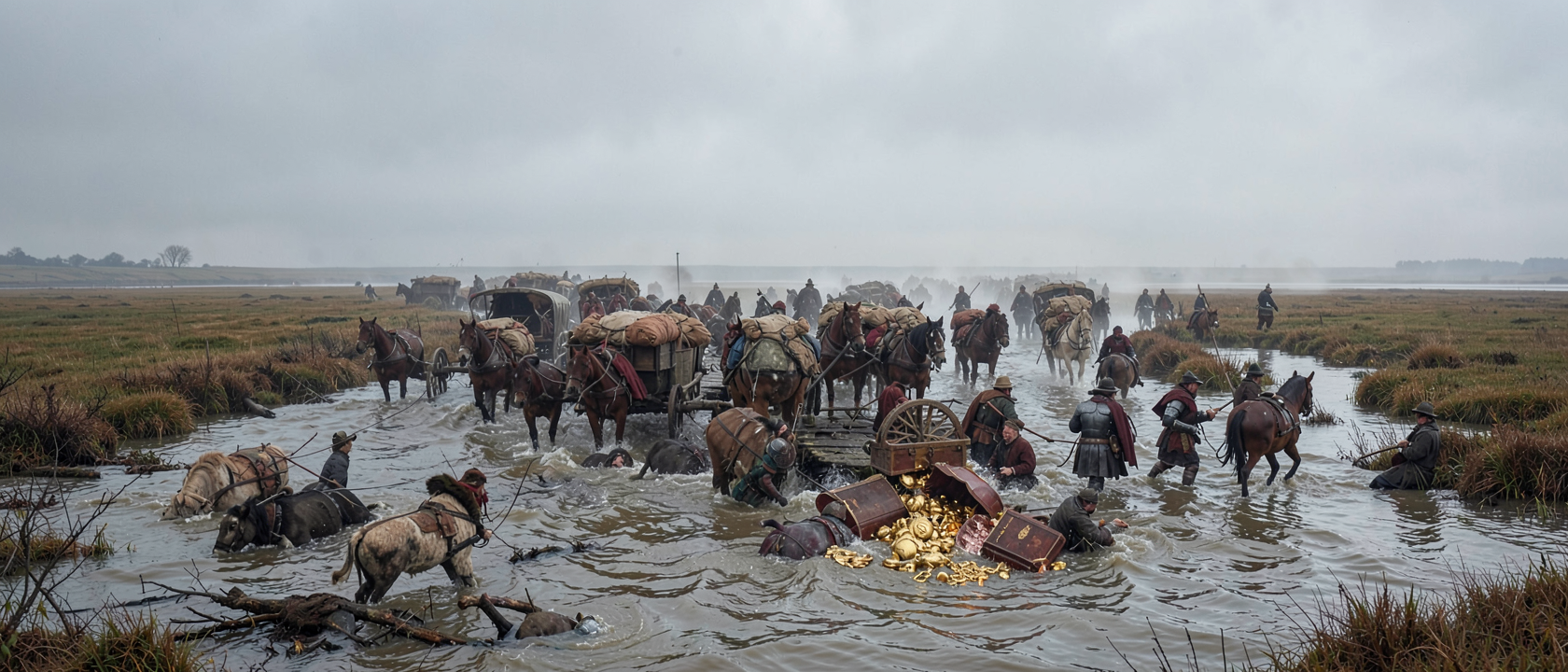
What traveled with him was not ordinary cargo. John held two complete sets of royal regalia. One had come down from his grandmother, Empress Matilda, and had spent time in the keeping of the Knights Templar, who returned it to him on May 28, 1215: a German crown, two swords, and a royal pallium of purple cloth. The Knights Hospitaller handed back the rest of it sometime in 1216. Alongside this, John had built a second hoard. On June 24, 1215, he wrote to seventeen prelates demanding the return of jewels and precious objects that churches and religious houses had been holding in safekeeping, a common arrangement at the time. Within a month he had pulled together a large collection: the surviving record lists more than 140 cups, 14 goblets, dishes, flagons, basins, belts, clasps, staffs, rings, pendants, shrines, crosses, and candelabra, among other pieces. He was moving all of it for two reasons at once: to pay for the war, and to keep the physical symbols of his kingship close while his right to wear the crown at all was being contested with armies. The route took him across the Wellstream, a tidal estuary later reshaped into the river Nene, which in the thirteenth century ran several miles wide between King’s Lynn and Long Sutton. At the crossing point historians have proposed, between Walpole Cross Keys and Long Sutton, it measured roughly 4.5 miles (7.2 km) across, and it was known as dangerous water for any traveler, let alone a line of loaded carts.
The Crossing
John himself took the safer road. He left King’s Lynn, crossed the Great Ouse, and traveled about 15 miles (24 km) southwest to Wisbech, where he spent the night before crossing a bridge over the Wellstream and continuing north. His baggage train went a different way, west toward Walpole Cross Keys, and from there attempted to cross the estuary directly, likely along a narrow path of sand exposed at low tide. According to Roger of Wendover, a contemporary chronicler, the tide caught the carts and the men moving them before they reached the far bank. This is Wendover’s account, not a confirmed fact independently verified elsewhere, and he went further, writing that none of the foot soldiers escorting the train survived to describe what happened, a claim no other source backs up. What was reportedly lost went down with them: the regalia, the gold and silver plate, the jewels, and the carts and horses carrying them.
Swineshead to Newark
That same night, chroniclers place John at Swineshead Abbey, overcome with grief and running a fever. Roger of Wendover added that he had eaten too many peaches and drunk too much cider. Over the following days his condition worsened as he was moved toward Newark Castle in Nottinghamshire. On the night of October 18, 1216, nine days after the disaster in the Wellstream, John died at Newark. He was 49. Whether the lost treasure had anything to do with it is disputed even in the medieval record: Ralph of Coggeshall, writing later, suggested John had already caught dysentery in King’s Lynn before the crossing ever happened, which would make the grief-and-overindulgence story a later embellishment of a sickness that had already begun.
A Plain Circlet at Gloucester
Nine days after his father’s death, on or about October 27, 1216, nine-year-old Henry III was crowned at Gloucester. He wore a plain gold circlet rather than a crown, a detail chroniclers recorded because it showed, in public, that the regalia was not on hand. Matthew Paris described the episode as a catastrophe. The Histoire de Guillaume le Maréchal, another chronicle of the period, tells a less dramatic story: that John’s coffers were already largely emptied by the cost of the war before the baggage train ever reached the estuary, which would mean the material loss was smaller than the legend later made it. The two accounts do not agree, and both come from the same stretch of history. A further complication arrived in 1220, when Henry III was crowned a second time, at Westminster Abbey. The historian David Carpenter has compared the regalia used that day to the inventory of items John held in 1216, and found pieces that appear to match. If that reading holds, not everything was lost in the Wellstream after all.
What Still Isn’t Settled
Three questions remain open rather than answered. The first is whether the shock of losing the treasure caused John’s fatal illness or merely coincided with it, given Ralph of Coggeshall’s separate account of dysentery contracted before the crossing. The second is where the crossing actually took place. W.H. St John Hope proposed a route in 1906 that engineers and hydrographers began questioning by 1913, and in 1972 G.F. Tagg used resistivity surveying to identify a different possible path, about 3 miles (4.8 km) long and set somewhat south of St John Hope’s line. The third is whether any of the treasure still lies in the ground. A 2016 dig at Tydd St Giles turned up only minor artifacts, and a larger excavation near Walpole Marsh in March 2024, led by the West Norfolk and King’s Lynn Archaeological Society and prompted by a planned solar farm, found no gold or jewels. Eight centuries on, the record gives a king who arrived to a warm welcome, a baggage train that did not reach the other side, and a death nine days later. It does not give a crown, a cup, or a settled answer as to where either one went.