
HEADLINE:
Moscow’s British Colony: 188 Foreigners Who Survived the 1812 Fire
ARTICLE:
A Census Before the Fire
In 1811, Moscow’s police compiled a count of the city’s foreign residents. Alongside the French, German, and Italian colonies, they listed 188 British subjects: 111 men and 77 women. The record names occupations, not personalities. Merchants and entrepreneurs appear next to engineers, master craftsmen, doctors, governesses, and school teachers, with a separate line for agricultural specialists brought in to run estates on English or Scottish lines. This was not a colony of laborers. It was a working slice of Moscow’s professional class, counted once, in a single year. The record is a snapshot. It says nothing about how long any of these people had already lived in the city, or how many of them would still be there a year later.
Useful Foreigners
That snapshot sat inside a longer pattern. In the years before the invasion, Russian nobility had already been drawing on British and Scottish expertise to run their estates around Moscow. Count F.V. Rostopchin built a farm on his estate at Voronovo, outside the city, with help from Scottish specialists. General A.A. Chesmenskiy, separately, ran a factory in his own village “in the English manner,” staffed by several British experts. Inside Moscow itself, a British groom named John Richardson lived and worked in the household of Prince A.M. Golitsyn. None of this made Britons central to Moscow life. It placed them inside it, in the houses and on the land of the city’s ruling families, doing work the Russian nobility valued enough to import.
The Choice Nobody Is Recorded Making
Napoleon’s army crossed into Russia in the summer of 1812 and fought its way toward Moscow, defeating the Russian army at Borodino on September 7. The road to the capital was now open. In the days that followed, most of the city’s population, estimated before the war at 250,000 to 270,000, left. So did much of the nobility. What remained by the time the French arrived is put, as an estimate, at somewhere between 6,200 and 10,000 civilians, plus another 10,000 to 15,000 sick and wounded Russian soldiers who could not be moved. No source tells us how individual British or Irish residents weighed the choice to go or stay. What the record shows is the city emptying around them, and a window closing on anyone still deciding.
Occupation and Fire
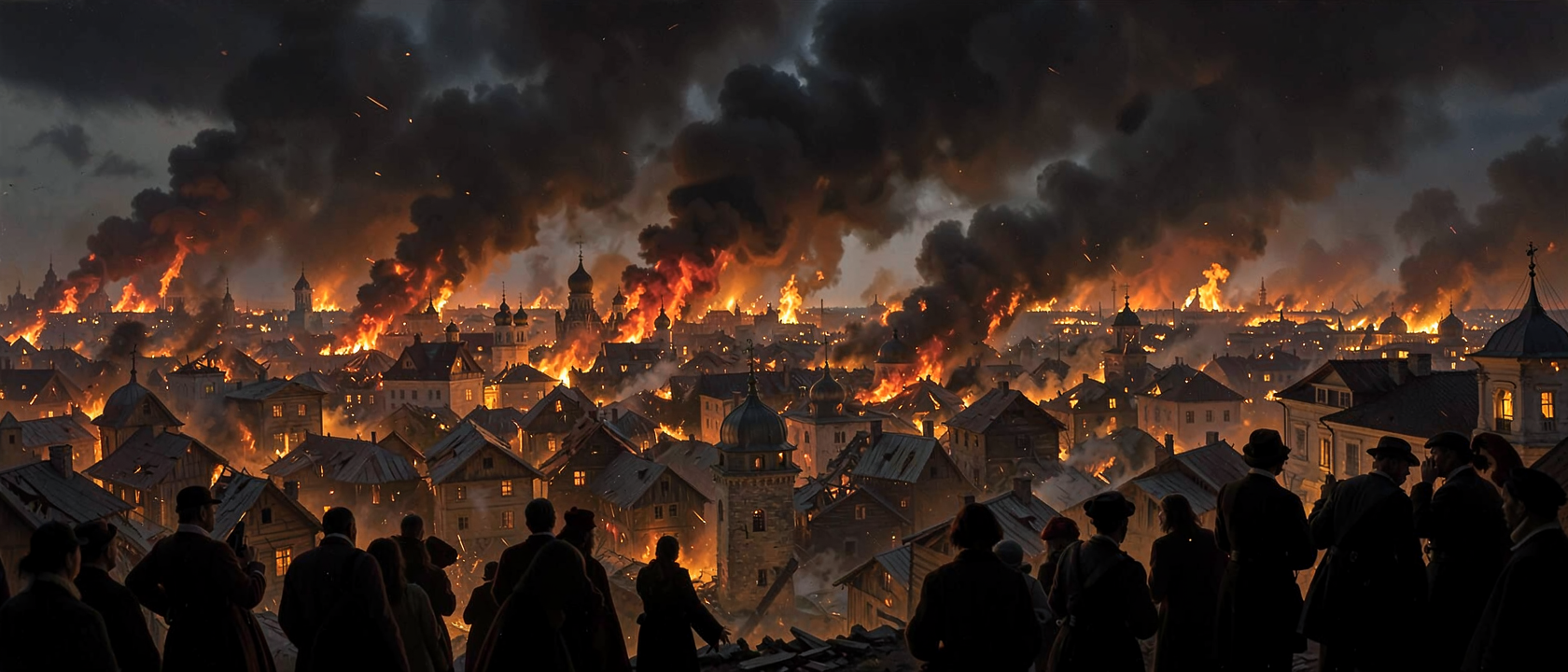
French troops entered Moscow on September 14, 1812. A fire broke out that same day and burned for five days, through September 18, destroying 6,496 of the city’s 9,151 residential buildings and 122 of its 329 churches. The occupation itself ran far longer, 36 days in total, until the French withdrew on October 19. Historians still argue over who set the fire. Some point to deliberate orders from Governor-General Rostopchin as part of a scorched-earth strategy; others argue it grew out of accidental campfires and looting amid the chaos of an army holding a half-empty city. What the sources agree on is plainer: at least some of Moscow’s British and Irish residents were still there when the French arrived, and still there when the fire burned itself out.
No Ledger of What It Cost
For Moscow as a whole, the fire left a measurable record: the ruined buildings and churches already noted, plus a wartime estimate from a French soldier, kept out of print by Napoleon’s censors, that five-sixths of the city had gone, weighed now against a more cautious modern figure of roughly three-quarters. None of that kind of accounting exists for the British and Irish community specifically. The sources give no casualty count, no list of ruined shops or workshops, no account from a governess or a merchant describing what those five days looked like from the inside. They state only that some of this group came through the occupation and the fire. The silence is not proof that nothing happened to them. It is proof that no one, at the time or since, wrote it down in a form that survived.
The Unanswered Register
What happened to the 188 British residents counted in 1811, between that count and the fire of 1812, has not been traced. How many had already left Moscow ahead of the French, how many stayed, and what became of named figures like John Richardson in Prince Golitsyn’s household, none of it is known. Moscow’s population during the crisis of 1812, British or otherwise, remains one of the least studied aspects of a campaign that has otherwise been picked over down to regiment strengths and supply wagons. A count of 188 people, taken a year before the fire, is the clearest thing on record. What became of them afterward stays an open register.